

Modest top-line growth in the first quarter masks a more dramatic shift at Nokia, where a surge in optical networking for AI infrastructure is reshaping its revenue mix. In line with demand, the firm has raised projections for fiber and IP sales through 2028. Meanwhile, its traditional mobile business struggles for growth.
In sum – what to know:
Optical networks – Nokia’s optical sales surged 20 percent to €821 million, leapfrogging IP and core software to become its second-largest business. Growth was fuelled by hyperscaler demand.
Cloud demand – Sales to AI and cloud customers jumped 49 percent, with other figures suggesting an even sharper rise; hyperscaler spending expectations have been revised sharply upwards.
Telco business – Carriers still dominate (over 70 percent of revenue), but RAN growth is flat, and ‘mobile infra’ dipped overall. But enterprise, defense, and AI segments gain strategic weight.
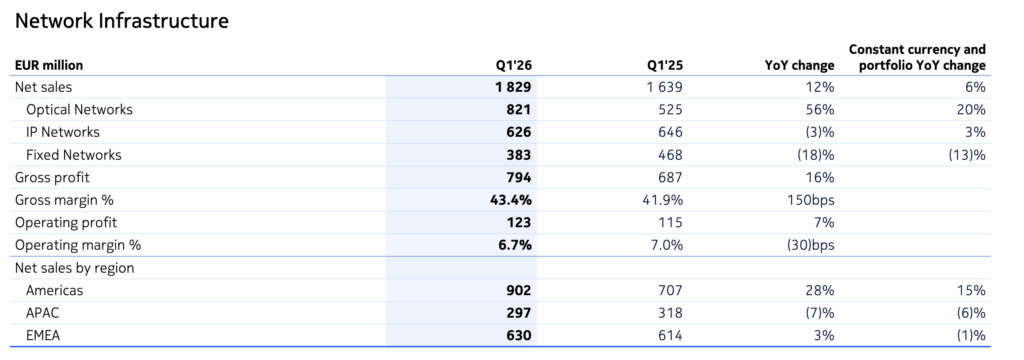
Nokia saw net sales climb in the first quarter to €4.497 billion – by two per cent or three percent, versus the same period in 2025, depending on how it is counted (reported and comparable figures; by four percent with currency and portfolio changes). But sales also spiralled way upwards in certain departments, or one anyway: in optical networks, part of its ‘network infrastructure’ (NI) unit, which reported a massive 56 percent uplift (20 percent on a comparable basis) to €821 million in the quarter, leapfrogging both its IP-networks (€626 million) and core-software (€530 million) units to place second for revenue contributions, only behind RAN sales – which remained flat.
Comparison with Ericsson’s quarterlies last week is instructive.
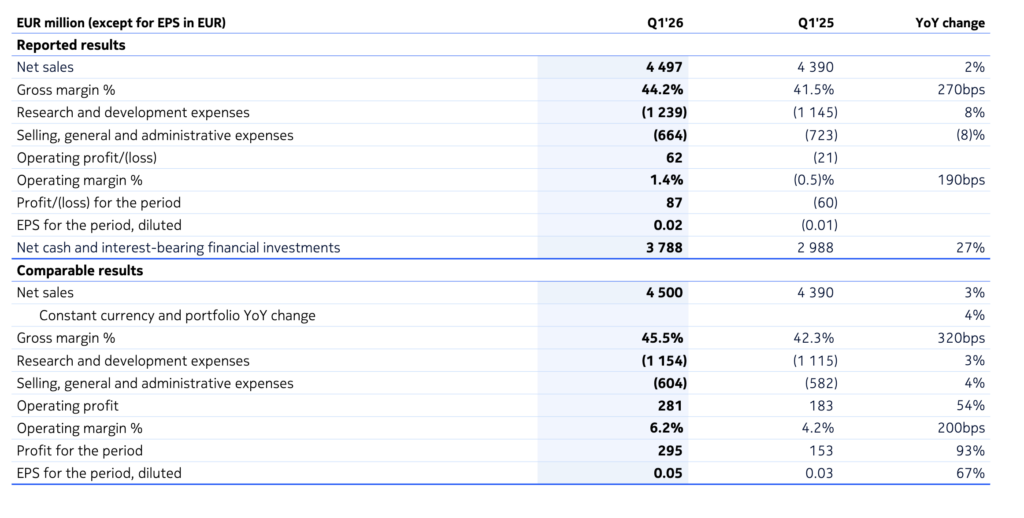
Net sales to ‘AI and cloud’ customers grew by 49 percent, it said – on a comparable basis; they now account for eight percent of group sales, it said. At its Capital Markets Day last November, when it announced its new NI/MI structure, plus the intended sale of its basket-case “portfolio businesses”, Nokia suggested the “largest hyperscalers” would spend $540 billion with it in 2026; it now expects them to spend over $700 billion. Nokia called it a “solid start”, citing “strong growth” in optical networks; its full-year outlook is unchanged, targeting €2-2.5 billion of comparable operating profit – despite raising its growth forecast for AI fiber and hyperscale business.
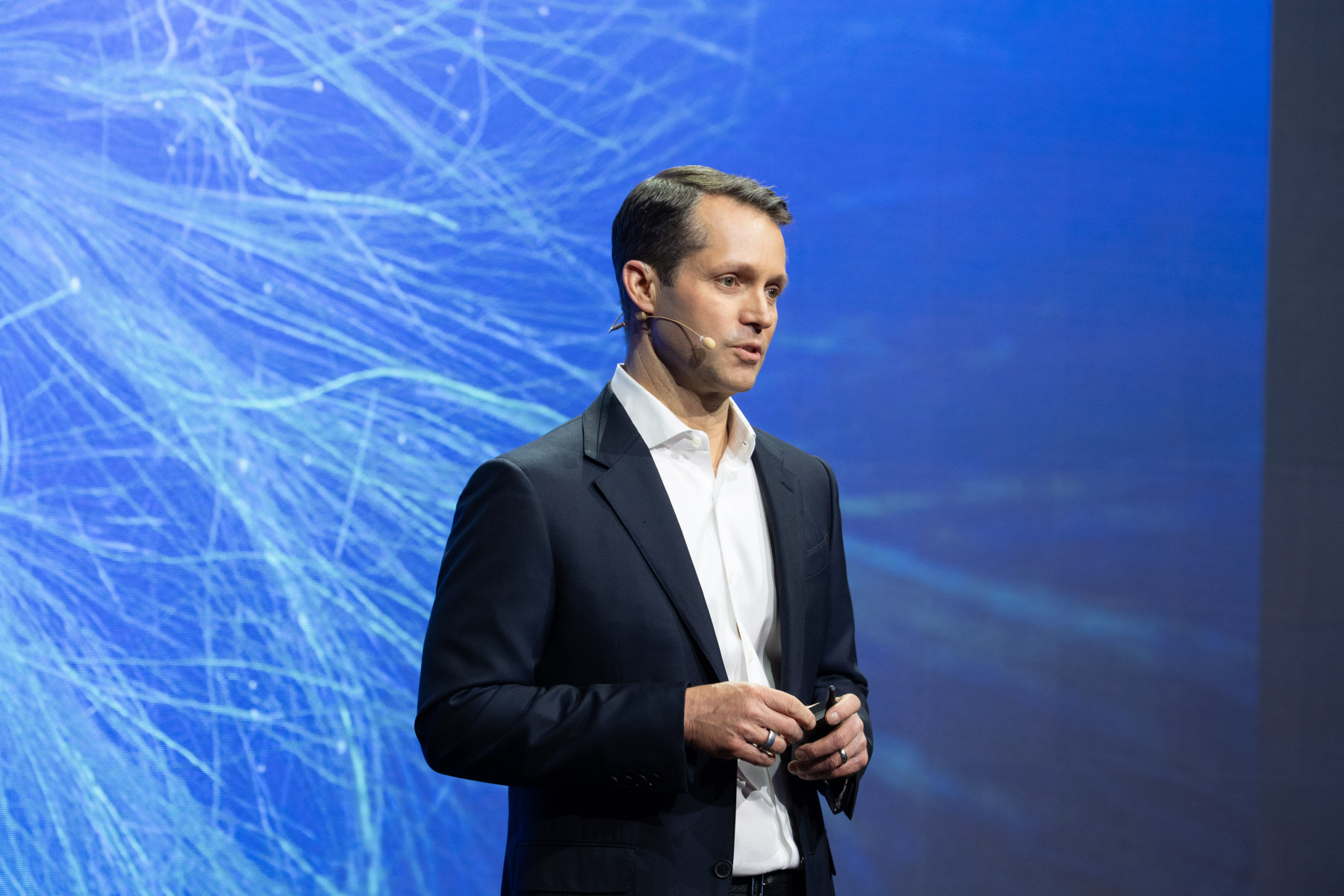
The addressable market for NI-related equipment, just in 2026, has a CAGR of 14 percent, it reckons – revised upwards from its nine-percent forecast in November. “This is already benefiting Nokia in orders and in revenue,” said Justin Hotard, president and chief executive, on an earnings call. It now thinks CAGR for AI fiber networks will be 27 percent through 2028, up from its forecast of 16 percent in November.
Hotard said: “Today, AI-driven traffic is estimated at around 20 percent of total network traffic, which is roughly 80 exabytes per month and is still primarily human to machine. As we move deeper into agentic AI adoption and ultimately physical AI adoption, machine-to-machine traffic will become the primary driver of traffic, and that will lead to a step change in network traffic. We already see this demand in AI factories, both in data center interconnect and inside the data center in routing and switching. Increasingly, this is also driving demand in transport networks across metro and long haul, and we believe this is a structural shift in the market which will sustain for multiple years.”
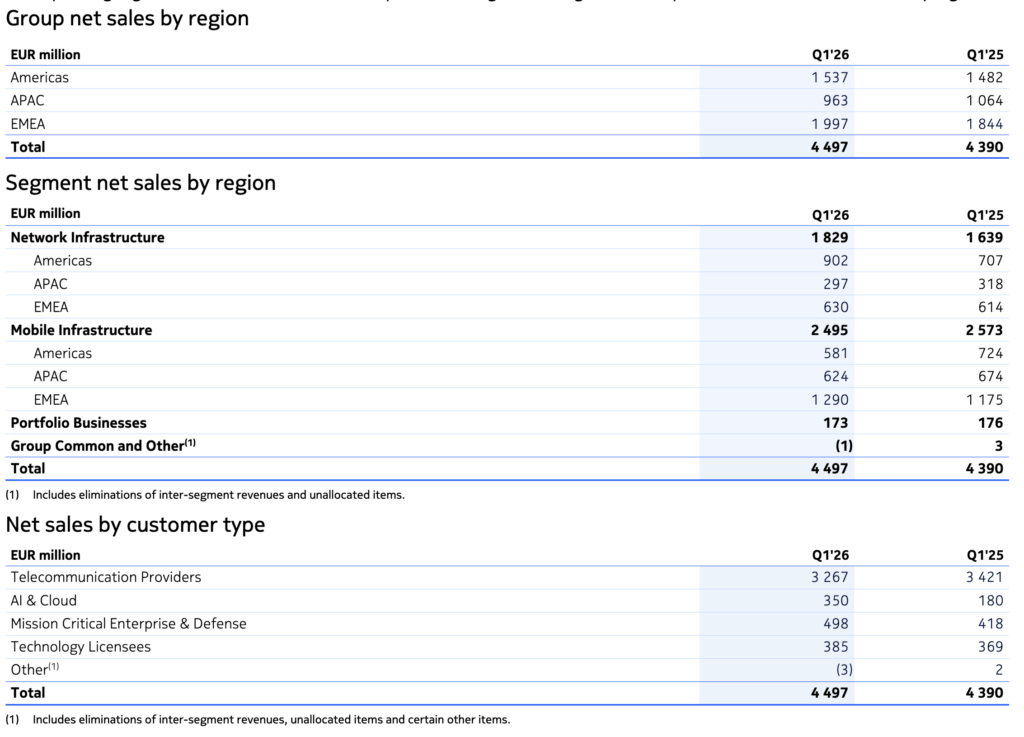
Confusingly, a table in its report breaks down sales by customer type, and says ‘AI and cloud’ contributed €350 million, versus €180 million a year ago – prior to any additions following the closure of its $2.3 billion acquisition of Infinera in March last year. Which is a jump of 94.4 percent, by our calculations. Interestingly, carrier/telco sales were €2.367 billion in the quarter, representing almost three quarters (72.6 percent) of its paying clients; besides, mission-critical and defense customers, which effectively comprise its ongoing enterprise interests, contributed €498 million in the first quarter, up by 19 percent versus a year ago (€418 million) – representing more customer value than AI and cloud (on this chart).
Some more envelope maths, to put its headline contributions in perspective: optical networks delivered about a fifth (18.3 percent) of its total income in the first quarter. RAN sales were about twice that (€1.58 billion; 35 percent); but RAN sales also declined by five percent (reported) – or else was flat (comparable). Total NI sales grew by 12 percent (six percent, comparable) to €1.829 billion; hyperscaler orders for optical systems were offset by declines in its IP (three percent in real terms; up three percent as a comparable score) and fixed networks (€383 million; down 18/13 percent) businesses.
By contrast, mobile infrastructure (MI), home to its radio (RAN) and core network products, saw takings slide some, down three percent (up by the same as a comparable figure) to €2.495 billion – meaning it is still the biggest business (55.5 percent of sales in the quarter were from MI, versus 40.7 percent via NI).
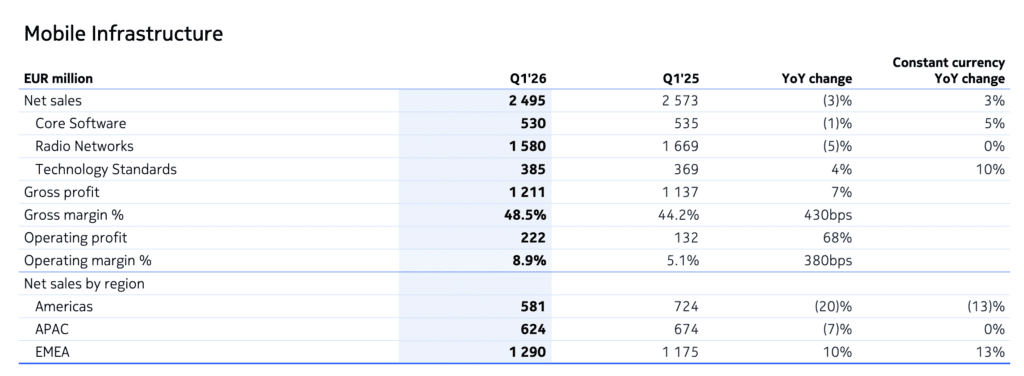
The regional picture in the quarter showed most progress in the EMEA region – with group sales up by 8.3 percent to €1.997 billion, and both NI and MI contributing (2.6 percent and 9.8 percent growth, to €630 million and €1.29 billion). The Americas was a mixed bag, meanwhile: 27.6 percent growth in NI (to €902 million), and a 19.8 percent reverse in MI (down to €581 million). APAC saw the opposite: a 6.6 percent decline (to €297 million) on the year ago period for NI contributions and a 7.6 percent jump (to €624 million) for mobile-related MI sales.
As well, its ‘technology standards’ business, part of MI, grew 10 percent with “several new deals” in the quarter, the company said. Overall, reported/comparable gross margin increased 270/320 basis points year-over-year to 44.2/45.5 percent in the quarter. Reported/comparable operating profit was €62/€281 million, or 1.4/6.2 percent of net sales – up considerably from the same period a year ago, however it is counted.
Net sales by ‘portfolio businesses’ were about steady year-over-year, despite them all being put on the chopping block (€173 million, down two percent as a reported figure, up four percent as a comparable one); profitability was better (€45 million, versus €39 million), operating margin was better (26 percent versus 22.2 percent), and operating loss was improved (€20 million versus €32 million).
Analysts were complementary, practically bowled over. “Wow,” crowed Sebastian Barros, formerly in charge of Ericsson’s enterprise business in Latin America, now in charge of Mexico-based tech consultancy Circles (and a noisy presence on social media). He said: “Sure, the legacy mobile business is stagnant, but that is the exact point. Nokia is actively squeezing the dead G-cycle to fund the plumbing of the intelligence grid, and the gambit is absolutely working. The Nokia-Nvidia partnership remains in the pilot stage, making it the biggest question mark in this AI gambit. While field trials with T-Mobile and SoftBank are underway, proving that GPUs can handle the power demands of a live network remains a ‘show me’ moment for the balance sheet.”
Barros has more analysis here.
Meanwhile, Patrick Kelly, founder at Appledore Research, and always good, wrote: “[It is] the clearest signal yet that its strategic pivot is working. The shift from a broad telecom equipment vendor toward a more focused AI and cloud infrastructure player – anchored in optical and IP – looks both well-timed and operationally credible. [Its] move to lift its AI and cloud market CAGR assumption from 16 percent to 27 percent in just five months reflects real demand. Its €1 billion of AI/cloud orders in the quarter and a strong optical book-to-bill reinforce that hyperscaler-driven DCI investment is outpacing prior models.
He went on: “The Infinera acquisition is already showing up in margin performance… Deeper integration into DSPs and photonics strengthens its control of the cost stack. In a market where pricing pressure from vendors… remains intense, this matters. If the claimed 70 percent TCO reduction from the new DSP generation holds up in live deployments, that becomes a decisive lever in hyperscaler procurement cycles.
“Flat [MI] performance – still impacted by earlier North America share loss – suggests Nokia has not yet fully stabilized its RAN position. Core software growth is more encouraging, particularly if AI-RAN evolves into a software-led monetization model. That said, the current AI-RAN pipeline is just that – a pipeline. Nokia has effectively de-risked its growth model and is now leveraged to AI infrastructure demand. Optical and IP are doing the heavy lifting. Mobile Infrastructure is still a 12-18 month transition, with the real inflection dependent on whether AI-RAN moves from trials to scaled deployments by 2027.”

