


RCR Wireless
  • News
  • Channels
    • 5G
    • 6G
    • BSS OSS
    • Carriers
    • IoT
    • Network Infrastructure
    • Open RAN
    • Private 5G
    • Telco AI
    • Telco Cloud
    • Test & Measurement
  • Resources
    • Reports
    • Webinars
    • White papers
    • AI Fundamentals
    • Analyst Angle
    • Editorial Calendar
    • Fundamentals
      • 5G NR Release 17
      • AI
        • Telco AI in 2025
    • Podcasts
      • Let’s Get Digital with Carrie Charles
      • Wireless Connectivity to Enable Industry 4.0 for the Middleprise
      • Well Technically…
      • Will 5G Change the World
      • Accelerating Industry 4.0 Digitalization
  • AI Infrastructure
  • Programs
  • Events
  • RCRtv
  • Advertise
  • Subscribe
Saturday, July 25, 2026
RCR Wireless
  • News
  • Channels
    • 5G
    • 6G
    • BSS OSS
    • Carriers
    • IoT
    • Network Infrastructure
    • Open RAN
    • Private 5G
    • Telco AI
    • Telco Cloud
    • Test & Measurement
  • Resources
    • Reports
    • Webinars
    • White papers
    • AI Fundamentals
    • Analyst Angle
    • Editorial Calendar
    • Fundamentals
      • 5G NR Release 17
      • AI
        • Telco AI in 2025
    • Podcasts
      • Let’s Get Digital with Carrie Charles
      • Wireless Connectivity to Enable Industry 4.0 for the Middleprise
      • Well Technically…
      • Will 5G Change the World
      • Accelerating Industry 4.0 Digitalization
  • AI Infrastructure
  • Programs
  • Events
  • RCRtv
  • Advertise
  • Subscribe
Add RCR Wireless as a preferred source on Google
  • Qualcomm 6G Insights
  • Huawei Content Hub
  • Qualcomm – 6G Vision
  • OSS/BSS Channel
  • RCRTech Roundtable: AI Infrastructure
RCR Wireless
RCR Wireless
  • Advanced Mimo
  • Mobile mmWave
  • 5G Positioning
  • Green Networks
  • Metaverse
  • Automotive
  • Industrial and Wide-area IoT
Copyright 2021 - All Right Reserved
Home - In US metro areas, umlaut finds traffic and app shifts
Test and Measurement

In US metro areas, umlaut finds traffic and app shifts

by Kelly Hill April 28, 2020
written by Kelly Hill April 28, 2020 Share
LinkedinEmail
Share 0LinkedinEmail
private lte and 5g
Image: 123RF
73

Some major urban business hubs of the U.S. are seeing less traffic, and what traffic there is, is moving faster. Hot spots of mobile activity have shifted from the heart of city centers into more diffuse areas, and Wi-Fi usage has spread out across metro areas as well.

Those conclusions come from data analysis by network benchmarking and analytics company umlaut (formerly P3), which has been tracking the impact of the COVID-19 pandemic on where and how mobile users are using their devices. After recently analyzing trends in major European cities, umlaut turned its focus to U.S. cities and looked at how patterns have changed in Los Angeles, California; New York City; the Washington, D.C. metropolitan area; and Chicago, Illinois.

Umlaut found that the use of business applications, particularly Zoom, rose in all of those areas beginning in mid-March. Cisco WebEx saw heightened use in the New York City metropolitan area, and Microsoft Teams saw a spike in the Chicago area earlier this month. The shift to educational app use for remote learning was spread across a wider variety of platforms, from DuoLingo to Google Classroom and Hangout Meet and others, and varied by metro area. Interestingly, umlaut found a rise in the use of communications apps in L.A., New York and D.C., and a bump in mobile shopping apps (Amazon in particular) in D.C. and Los Angeles, but didn’t find a statistically significant change in the use of entertainment apps on mobile in any of those major metros.

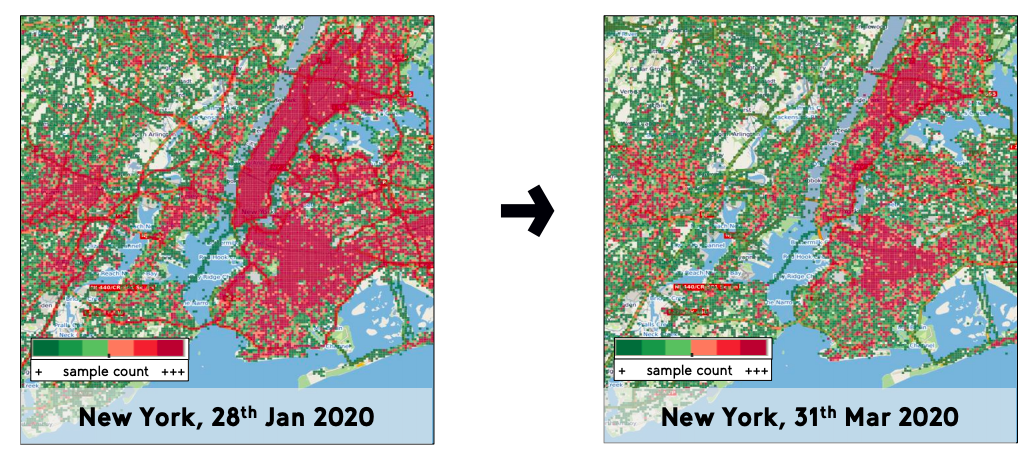
In terms of whether mobile users are staying at home, umlaut found a marked decrease in mobility as of mid-March, with NYC seeing the most profound impacts. Comparing user density and outdoor duration of stay from late January to late March in New York City, the changes are immediately visible:
Screen Shot 2020 04 28 at 12.03.58 PM

Image: umlaut

Umlaut also said that its data for NYC shows that Wi-Fi traffic has shifted to Brooklyn, and mobile traffic has moved away from Manhattan. In Washington D.C. and Los Angeles, its data reflects reduced mobility as well as traffic is moving faster than usual, since fewer vehicles are on the roads.

AT&T continues to see heightened voice call volume

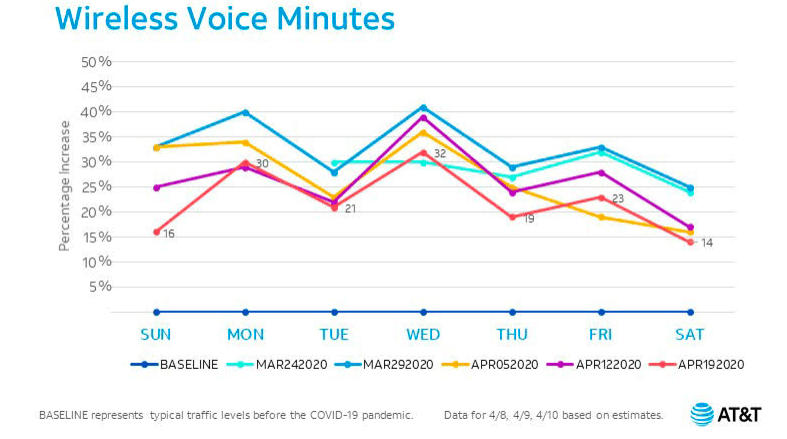
In related news, AT&T continued to report increases in various types of voice calling — which has persisted since stay-at-home orders began to take effect. In a network update from Saturday, April 25, the carrier said that compared to a typical Saturday, wireless voice minutes were up 14%, consumer home voice call minutes were up 25%, and Wi-Fi calling minutes were up 45%.

While the increase in voice usage has been a sustained trend since March, AT&T is reporting that over time, the amount of the increase is dropping slightly. When comparing volumes on days of the week, home calling minutes have been peaking on Sundays and Wednesdays, wireless voice is the highest on Mondays and Wednesdays, and Wi-Fi calling is highest on Wednesdays.
Screen Shot 2020 04 28 at 11.29.02 AM 1

You Might Also Like
  • Real-world network emulation is critical for 5G deployments (Reader Forum)
  • Complexity, convergence, AI and the demand for trust are reshaping telecom testing
  • Test And Measurement Market Pulse Report
  • Anterix: ‘Terrific’ results from NTN testing with Lynk Global
  • Opensignal on fixed broadband: Cable upload speeds jump, FWA improves
  • Agentic AI meets intent-based networking: A new era of network automation
Share 0 LinkedinEmail
Kelly Hill

Kelly Hill reports on network test and measurement, AI infrastructure and regulatory issues, including spectrum, for RCR Wireless News. She began covering the wireless industry in 2005, focusing on carriers and MVNOs, then took a few years’ hiatus and returned to RCR Wireless News to write about heterogeneous networks (remember those?) and network infrastructure. Kelly is an Ohio native with a masters degree in journalism from the University of California, Berkeley, where she focused on science writing and multimedia. She has written for the San Francisco Chronicle, The Oregonian and The Canton Repository. She lives in northern Virginia, not far from Data Center Alley.

previous post
5G paired with private network capability key for smart buildings: JMA
next post
Digital Factory Solutions Report series: Industrial AR – and the rise of the workers

White Papers

  • Norton eBook: The 2026 Telco Playbook

  • Enea White Paper: Why Intelligent AAA is the Swiss Army Knife of Telecom

  • CSG White Paper: Telco AI Enabler: Mediation’s Defining Role

  • Enea White Paper: Scalable Database Design for 5G and Beyond

  • Supermicro and NVIDIA Whitepaper: Powering sovereign AI at scale

Editorial Reports

  • Market Pulse Report: Telco AI in 2026 – Trends, Challenges and Opportunities

  • Nvidia Report: The State of AI in Telecommunications: 2026 Trends

  • Report: Scaling Optical Networks For The Hyperscale And AI Era

Webinars

  • Webinar: Building 6G — aligning technology, policy and purpose

  • SIMCom Webinar: Scaling your next deployment – from plastic to provisioning

  • Webinar: Rethinking the RAN as AI, cloud and openness converge

  • Webinar: Scale-Up, Scale-Out, Scale-Across – Building AI-Era Network Fabrics

  • Webinar: NTN in motion – evolving standards, expanding services

Since 1982, RCR Wireless News has been providing wireless and mobile industry news, insights, and analysis to mobile and wireless industry professionals, decision makers, policy makers, analysts and investors.

Facebook Twitter Youtube Linkedin Envelope Rss

Useful Links

  • Subscribe
  • About RCR Wireless News
  • Contact Us
  • Advertise
  • Editorial Calendar
  • Archive
  • RSS
  • Wireless News Archive
  • Subscribe
  • About RCR Wireless News
  • Contact Us
  • Advertise
  • Editorial Calendar
  • Archive
  • RSS
  • Wireless News Archive

Edtior's Picks

AT&T says its network is already built for the agentic AI wave
AT&T and Ericsson use network sensing to spot drones with ordinary 5G towers
Huawei sees Mobile AI driving new wave of uplink network investment

Latest Articles

AT&T says its network is already built for the agentic AI wave
AT&T and Ericsson use network sensing to spot drones with ordinary 5G towers
Huawei sees Mobile AI driving new wave of uplink network investment
Spectrum supercycle – US opens floodgates; UK shares it out

© 2026 RCR Wireless News All Right Reserved. Developed by Eight Hats.

Cookie Policy | Privacy Policy

RCR Wireless
  • News
  • Channels
    • 5G
    • 6G
    • BSS OSS
    • Carriers
    • IoT
    • Network Infrastructure
    • Open RAN
    • Private 5G
    • Telco AI
    • Telco Cloud
    • Test & Measurement
  • Resources
    • Reports
    • Webinars
    • White papers
    • AI Fundamentals
    • Analyst Angle
    • Editorial Calendar
    • Fundamentals
      • 5G NR Release 17
      • AI
        • Telco AI in 2025
    • Podcasts
      • Let’s Get Digital with Carrie Charles
      • Wireless Connectivity to Enable Industry 4.0 for the Middleprise
      • Well Technically…
      • Will 5G Change the World
      • Accelerating Industry 4.0 Digitalization
  • AI Infrastructure
  • Programs
  • Events
  • RCRtv
  • Advertise
  • Subscribe
RCR Wireless
  • News
  • Channels
    • 5G
    • 6G
    • BSS OSS
    • Carriers
    • IoT
    • Network Infrastructure
    • Open RAN
    • Private 5G
    • Telco AI
    • Telco Cloud
    • Test & Measurement
  • Resources
    • Reports
    • Webinars
    • White papers
    • AI Fundamentals
    • Analyst Angle
    • Editorial Calendar
    • Fundamentals
      • 5G NR Release 17
      • AI
        • Telco AI in 2025
    • Podcasts
      • Let’s Get Digital with Carrie Charles
      • Wireless Connectivity to Enable Industry 4.0 for the Middleprise
      • Well Technically…
      • Will 5G Change the World
      • Accelerating Industry 4.0 Digitalization
  • AI Infrastructure
  • Programs
  • Events
  • RCRtv
  • Advertise
  • Subscribe
@2020 - All Right Reserved. Designed and Developed by PenciDesign
