

RCR Wireless
  • News
  • Channels
    • 5G
    • 6G
    • BSS OSS
    • Carriers
    • IoT
    • Network Infrastructure
    • Open RAN
    • Private 5G
    • Telco AI
    • Telco Cloud
    • Test & Measurement
  • Resources
    • Reports
    • Webinars
    • White papers
    • AI Fundamentals
    • Analyst Angle
    • Editorial Calendar
    • Fundamentals
      • 5G NR Release 17
      • AI
        • Telco AI in 2025
    • Podcasts
      • Let’s Get Digital with Carrie Charles
      • Wireless Connectivity to Enable Industry 4.0 for the Middleprise
      • Well Technically…
      • Will 5G Change the World
      • Accelerating Industry 4.0 Digitalization
  • AI Infrastructure
  • Programs
  • Events
  • RCRtv
  • Advertise
  • Subscribe
Monday, July 27, 2026
RCR Wireless
  • News
  • Channels
    • 5G
    • 6G
    • BSS OSS
    • Carriers
    • IoT
    • Network Infrastructure
    • Open RAN
    • Private 5G
    • Telco AI
    • Telco Cloud
    • Test & Measurement
  • Resources
    • Reports
    • Webinars
    • White papers
    • AI Fundamentals
    • Analyst Angle
    • Editorial Calendar
    • Fundamentals
      • 5G NR Release 17
      • AI
        • Telco AI in 2025
    • Podcasts
      • Let’s Get Digital with Carrie Charles
      • Wireless Connectivity to Enable Industry 4.0 for the Middleprise
      • Well Technically…
      • Will 5G Change the World
      • Accelerating Industry 4.0 Digitalization
  • AI Infrastructure
  • Programs
  • Events
  • RCRtv
  • Advertise
  • Subscribe
Add RCR Wireless as a preferred source on Google
  • Qualcomm 6G Insights
  • Huawei Content Hub
  • Qualcomm – 6G Vision
  • OSS/BSS Channel
  • RCRTech Roundtable: AI Infrastructure
RCR Wireless
RCR Wireless
  • Advanced Mimo
  • Mobile mmWave
  • 5G Positioning
  • Green Networks
  • Metaverse
  • Automotive
  • Industrial and Wide-area IoT
Copyright 2021 - All Right Reserved
Home - ‘The missing piece:’ What is the third-party enablement business model for rural broadband?
Business

‘The missing piece:’ What is the third-party enablement business model for rural broadband?

by Catherine Sbeglia Nin August 30, 2021
written by Catherine Sbeglia Nin August 30, 2021 Share
LinkedinEmail
Share 0LinkedinEmail
Harmoni
91

C Spire’s technology strategy lead: ‘No one does rural broadband particularly well’

In a two-year research project of the Rural Broadband Consortium, C Spire led a group of companies that included Nokia, Microsoft, Facebook and others to explore the challenges of cost-effective rural broadband deployment, as well as what technologies and additional business model changes might help.

According to Ivy Kelly, who is responsible for C Spire’s technology strategy and who led the research, rural broadband is something that “no one does particularly well.” The report, she said, aimed to address what that is and what could be done about it.

“We asked ‘How do we approach it? What does it mean to do it? Why is it a problem in the first place?’” she told RCR Wireless News.

Kelly explained that she and her research team tried to look at the problem of rural broadband holistically — the technology, the business case, the tools, adoption and so on. So while C Spire’s insights as a rural network operator helped inform the research, the consortium ultimately concluded that multiple technologies, from 5G to satellites, and third-party business and public-private partnerships, are the key to supporting faster, more efficient rural broadband deployment.

“It’s not just about what technology is used,” she continued, “it’s also about economics and adoption and those come into play around what the markets look like because the markets are very different. Different tools and technologies need to be mixed and matched to find the best solutions for each market.”

In fact, the report concluded that “broadband access to rural households can be a unique engineering feat requiring multiple technology solutions. The design challenges to serving rural markets due to environmental variation also manifest in a provider’s business model.”   

The communications industry is organized around different types of technologies — the cellular folks, the fiber folks, the satellite folks and so on — keeping equipment and service providers siloed in their efforts to eradicate the digital divide. But what we really need, the consortium argued, is something more cooperative.

‘The missing piece in rural broadband:’ The third-party enablement model

The Rural Broadband Consortium concluded that the most common business model for broadband is that of an “operator-only ISP,” in which a single operator designs, builds, operates and maintains the network. In this model, the operator is also responsible for customer acquisition, and therefore, receives all the revenues from those customers.

In such a model, stated the paper, “each ISP uses its own expertise for technology design and feasibility and analyzes its resources (technical and physical) to determine how they can be reused or expanded to serve the new area. If the area does not meet the ISPs’ criteria for business case viability, the ISP moves on to a different area.”

The limited revenue offered by rural markets compared to more populated urban markets combined with how easily the cost of serving rural communities can skyrocket — from spectrum costs to tower costs to backhaul, just to name a few — it can be nearly impossible to make the business case for bringing broadband internet service to these locations.

“A single company, no matter how large and financially sound,” the report said, “is not likely to take on the challenge of connecting millions of rural users when there are still tens of millions of urban users that are waiting to be served at a much lower cost point.”

As a result, the consortium offered an alternative business model called a “third-party enablement model.” In this model, there would be different iterations in which two parties collaborate to provide service, allowing “shared costs, different levels of expertise and more efficiencies in areas where owning the whole process is challenging.”
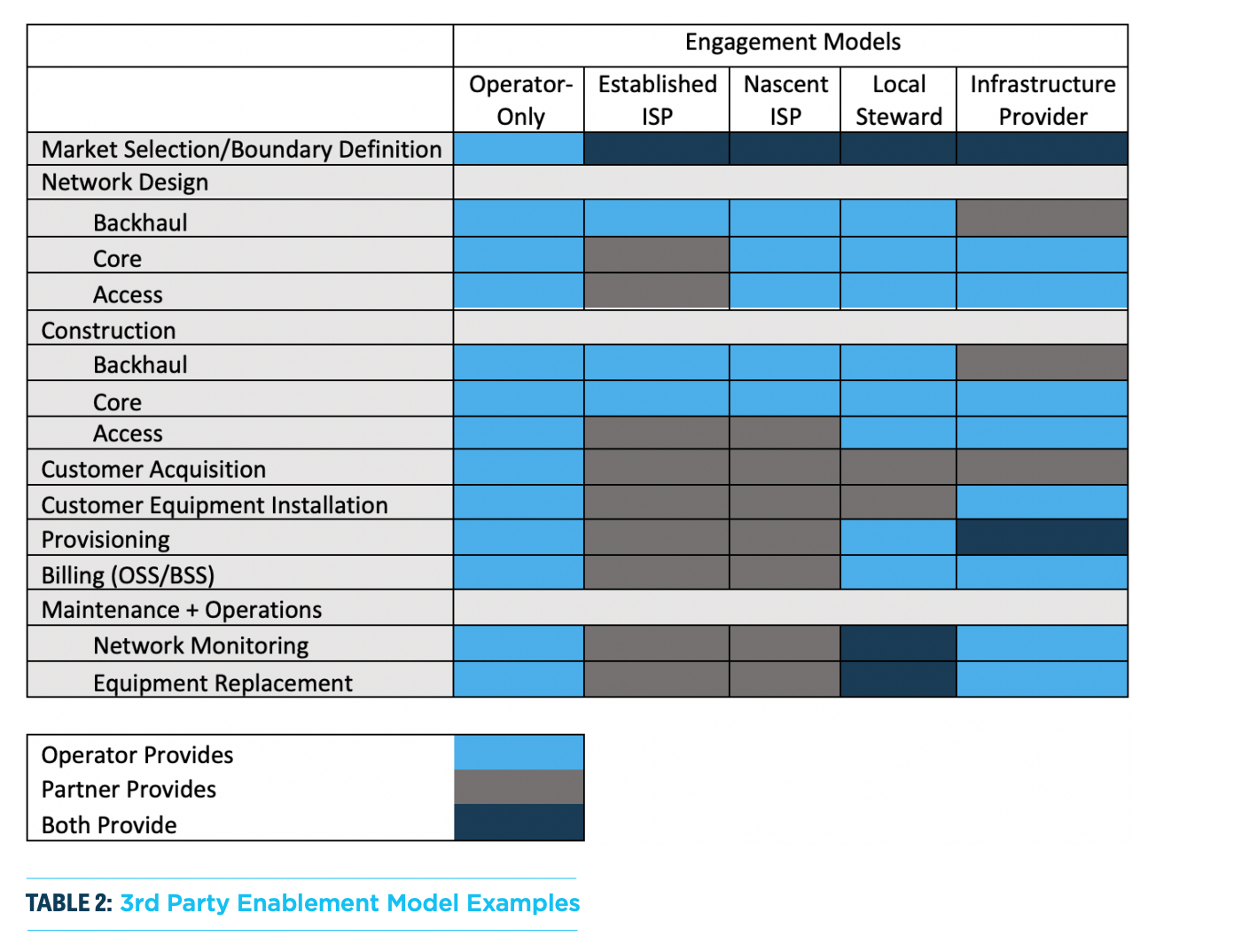
Screen Shot 2021 08 04 at 12.47.25 PM
Courtesy of C Spire

The report explored three potential partner-types for operators: “Local stewards,” such as a business owner, homeowner association or even individual consumers who can be creative and flexible in helping to establish broadband service; infrastructure providers such as local governments, utility companies or cooperatives who have assets that can aid in deployment; or partnering with an emerging or established ISP to share capabilities and toolsets in an arrangement in which could make increasing connectivity more cost-effective for both parties.

For its part, C Spire has shared these findings with public policy makers at the local and state levels and as a way to open up a deeper conversation about how to better, and more collaboratively, address rural broadband.

“What if a company that does one thing well is paired with another company that does something else well, and together, try to solve the rural problem?” offered Kelly. “This seems to have a lot of value but would mean we have to turn the idea of how to do wireless service on its head and be willing to partner in new and different ways. That’s the missing piece.”

For more on this topic, read the full report.

You Might Also Like
  • ‘Literally truthful’ claims — T-Mobile US responds to Verizon lawsuit
  • T-Mobile US outpaces rivals as broadband becomes new battleground
  • SoftBank delivers record revenue, maps telco strategy beyond traditional services
  • T-Mobile US’ switching strategy lands in court again
  • SK Telecom turns to AI to restore profitability after FY2025 revenue decline
  • Enea White Paper: Converging Telecom Architecture & Business
Share 0 LinkedinEmail
Catherine Sbeglia Nin

Catherine Sbeglia Nin is the Managing Editor for RCR Wireless News, where she covers topics such as Wi-Fi, network infrastructure, AI and edge computing. She also produced and hosted Arden Media's podcast Well, technically... After studying English and Film & Media Studies at The University of Rochester, she moved to Madison, WI. Having already lived on both coasts, she thought she’d give the middle a try. So far, she likes it very much.

previous post
ZTE’s operating revenues increase 12.4% year-on-year in H1
next post
US midband spectrum auctions, recapped

White Papers

  • Norton eBook: The 2026 Telco Playbook

  • Enea White Paper: Why Intelligent AAA is the Swiss Army Knife of Telecom

  • CSG White Paper: Telco AI Enabler: Mediation’s Defining Role

  • Enea White Paper: Scalable Database Design for 5G and Beyond

  • Supermicro and NVIDIA Whitepaper: Powering sovereign AI at scale

Editorial Reports

  • Market Pulse Report: Telco AI in 2026 – Trends, Challenges and Opportunities

  • Nvidia Report: The State of AI in Telecommunications: 2026 Trends

  • Report: Scaling Optical Networks For The Hyperscale And AI Era

Webinars

  • Webinar: Building 6G — aligning technology, policy and purpose

  • SIMCom Webinar: Scaling your next deployment – from plastic to provisioning

  • Webinar: Rethinking the RAN as AI, cloud and openness converge

  • Webinar: Scale-Up, Scale-Out, Scale-Across – Building AI-Era Network Fabrics

  • Webinar: NTN in motion – evolving standards, expanding services

Since 1982, RCR Wireless News has been providing wireless and mobile industry news, insights, and analysis to mobile and wireless industry professionals, decision makers, policy makers, analysts and investors.

Facebook Twitter Youtube Linkedin Envelope Rss

Useful Links

  • Subscribe
  • About RCR Wireless News
  • Contact Us
  • Advertise
  • Editorial Calendar
  • Archive
  • RSS
  • Wireless News Archive
  • Subscribe
  • About RCR Wireless News
  • Contact Us
  • Advertise
  • Editorial Calendar
  • Archive
  • RSS
  • Wireless News Archive

Edtior's Picks

Verizon strikes $1bn DCI deal with Google; AI cloud and edge sales to...
SK Telecom launches dedicated AI infra company
Hollow-core fiber won’t hit cost parity for a decade – regarding HKT’s 3.2Tbps...

Latest Articles

Verizon strikes $1bn DCI deal with Google; AI cloud and edge sales to ramp in 2027
SK Telecom launches dedicated AI infra company
Hollow-core fiber won’t hit cost parity for a decade – regarding HKT’s 3.2Tbps DCI ‘superhighway’
Friday (telco diary) | The AI penny-drop for telcos

© 2026 RCR Wireless News All Right Reserved. Developed by Eight Hats.

Cookie Policy | Privacy Policy

RCR Wireless
  • News
  • Channels
    • 5G
    • 6G
    • BSS OSS
    • Carriers
    • IoT
    • Network Infrastructure
    • Open RAN
    • Private 5G
    • Telco AI
    • Telco Cloud
    • Test & Measurement
  • Resources
    • Reports
    • Webinars
    • White papers
    • AI Fundamentals
    • Analyst Angle
    • Editorial Calendar
    • Fundamentals
      • 5G NR Release 17
      • AI
        • Telco AI in 2025
    • Podcasts
      • Let’s Get Digital with Carrie Charles
      • Wireless Connectivity to Enable Industry 4.0 for the Middleprise
      • Well Technically…
      • Will 5G Change the World
      • Accelerating Industry 4.0 Digitalization
  • AI Infrastructure
  • Programs
  • Events
  • RCRtv
  • Advertise
  • Subscribe
RCR Wireless
  • News
  • Channels
    • 5G
    • 6G
    • BSS OSS
    • Carriers
    • IoT
    • Network Infrastructure
    • Open RAN
    • Private 5G
    • Telco AI
    • Telco Cloud
    • Test & Measurement
  • Resources
    • Reports
    • Webinars
    • White papers
    • AI Fundamentals
    • Analyst Angle
    • Editorial Calendar
    • Fundamentals
      • 5G NR Release 17
      • AI
        • Telco AI in 2025
    • Podcasts
      • Let’s Get Digital with Carrie Charles
      • Wireless Connectivity to Enable Industry 4.0 for the Middleprise
      • Well Technically…
      • Will 5G Change the World
      • Accelerating Industry 4.0 Digitalization
  • AI Infrastructure
  • Programs
  • Events
  • RCRtv
  • Advertise
  • Subscribe
@2020 - All Right Reserved. Designed and Developed by PenciDesign

