
Ericsson chief Per Narvinger has defended the firm’s custom silicon strategy for AI RAN, quite robustly, citing immediate opportunities and 10% spectrum-efficiency gains, and future options for GPU adoption too.
In sum – what to know:
Link adaptation – Ericsson cites AI-native link adaptation, delivering 10% spectral efficiency gains, as the test case for custom ASICs – as deployed by three operators in 60,000 base stations.
Immediate start – AI RAN on custom ASICs is an immediate revenue opportunity for operators, says Ericsson – and says value should start to “come back” as RAN market remains otherwise flat.
Future flexibility – GPUs in baseband units remain an option in the future, said Ericsson, meanwhile enterprise chief Åsa Tamsons has signed off with a list of Ericsson’s private 5G triumphs.
Lots yesterday (October 15), mixing news and views, out of Ericsson’s Q3 review. Apart from solid revenue gains, the big headline is the Swedish vendor has dismembered and dispersed (“dissolved, as such”) its ‘enterprise wireless’ division, home to its private 5G and neutral-host solutions, into its ‘networks’ business – not, it says, to kill it, or run it down, but to streamline its R&D muscle and innovate around indoor connectivity. Interestingly, its earnings calls included vague-strategy about optimizing Starlink-hyped satellite comms for roaming on indoor terrestrial networks – which might just be a sweet spot for private and neutral-host systems with both operators and enterprises. We will see; it sounds like a Nokia-style retreat, but it is presented as a (frustrated) growth tactic.
There was also helpful commentary from Ericsson chief Per Narvinger about the direction of the company, and of the whole industry: that operational discipline is helpful, but won’t grow the market, and that the industry faces a structural problem directly linked to the “AI boom” – which also saw its own sales rise in the quarter on pre-emptive purchasing from cost-panicked customers, mindful of price hikes linked to AI componentry. So the market is “very flattish”, as Narvinger said, and 5G-nothing is working very well for top-line growth. It’s grim out there. But Ericsson is still managing to eke out a growth story (notably so, in the circumstances, posting a seven percent jump in organic sales), and has patience, and some new ideas. It is also keeping its options open.
This was another point, left out of the Q3 write-up yesterday – salvaged from the cutting room floor, here. In the Q&A session with city analysts at the end of the call, Narvinger was quizzed on AI RAN in its various forms. Has Ericsson “completely closed the door” to putting GPUs into its baseband units? The question, from (Robert Sanders at) Deutsche Bank, sought to know how firmly Ericsson is committed to its custom ASIC strategy – or rather how much wriggle room it will publicly afford itself for Nvidia-style acceleration in its baseband units (per Nokia’s opposite strategy). Is there a scenario, perhaps, where you reconsider that point of view if T-Mobile US, say, demonstrates significant jumps in spectral efficiency over the next year? Or are you just philosophically against that approach?
Narvinger responded: “We are not philosophically against anything. We try to do what makes business sense. We have disaggregated our software and hardware, meaning we have a lot of flexibility… in the future. Having said that, right now… it’s an extraordinary asset to have [our] own ASICs. [It] makes it possible to [deliver] functionality fast… [and] be very cost competitive.” Narvinger went on to present the case for ASIC-based link adaptation, as discussed in these pages recently. “It’s been around in the industry for as long as I’ve been, so more than three decades,” said Narvinger. The new “AI native” version brings a 10 percent gain in spectrum efficiency already, reckons Ericsson. The firm has deployed the solution with “three operators”, he said.
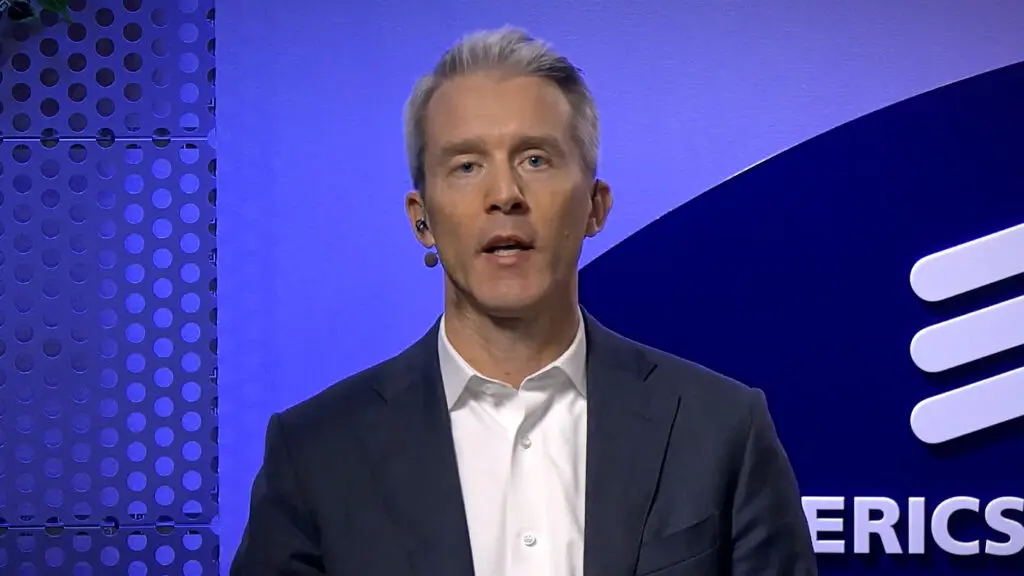
Optus is one; AT&T, Bell Canada, and T-Mobile are testing it, at least. “We have more than 60,000 base stations running this functionality,” he said. “So we are reaping these AI gains today. Reaping gains from AI is not about what platform you execute on, it’s [about] actually [getting] the functionality out there… to create these innovative models… We are leading in this space. But we are not ruling out any other platform… We continuously evaluate what is more cost efficient to run on. But AI is not something that will happen in 2028. It is happening here and now, in our networks.” There was a similar question, later, from Bank of America, about the extent AI RAN is driving revenues, today – and any dynamics related to custom silicon versus the GPUs.
Again, Narvinger was forthcoming, and quite forceful. “It is a revenue opportunity because it is obvious we are providing value,” he said. “So the example of 10 percent more spectrum efficiency – you could put that in the context of SpaceX buying spectrum last week for $8 billion. If you get 10 percent more out of the spectrum, you could very quickly translate that to $800 million of value. Of course, we feel, of course, some of that [value] should come back to Ericsson. We definitely see it as a potential upsell. We absolutely see it as a differentiator when you’re competing in the market. Again, we are doing it on custom silicon.”
He added: “[AI-native link adaptation] can be executed on basebands out there deployed today, already. Obviously we will always come with [the] next generation hardware. Who knows? Maybe we will deploy on GPUs in the future. But then you [would] need to go out to the site and deploy new hardware… We can start deploying these models already today, and reap the benefits. That [offers] fantastic value for customers, and some of that value should, as I said, come our way.” For now, Ericsson’s bet is that the fastest route to AI RAN growth is to make its existing silicon smarter – and leave the GPU door open, without giving up the ASIC advantage it is trying to sell.
As a footnote, and further to the coverage yesterday of Ericsson’s decision to disband its enterprise wireless division, Åsa Tamsons, senior vice president and head of the group, wrote on LinkedIn to confirm her departure – from the role, at least. Her future at Ericsson is unconfirmed, except that she will continue as an executive advisor to “ensure a smooth transition”. She said: “After eight and a half years at Ericsson… now is the right time for me to move on… This isn’t goodbye yet. I’ll share more… in due course.” She went on to list the division’s achievements: 200% business growth since 2020; “significantly” improved profitability; “market leadership” in private 5G; nearly 40,000 enterprise customers; about 3,000 channel partners; deployments in just about every industrial vertical.
Still not enough to standalone, it seems.