


A reciprocal infrastructure deal between Telstra and Google, a new India-Singapore route from FLAG, and a record-breaking fiber transmission test from Japan’s NICT all point to the same thing – that the subsea market is entering a new phase, and the Pacific Ocean is the new criss-cross center of gravity for connected AI workload
In sum – what to know:
- Telstra and Google signal a new wholesale model for AI-era connectivity – The pair will exchange terrestrial and subsea capacity, combining Telstra’s Aura Network backbone with Google’s Pacific cable systems to support growing AI and cloud traffic across Australia and the wider Asia-Pacific region.
- Route diversity has become a strategic priority – FLAG’s new Chennai-to-Singapore cable route adds a second path between India and Southeast Asia, reducing dependence on traditional westbound corridors and reflecting industry demand for more resilient, multi-path network architectures.
- Future capacity growth will come from both new routes and better fiber technology – While operators continue to build new subsea infrastructure, NICT’s 450 Tbps transmission record on standard optical fiber highlights the significant untapped potential of existing networks through advances in optical engineering.
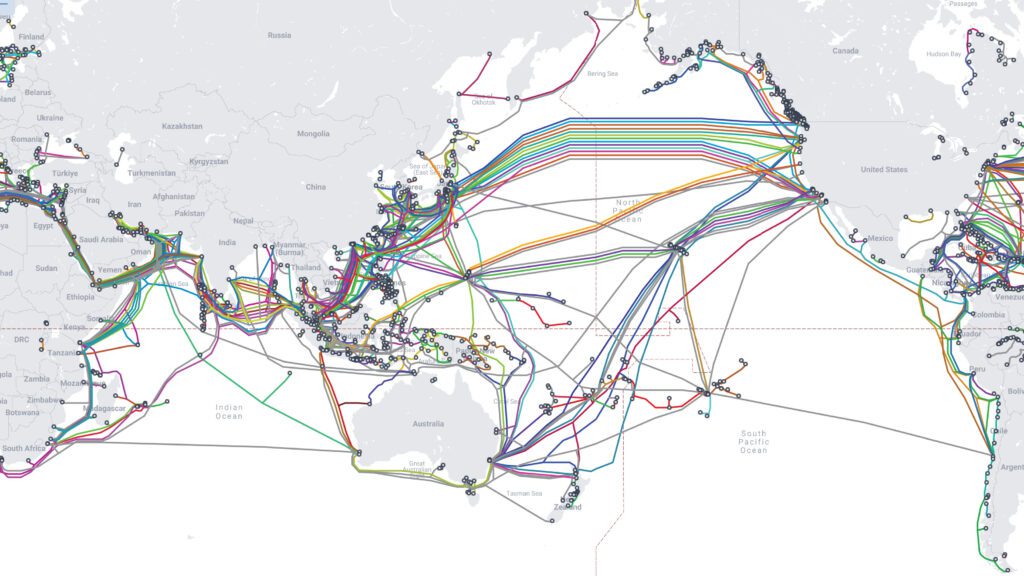
Important news in the subsea cable sector, as Australian operator Telstra has a new land-and-sea network-swap deal with US hyperscaler Google to pump AI workloads in and out of Australia, along the former’s fiber backbone and the latter’s pipes into the Asia Pacific region. There are a few things to consider here, about the deal structure, infrastructure strategy, and broader macro shift in global subsea routing. In the end, it shows the Pacific subsea system as the new AI expansion grid, supplementing the original Atlantic enterprise backbone. It also exists as a kind of hybrid interface deal between a tier-one hyperscaler, commanding global subsea infrastructure, and a tier-two telco, orchestrating some regional terrestrial routing assets; it works strategically for both parties.
As well, there is related news, also interesting: from private subsea cable operator FLAG, about a second route between South and Southeast Asia, going between Chennai on India’s east coast and a new landing station in Singapore. FLAG opened a west-coast line to Singapore last year, going via Mumbai; the new Chennai link brings capacity and diversity, and is offered for end-to-end routing via its ECHO system between Singapore and the US – easing reliance on west-bound routes via the Middle East and Europe. Meanwhile, there is news as well that the National Institute of IT and Communication Technology (NICT) in Japan achieved a record 450 Tbps on a single standard fiber pair, actually between two sites in London – which shows future capacity will come from the tech, too.
But we should just go through the news, briefly.
Reciprocal infra exchange

Firstly: Google and Telstra have an exchange deal to rent space on each other’s networks: Google is to take inter-city dark fiber on Telstra’s Aura Network terrestrial fiber backbone, and Telstra is to take capacity on Google’s Tabua, Proa, Bulikula subsea cable systems. Telstra’s new Aura Network is a long-haul, high-capacity internal network designed to connect major cities, data centers, and international cable landing stations on both coasts, and part of the operator’s digital infrastructure strategy.
Telstra has “already laid” 8,000 kilometers of high-capacity fiber across Australia; the Melbourne-Canberra-Sydney coastal “routes” opened late last year. Telstra is tapping into Google’s regional-APAC Pacific Connect and ‘Down-Under’ Australia Connect network initiatives, which organise and commercialise capacity on its APAC subsea systems, linking to Japan, the Pacific Islands, and the US, and making Australia a regional connectivity hub.
So it is a two-way wholesale arrangement, where the two companies are customers of each other – which is the new standard model between subsea cable operators, particularly hyperscalers, and terrestrial fiber network operators, where telcos are increasingly regional orchestrators for global internet and AI workloads, mostly running only the last terrestrial in-land miles on their own systems.
A statement from the pair said: “As AI applications and workloads continue to grow rapidly, the underlying infrastructure must evolve to securely and reliably support data flows not only within Australia, but also across key international corridors. This partnership addresses that need directly. The connective terrestrial and subsea infrastructure will provide redundant routing paths, minimizing the risk of disruptions and ensuring that businesses, government services, and everyday Australians can experience uninterrupted, high-speed connectivity.”
Steven Worrall, chief executive at Telstra Digital Infrastructure, said: “The Aura Network is the backbone of Australia’s digital future; connectivity is its lifeblood… [Its] rollout is gathering significant momentum. By also securing fiber pairs along high-demand global routes, Telstra is building resilient, secure, and scalable infrastructure that will power the next industrial revolution… This partnership [comes] at a critical moment, as AI and data-intensive technologies reshape economies… [It reinforces] Australia’s role as a regional enabler for cloud, data, and AI ecosystems across the APAC region and beyond.”
Second Asia/South Asia route
Secondly, and related: FLAG’s new Chennai-to-Singapore subsea route follows its Mumbai-to-Singapore launch last year, giving it east- and west-coast subsea corridors between South and Southeast Asia, and a direct “end-to-end” link into the US via its ECHO system between Singapore and the US – which aligns with both hyperscaler-controlled Pacific cables and direct APAC-to-US routing preferences. The London-headquartered firm has a stated 2030 (‘vision’) strategy to invest to “strengthen global coverage, diversity, and long-term network resilience”, with a focus on India “as a connectivity hub and a core operational base”.
Paul Abfalter, chief strategy and revenue officer at FLAG, commented: “Global connectivity is entering a more complex phase, where reliance on a small number of routes is no longer sustainable. Adding a second, geographically distinct path between India and Singapore is a deliberate step to strengthen long‑term network resilience and control. This route reinforces how FLAG is building a more flexible, multi‑path architecture that allows traffic to be managed, protected and rerouted as demand continues to scale across Asia and beyond.”
Record optical fiber transmission
Thirdly: the National Institute of Information and Communications Technology (NICT) in Japan has claimed a record 450 Tbp data transmission over a standard optical fiber across a 39-kilometer stretch of cable in London, between University College London and the Telehouse North data center. It is the first time such a data rate has been demonstrated outside of lab conditions; the previous record was 430 Tbps. The research was presented at the Optical Fiber Communication Conference (OFC 2026) in March in Los Angeles.
Commercial optical systems typically use only the C and L transmission bands; NICT researchers expanded the transmission across the O, E, and S bands as well, and carried 1,273 wavelength channels across 42.4 THz of spectrum – more than four times the bandwidth of commercial deployments. The team developed new optical amplifier technologies to operate across the wider spectrum range. NICT said further work will focus on extending the transmission distance of wideband systems and improving compatibility with deployed fiber networks.
The tech remains in the research stage, but the results say future capacity gains will also come from better-exploiting optical spectrum on existing fibers – rather than just relying on new terrestrial and subsea routes. But for now…
AI’s new subsea super-highways
… and finally, and in sum: the subsea market is changing, with an urgent focus on route diversity, and a square focus on new Pacific routes to cope with the AI storm. Hypescalers are building and also leasing, to an extent, their international capacity, and telcos are becoming important as specialist regional route aggregators, stitching terrestrial and subsea assets into coherent transport networks. The Telstra/Google arrangement is more than a capacity deal. It is a reciprocal wholesale setup between a hyperscaler company that, along with a few others (AWS, Meta, Microsoft), increasingly controls global subsea networks, to carry data traffic between their big global hubs, and a telco outfit that controls strategic access to it in a supra-national region of the world.
The AI angle, meanwhile, is not just marketing, either. AI workloads have created huge east-west traffic flows already between data centers and training clusters, and put a new premium on latency, resilience, and route diversity. Data center operators, often the same deep-pocketed hyperscalers that have taken charge of the subsea systems, want more routes and more landing points to have more options to move traffic when things go wrong. Which is the logic behind Telstra’s investment in its own Aura Network and its rented capacity on Google’s Pacific subsea systems. It is also what sits behind FLAG’s decision to build a second India-to-Singapore route. Both create routing flexibility as AI demand scales, and make them strategic to global AI dispersion.
Which is, increasingly, a Pacific play. The Atlantic corridor between North America and Europe is the world’s most important backbone for enterprise and financial services, but much of the subsea industry’s expansion activity is now happening in the Pacific. Australia is strengthening links into systems connecting Japan, Singapore, and the US West Coast; India is being pulled more directly into Singapore-led routes and onward into Pacific networks; and hyperscalers are increasingly shaping the architecture of these routes themselves. And really, the Pacific subsea system is starting to look like the industry’s AI expansion grid – going alongside the Atlantic enterprise backbone.
But, yes, there is innovation in fiber tech, too. Capacity growth will not just come from laying more cable. The NICT demo of 450 Tbps on a standard fibre pair shows there is untapped potential in the networks already in the ground, or under the sea. But whatever, the urgency to stand-up new route diversity does not go away – and in this world, as AI potential and disruption makes a geo-political arms race of tech, route diversity is as important as raw bandwidth.

