


Telefónica opened 2026 with steady growth, stronger profitability, and lower debt, driven largely by a surge in Brazil and discipline in Germany and Spain. Execs moved to calm expectations about its capital exposure in Europe’s new AI gigafactory push.
Quarterly boom in Brazil – Telefónica’s saw group revenue and EBITDA inch upwards (0.8% and 1.8%) in the quarter, with Brazil outrunning everywhere else (rising 7.4 percent and 8.7 percent).
1&1 pressure in Germany – Spain was steady, and Germany fell as 1&1 shifted MVNO traffic elsewhere; German EBITDA growth was in the “high single digits” otherwise; both were disciplined, it said.
Gigafactory exposure in EU – Telefónica’s said it will not be over-extended or -exposed by its leadership of a Spanish consortium bid for an EU AI gigafactory project; same discipline abides, it said.
Telefónica kicked off 2026 with some kind of momentum, posting first-quarter revenue of €8.1 billion, up 0.8 percent on the same period a year ago. Strong growth in Brazil offset mixed performance in Europe. In response to city analysts, the firm also said its leadership role in Spain’s current AI gigafactory bid with the EU would not leave it overly exposed, on the grounds it will contribute a 10-15 percent equity stake in a state-backed mostly-debt funded consortium project. Nor will it see a crazy AI infrastructure upside – just a viable anchor in a piece of sovereign European AI in its home country.
The group posted adjusted EBITDA of €2.8 billion in the quarter, up by 1.8 percent. The result underscored its mproved profitability – mostly from its performance in Brazil, where revenue (up 7.4 percent, on “record high ARPU”) and EBITDA (up 8.7 percent) rose faster than inflation, but also from decent strength in Spain (up two percent on both counts; “best-ever churn” of 0.7 percent; performance “slightly above our expectation”), and portfolio management with op-co disposals in Colombia and Chile.
The latter reduced its group net debt by about €1.5 billion, it said. On city analysts’ lips during an earnings call, the firm addressed the situation in Germany, which has seen declines in revenue and adjusted EBITDA (down 8.6 percent and 8.4 percent) with 1&1’s phased migration to Vodafone for MVNO roaming and onto its very own network infrastructure as it is deployed. Otherwise, its Germany unit, operating as Telefónica / O2 Deutschland, looked strong, claiming “high single-digit” year-on-year adjusted-EBITDA growth, plus lower revenue losses, in terms of underlying performance – excluding the 1&1 shenanigans (“effect”).

It recorded a net gain in mobile contracts (48,000) and lower churn (1.1 percent) – with “activity focused on profitable growth and network quality”. Which chimes exactly with Telefónica’s repeated line about its so-called ‘transform and grow’ strategy around network simplification, digital operations, and portfolio op-ex control. German has been at the centre of its cost-cutting with multiple efficiency programmes pitched at its channel economics, energy profile, and operating model – all now feeding through into its underlying EBITDA growth. Its German operation is “best-in-class” in terms of cost management, it said. It expects to return to growth in Germany in 2027.
Between them, Emilio Gayo and Juan Azcué, its chief operating and financial officers, rejected that Germany needs a reset in scale or capital allocation, arguing its current footprint is sufficient to compete and meet guidance – while also acknowledging that scale improves margins, and that it will consider local M&A opportunities, whether in Germany or in its home market in Spain, where they are clearly value-accretive, driven primarily by quantifiable cost and network synergies, rather than speculative revenue upside (“where it makes sense”). It said it is pushing harder into fixed comms and bundled offers in Germany. Its network now ranks second for quality in Germany, it said.
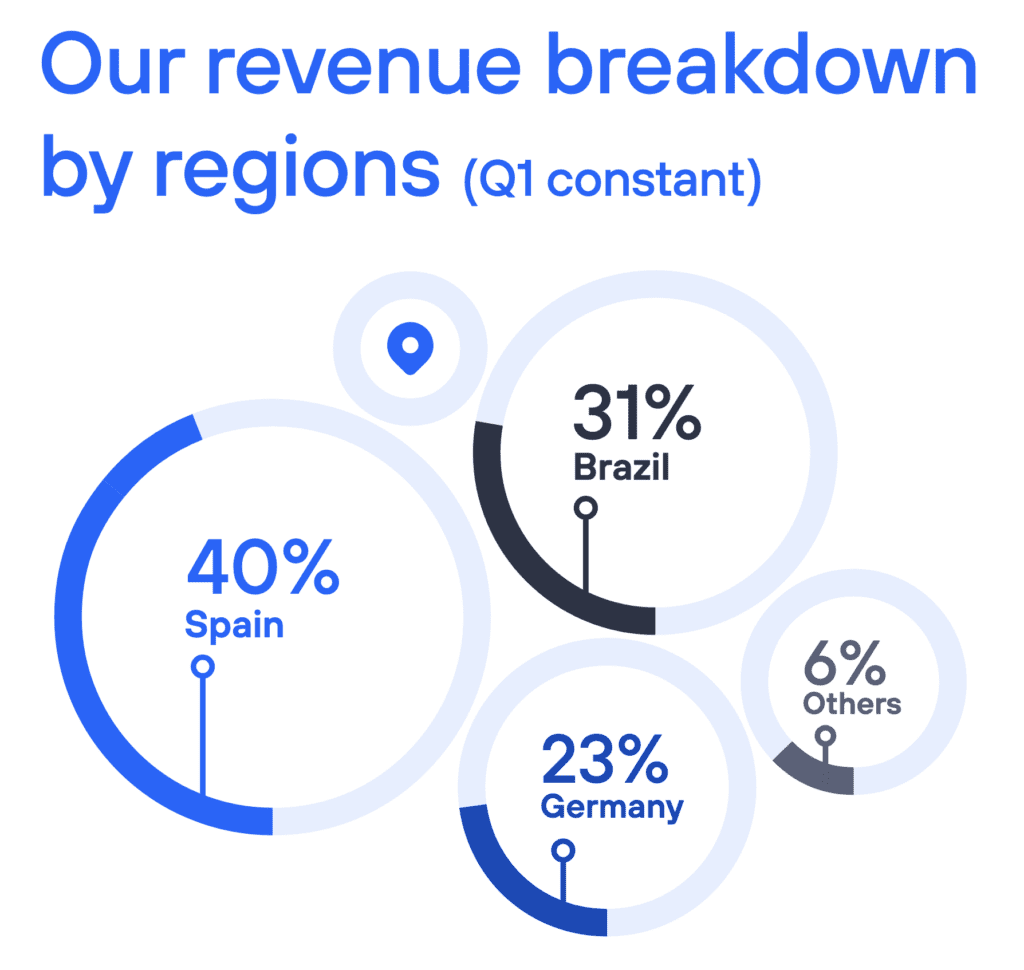
Germany contributed about a quarter (23 percent) of Telefónica’s total revenue in the quarter; Spain contributed 40 percent and Brazil contributed 31 percent. Of its “others”, delivering just six percent, the UK joint-venture operation with Virgin Media, VMO2, is “on track” to meet its 2026 financial targets with improvements in both its fixed-line and mobile businesses. It cited the impact of fiber pricing constraints on fixed ARPU – limiting revenue growth even as network and customer metrics improve. Overall, the group reaffirmed its full-year 2026 target of around €3 billion in free cash flow. Investors responded positively. Shares rose about six percent in pre-market trading.
Of note, Telefónica also answered a question on the call about its involvement in the EU’s €20 billion AI “gigafactory” scheme, part of a wider €200 billion plan to boost the region’s AI competitiveness. Specifically, Telefónica is spearheading a Spanish state-backed bid, together with construction group ACS, for one of five gigawatt-factory projects to be awarded in June/July.
James Ratzer at New Street Research asked how much Telefónica would actually invest in the project, and the kind of return it might expect – and whether it might be considered as a core telecom investment or a new infrastructure business.
To which Telefónica basically responded that ‘nothing is decided’, and ‘not very much’ – on the grounds it might be the leader in the development, but it remains a consortium effort, mostly hinged on debt funding (so the equity portion is relatively small, and Telefónica’s is smaller) and that it is still in the bidding phase anyway, set to be completed by the summer and decided by the winter. Gayo said: “We are at the beginning of the process. The investment [we] can do here is always limited… [to] parameters we consider are value-accretive for the group.” Which is the whole discipline in its ‘transform and grow’ strategy, of course.
Borja Ochoa, chief executive at Telefónica España, explained: “We are leading the Spanish consortium, and are concentrated right now on all the work [to prepare] the final offer, to be presented between June and July. We expect an outcome by the end of the year. We cannot give any further information than that.” So it sounds like the potential capital size will be limited to only a few hundred million euros, pressed Ratzer, picking up on Gayo’s point about “limited” wriggle-room for investment. “Or is that even too much?” Azcué chimed in: “We’re talking about a minority [investment] – between 10 and 15 percent, or something around that; definitely below the amount you’re saying.”
Returns will be consistent with “infra-digital” assets, said Azcué – per an AI transcript of the call – meaning predictable infrastructure returns on long-term deals, rather than quick venture-style AI upside. So the risk is capped, and the gigafactory discussion for Telefónica is not about transforming into an AI infrastructure company, but about selectively anchoring a piece of sovereign AI. He explained: “Around two-thirds of that, if not more, is financed via debt. The rest is equity, and it’s a consortium with the state – and we’re only taking an amount of that. So it is way lower than the figures you put, and the returns will be consistent with infra-digital returns.”

