


RCR Wireless
  • News
  • Channels
    • 5G
    • 6G
    • BSS OSS
    • Carriers
    • IoT
    • Network Infrastructure
    • Open RAN
    • Private 5G
    • Telco AI
    • Telco Cloud
    • Test & Measurement
  • Resources
    • Reports
    • Webinars
    • White papers
    • AI Fundamentals
    • Analyst Angle
    • Editorial Calendar
    • Fundamentals
      • 5G NR Release 17
      • AI
        • Telco AI in 2025
    • Podcasts
      • Let’s Get Digital with Carrie Charles
      • Wireless Connectivity to Enable Industry 4.0 for the Middleprise
      • Well Technically…
      • Will 5G Change the World
      • Accelerating Industry 4.0 Digitalization
  • AI Infrastructure
  • Programs
  • Events
  • RCRtv
  • Advertise
  • Subscribe
Wednesday, August 26, 2026
RCR Wireless
  • News
  • Channels
    • 5G
    • 6G
    • BSS OSS
    • Carriers
    • IoT
    • Network Infrastructure
    • Open RAN
    • Private 5G
    • Telco AI
    • Telco Cloud
    • Test & Measurement
  • Resources
    • Reports
    • Webinars
    • White papers
    • AI Fundamentals
    • Analyst Angle
    • Editorial Calendar
    • Fundamentals
      • 5G NR Release 17
      • AI
        • Telco AI in 2025
    • Podcasts
      • Let’s Get Digital with Carrie Charles
      • Wireless Connectivity to Enable Industry 4.0 for the Middleprise
      • Well Technically…
      • Will 5G Change the World
      • Accelerating Industry 4.0 Digitalization
  • AI Infrastructure
  • Programs
  • Events
  • RCRtv
  • Advertise
  • Subscribe
Add RCR Wireless as a preferred source on Google
  • Qualcomm 6G Insights
  • Huawei Content Hub
  • Qualcomm – 6G Vision
  • OSS/BSS Channel
  • RCRTech Roundtable: AI Infrastructure
RCR Wireless
RCR Wireless
  • Advanced Mimo
  • Mobile mmWave
  • 5G Positioning
  • Green Networks
  • Metaverse
  • Automotive
  • Industrial and Wide-area IoT
Copyright 2021 - All Right Reserved
Home - A lunar network project powered by digital twins
Network InfrastructureTest & Measurement

A lunar network project powered by digital twins

by Sulagna Saha April 27, 2026
written by Sulagna Saha April 27, 2026 Share
LinkedinEmail
Share 0LinkedinEmail
Image: 123rf.com
965

Synopsys and NASA are collaborating on a lunar cellular network project in which high-fidelity digital twins simulate the terrain, antenna performance, and connectivity, all from the Earth

The world watched with wide-eyed wonder as Artemis II looped around the Moon, traveling 252,756 miles from Earth — the farthest humans have ever traveled in space — in a 10-day voyage. But behind the scenes, an equally compelling technological story was unfolding that few talked about. 

Under the hood, missions like Artemis II are heavily supported by digital twins that help astronauts recreate space conditions and test gears in safe lab environments ahead of the missions. Synopsys, a test and measurement company known for silicon design, IP, and simulation solutions, is collaborating with NASA on future Artemis missions. 

Synopsys is working with the NASA Glenn Research Center at Cleveland and Cesium, provider of a digital twin geospatial platform owned by software company Bentley Systems, to help analyze the performance of antennas embedded in space suites and rovers in lunar missions. The work is part of a bigger project called the Lunar 3rd Generation Partnership Project (Lunar 3GPP) that aims to deploy a lunar cellular network to support future Artemis missions. 

“As we move further into the unforgiving and promising environment of space, we need to innovate quickly, boldly, and effectively,” said Jim Bridenstine, former NASA administrator and current advisor for Synopsys, in a statement. “Embracing digital engineering technologies that enable teams to model, test, and refine designs virtually before hardware is built, is an important step to reducing risk and accelerating innovation.”

RCR spoke with Shawn Carpenter, program director for 5G/6G & space, at Synopsys, to get a sneak-peek of the workflow. 

“The challenge anyone working in the telecommunications industry has is trying to predict whether a communication [equipment] that they’re going to install in a particular site or location will work out of the box when they install it,” Carpenter said. “Quite often, there’s a lot of site planning that goes into effect to determine that.” This involves studying the physical geography of the place, mapping coverage to the realistic conditions, identifying shadow zones, determining capacity, and so on.

But when it comes to deploying a high-bandwidth cellular network on the Moon, physical survey is the first barrier. “[NASA] does not have the luxury of having advanced access to the site, except through very costly means, putting equipment up there in an autonomous placement of devices and doing site testing,” Carpenter noted. 

But if the network has to keep astronauts, rovers, and other assets connected on Moon, while handling high-resolution, high-def videos, and large amounts of telemetry data, mapping the terrain is a vital first step. “If you’re going to have a lunar rover driving down, perhaps into a crater or over your visibility horizon because of the rock and the lunar regolith [a layer of loose rocks and soil], you want to know that you’re going to be able to maintain connectivity,” Carpenter pointed out.

This is directly related to the placement of antennas. “The reality of antenna placement is where you put it on a host platform influences where it can be sensitive and where it can be blind.”
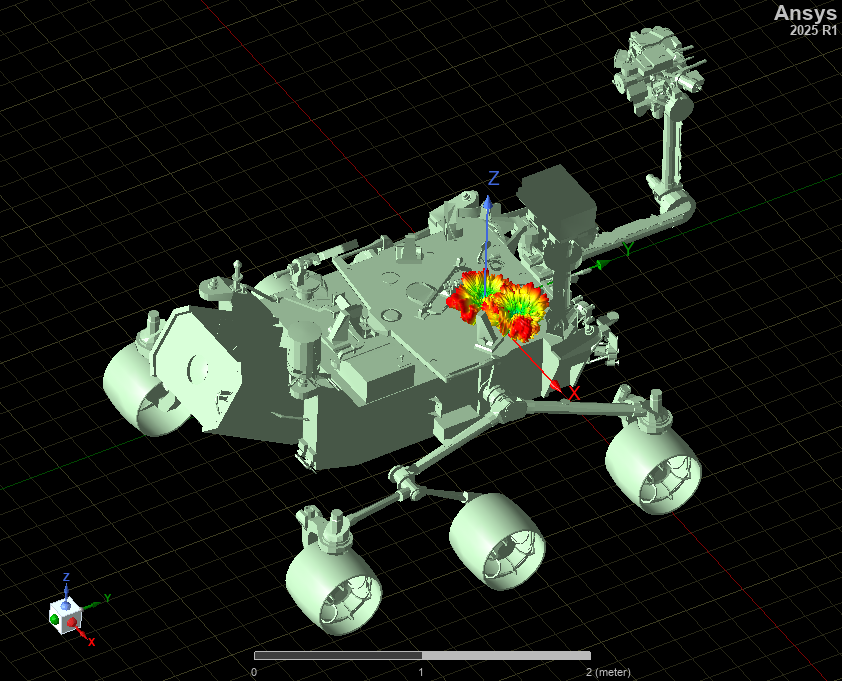
Ansys HFSS simulates the installed performance of an antenna on a lunar rover
Image provided by Synopsys

This changes what is called the radiation pattern of antenna systems, in other words, the way the systems radiate and receive electromagnetic energy.

Now there is a way to perform this hardware-dependent site inspection and antenna testing entirely from afar. “If you don’t have access to the site, then the best way to deal with that is through simulation,” Carpenter said.

Antenna placement modeling is heavily used in aerospace and defense industries where mobile antennas are common. “You put an antenna on one spot, like, for example, in an aircraft fuselage. It has areas where it can see and hear, in other areas, where it cannot, and those areas move as the aircraft rolls, pitches, and yaws. It changes the pattern because the pattern goes with the vehicle,” he explained.

However, the simulation must be of high-fidelity “to match or predict the physics of propagation on that surface, in addition to being fast enough…so that you can run every conceivable mission, every conceivable walk plan and drive plan that someone will run on the Moon,” he said. 

Synopsys recently acquired a company called Ansys which brings over 30 years of experience in antenna placement modeling. So it’s no surprise that its software-based workflow for NASA is powered by the Ansys RF Channel Modeller which simulates radio frequency (RF) signal propagation performance. The solution uses “true-to-reality” Moon topography data from Cesium to essentially create a digital copy of the Moon. As the rovers travel across this simulated lunar environment, they reveals shadow zones with geospatial accuracy, informing site planning and enabling continued connectivity between network assets and astronauts.

The real breakthrough, however, Carpenter highlighted, is not the simulation accuracy, but the speed. “We can knock these simulations out in a couple of milliseconds, which is about a million times faster,” he said.

The solution is seeing broad interest in the aerospace and defense community, as well as in commercial telecom where digital twins are helping model real-world scenarios in the pre-deployment stage.

Further to this, the company is also collaborating with NASA and Electro Magnetic Applications, Inc. (EMA) on a research project focused on assessing the charging levels on Artemis spacesuits. The company is helping researchers understand electrostatic discharge risks that arise from spacesuits’ exposure to plasma radiations. 

The scope of the project includes predicting how charged particles from the lunar regolith can change propagation characteristics, how spacesuits impact antenna performance, how reflections from metallic surfaces on the suits’ fabric affect signal distribution, levels of radiation that might come in through the visor, and the amount of signal levels that might interact with human tissue.

Similar approaches are being adopted in the cellular industry for testing safe levels of emissions. 

You Might Also Like
  • AI infrastructure drives Keysight test demand
  • Criss-cross comms – Lumen bets on east-west AI, while the edge keeps north-south in play
  • Thursday (telco diary) | Ghosts in the machine – Wanted: more humans to build AI
  • Lumen ready for AI traffic rush – with programmable fabric and “more fiber than anyone”
  • AI fiber build-out undermines rural BEAD skills-drive
  • Wednesday (telco diary) | Smells like team spirit – and that tech-bro Musk
Share 0 LinkedinEmail
Sulagna Saha

Sulagna Saha is a technology editor at RCR. She covers test and measurement, non-terrestrial networks, defense comms, quantum and other beats. Before joining RCR, she led coverage for Techstrong.ai and Techstrong.it at The Futurum Group, and wrote on AI, cloud and edge computing, cybersecurity, data storage, networking, and mobile and wireless. Her work has also appeared on Fierce Network, Security Boulevard, Cloud Native Now, DevOps.com and other leading tech publications. Sulagna is based out of Cleveland.

previous post
CBNG targets U.S. FWA growth with Dallas hub
next post
Sovereignty is about resiliency, says BT – and how to kill the foreign kill switch

White Papers

  • Norton eBook: The 2026 Telco Playbook

  • Enea White Paper: Why Intelligent AAA is the Swiss Army Knife of Telecom

  • CSG White Paper: Telco AI Enabler: Mediation’s Defining Role

  • Enea White Paper: Scalable Database Design for 5G and Beyond

  • Supermicro and NVIDIA Whitepaper: Powering sovereign AI at scale

Editorial Reports

  • Report: Building AI-Era Network Fabrics

  • Quantum Safe Networks Market Pulse Report

  • Report: NTN in motion — evolving standards, expanding services

Webinars

  • Mimosa Webinar – Build the Right Network

  • Webinar: Building 6G — aligning technology, policy and purpose

  • SIMCom Webinar: Scaling your next deployment – from plastic to provisioning

  • Webinar: Rethinking the RAN as AI, cloud and openness converge

  • Webinar: Scale-Up, Scale-Out, Scale-Across – Building AI-Era Network Fabrics

Since 1982, RCR Wireless News has been providing wireless and mobile industry news, insights, and analysis to mobile and wireless industry professionals, decision makers, policy makers, analysts and investors.

Facebook Twitter Youtube Linkedin Envelope Rss

Useful Links

  • Subscribe
  • About RCR Wireless News
  • Contact Us
  • Advertise
  • Editorial Calendar
  • Archive
  • RSS
  • Wireless News Archive
  • Subscribe
  • About RCR Wireless News
  • Contact Us
  • Advertise
  • Editorial Calendar
  • Archive
  • RSS
  • Wireless News Archive

Edtior's Picks

Lightyear launches Dispatch, an agentic AI platform for enterprise telecom
The smart apartment era is ending. The smart building contract is next (Analyst...
Mimosa Webinar – Build the Right Network

Latest Articles

Lightyear launches Dispatch, an agentic AI platform for enterprise telecom
The smart apartment era is ending. The smart building contract is next (Analyst Angle)
Mimosa Webinar – Build the Right Network
ZTE’s computing business drives H1 growth as carrier spending weakens

© 2026 RCR Wireless News All Right Reserved. Developed by Eight Hats.

Cookie Policy | Privacy Policy

RCR Wireless
  • News
  • Channels
    • 5G
    • 6G
    • BSS OSS
    • Carriers
    • IoT
    • Network Infrastructure
    • Open RAN
    • Private 5G
    • Telco AI
    • Telco Cloud
    • Test & Measurement
  • Resources
    • Reports
    • Webinars
    • White papers
    • AI Fundamentals
    • Analyst Angle
    • Editorial Calendar
    • Fundamentals
      • 5G NR Release 17
      • AI
        • Telco AI in 2025
    • Podcasts
      • Let’s Get Digital with Carrie Charles
      • Wireless Connectivity to Enable Industry 4.0 for the Middleprise
      • Well Technically…
      • Will 5G Change the World
      • Accelerating Industry 4.0 Digitalization
  • AI Infrastructure
  • Programs
  • Events
  • RCRtv
  • Advertise
  • Subscribe
RCR Wireless
  • News
  • Channels
    • 5G
    • 6G
    • BSS OSS
    • Carriers
    • IoT
    • Network Infrastructure
    • Open RAN
    • Private 5G
    • Telco AI
    • Telco Cloud
    • Test & Measurement
  • Resources
    • Reports
    • Webinars
    • White papers
    • AI Fundamentals
    • Analyst Angle
    • Editorial Calendar
    • Fundamentals
      • 5G NR Release 17
      • AI
        • Telco AI in 2025
    • Podcasts
      • Let’s Get Digital with Carrie Charles
      • Wireless Connectivity to Enable Industry 4.0 for the Middleprise
      • Well Technically…
      • Will 5G Change the World
      • Accelerating Industry 4.0 Digitalization
  • AI Infrastructure
  • Programs
  • Events
  • RCRtv
  • Advertise
  • Subscribe
@2020 - All Right Reserved. Designed and Developed by PenciDesign
