RCR Wireless
  • News
  • Channels
    • 5G
    • 6G
    • BSS OSS
    • Carriers
    • IoT
    • Network Infrastructure
    • Open RAN
    • Private 5G
    • Telco AI
    • Telco Cloud
    • Test & Measurement
  • Resources
    • Reports
    • Webinars
    • White papers
    • AI Fundamentals
    • Analyst Angle
    • Editorial Calendar
    • Fundamentals
      • 5G NR Release 17
      • AI
        • Telco AI in 2025
    • Podcasts
      • Let’s Get Digital with Carrie Charles
      • Wireless Connectivity to Enable Industry 4.0 for the Middleprise
      • Well Technically…
      • Will 5G Change the World
      • Accelerating Industry 4.0 Digitalization
  • AI Infrastructure
  • Programs
  • Events
  • RCRtv
  • Advertise
  • Subscribe
Thursday, July 9, 2026
RCR Wireless
  • News
  • Channels
    • 5G
    • 6G
    • BSS OSS
    • Carriers
    • IoT
    • Network Infrastructure
    • Open RAN
    • Private 5G
    • Telco AI
    • Telco Cloud
    • Test & Measurement
  • Resources
    • Reports
    • Webinars
    • White papers
    • AI Fundamentals
    • Analyst Angle
    • Editorial Calendar
    • Fundamentals
      • 5G NR Release 17
      • AI
        • Telco AI in 2025
    • Podcasts
      • Let’s Get Digital with Carrie Charles
      • Wireless Connectivity to Enable Industry 4.0 for the Middleprise
      • Well Technically…
      • Will 5G Change the World
      • Accelerating Industry 4.0 Digitalization
  • AI Infrastructure
  • Programs
  • Events
  • RCRtv
  • Advertise
  • Subscribe
Add RCR Wireless as a preferred source on Google
  • Qualcomm 6G Insights
  • Huawei Content Hub
  • Qualcomm – 6G Vision
  • OSS/BSS Channel
  • RCRTech Roundtable: AI Infrastructure
RCR Wireless
RCR Wireless
  • Advanced Mimo
  • Mobile mmWave
  • 5G Positioning
  • Green Networks
  • Metaverse
  • Automotive
  • Industrial and Wide-area IoT
Copyright 2021 - All Right Reserved
Home - Industry 4.0’s hourglass figure – AI and IoT put squeeze on OT hardware spend
Industrial AIIndustry 4.0Internet of Things (IoT)IoT

Industry 4.0’s hourglass figure – AI and IoT put squeeze on OT hardware spend

by James Blackman April 7, 2026
written by James Blackman April 7, 2026 Share
LinkedinEmail
Share 0LinkedinEmail
Background image: 123rf Industry 4.0 AI
Background image: 123rf
1.2K

Bain & Company warns that traditional industrial control systems are losing their central role as AI and smart devices redefine the economic landscape. By 2030, software, AI workflows, and intelligent field devices will capture the bulk of industry profit.

In sum – what to know:

Hourglass figures – Economic value is migrating away from middle-layer control hardware to top-layer AI software and bottom-layer IoT devices.

AI sense-making – By 2030, nearly half of industry revenues will rely on AI solutions, which could unlock up to $70 billion in new market value.

Hybrid verticals – hybrid sectors like pharma already show the shift, with discrete and process-heavy industries set to also accelerate AI adoption.

Bain & Company has issued a fairly meaty report ahead of Hannover Messe this month (April 20-24) about the state of Industry 4.0 in the AI era, and declared that industrial control systems, where enterprises have traditionally sunk most of their innovation budgets, have reached their limits, and that their economic priorities have also changed. AI has upped the ante, the company says, and made the kind of incremental production gains traditionally achieved with upgraded control systems appear limiting – versus the new value creation that industrial AI promises. 

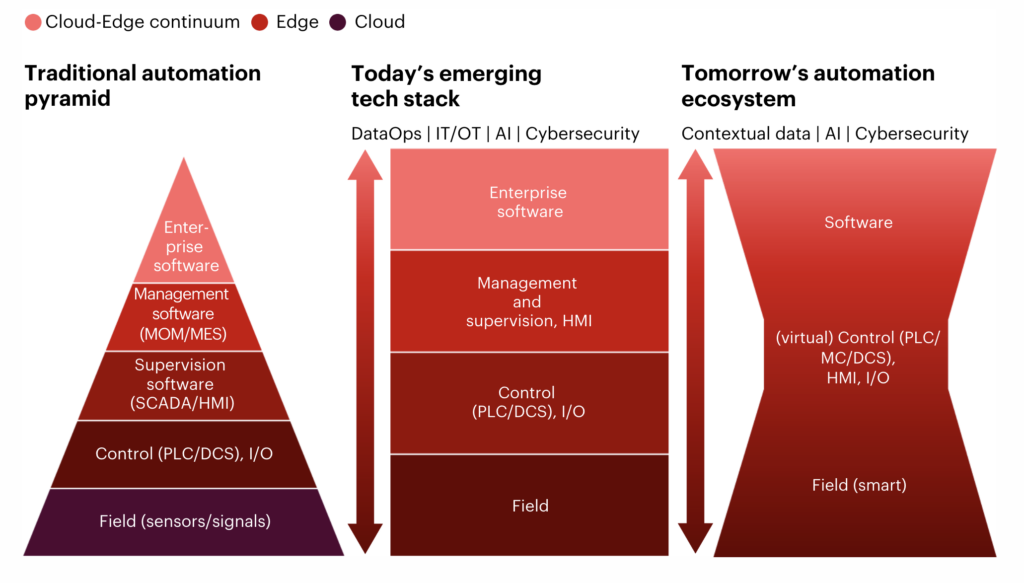
Industrial enterprises are all-in on AI, the report says. Take note: they are also all-in on IoT, in a broad fashion – in the form of ‘smart field devices’ (“sensors, actuators, drives, robots, conveyors, and machine vision”); as they have been for years. The shift away from control hardware – programmable logic controllers (PLCs), distributed control systems (DCSs), input/output modules (I/O), supervisory control and data acquisition (SCADA), proprietary software – will see the old profit ‘pyramid’ morph into an ‘hourglass’ shape, with the middle control layer squeezed.
Bain industrial AI
Notes: I/O is input/output module; PLC is programmable logic controller; DCS is distributed control system; SCADA is supervisory control and data acquisition; HMI is human-machine interface; MC is motion control; MOM is manufacturing operations management; MES is manufacturing execution system; IT is information technology; OT is operational technology Source: Bain analysis

Meanwhile, the top software layer, most notably, will be expanded over the next few years to reflect the new AI money-flows. By 2030, more than 80 percent of industry “profit pools” (enterprise investments / vendor profits) will sit at the two ends of this hourglass-shaped value map, showing investments in different levels of the industrial tech stack. More than half of spending will go on top-layer data management software, to orchestrate and optimize data in AI-related workflows. Such software scales fast, and affords high margins, it says. 

An additional 25-30 percent will go on field devices, mostly designated as ‘smart’ and invariably connected. It writes: “Value is concentrating in software, data platforms, and AI-enabled workflows. These [top] layers scale faster, carry higher margins, and compound in value as data and use cases accumulate… At the bottom, value is reemerging in smart field devices… [which] are no longer passive endpoints. With embedded intelligence, connectivity, and edge computing, they generate data, execute decisions, and continuously improve performance. 

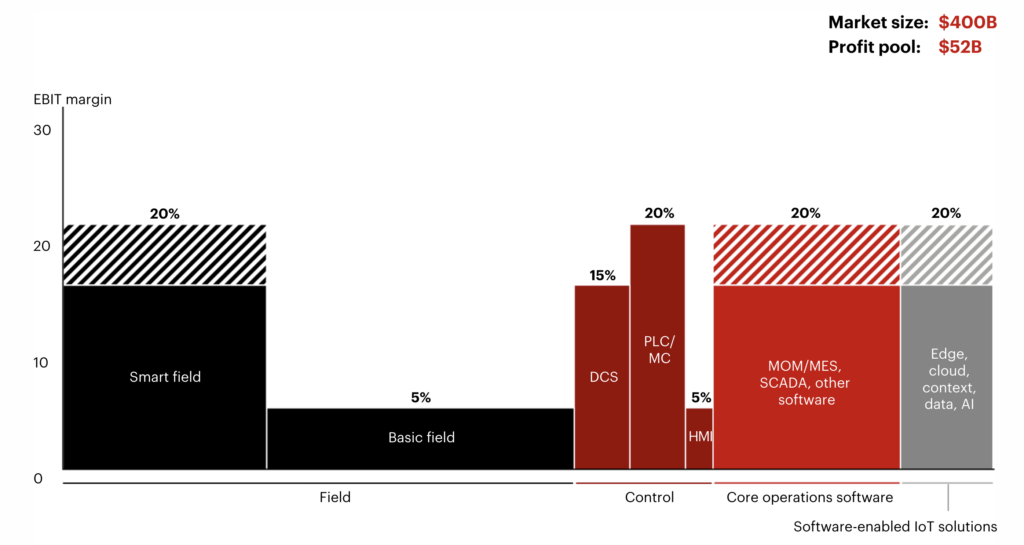
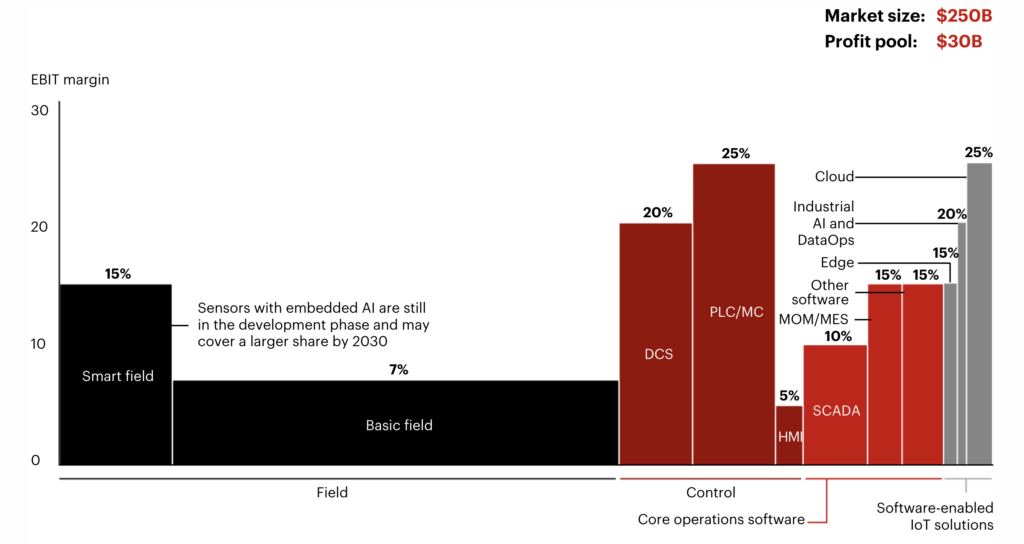
“The traditional control layer in the middle… remains essential but is becoming harder to scale and differentiate. New entrants are compressing margins by shifting value away from these core controls… Most industry profit pools will flow to the two ends of this hourglass, away from the center.” In terms of new revenue value for tech vendors, the (blog of the) report has a couple of weird graphs, a little hard to make out, suggesting the “profit pool” for industrial tech will go from $30 billion in 2025 to $52 billion in 2030, while the market goes from $250 billion to $400 billion. 
Bain industrial AI 2
2025 – today’s emerging tech stack, as presented by Bain & Company
Bain industrial AI 3
2030 – tomorrow’s automation ecosystem, as presented by Bain & Company

Notes: Market and profit pool size are estimates; field categories include sensors, actuators, drives, industrial robots, conveyors, and machine vision; smart field includes equipment with Internet of Things (IoT)–enabled intelligence, compute, and native connectivity; other software includes historian software, advanced process control (APC), simulation software, and digital twins; I/O is input/output; PLC is programmable logic controller; DCS is distributed control system; SCADA is supervisory control and data acquisition; HMI is human-machine interface; MC is motion control; MOM is manufacturing operations management; MES is manufacturing execution system. Sources: Bain analysis; ARC Advisory Group Automation Report

These are estimates, it notes. It offers a percentage breakdown of all the elements in the stack, which appears to be rough percentage-share estimates, and don’t clearly add up (to 100 percent). But the message is the same: spiralling shares either side of a collapsing forecast in the middle, related to industrial control hardware. “Control still matters, but it is no longer the profitable core of the industrial automation industry,” it writes. It has another revenue forecast, besides (see below): that “AI-enabled solutions alone could unlock up to” $70 billion in “new market value” by 2030. 

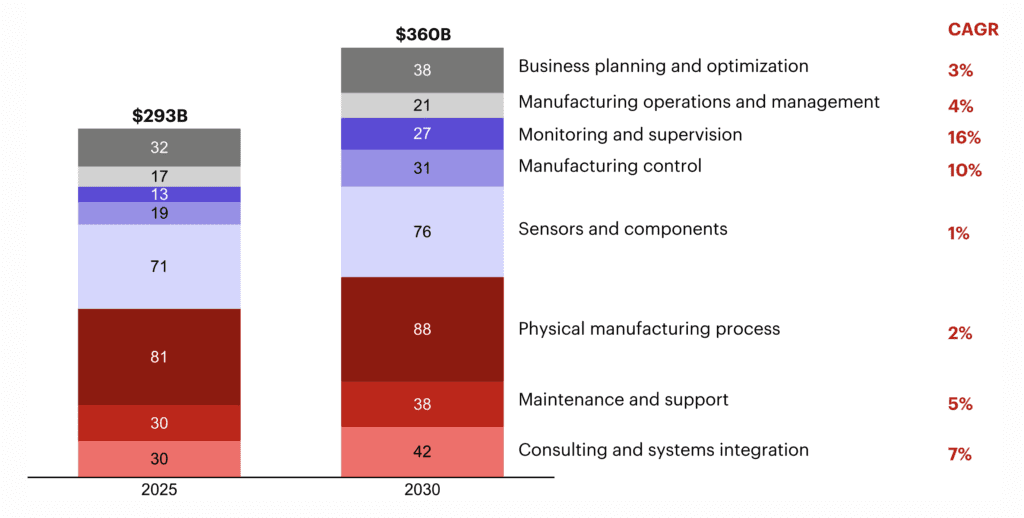
But “AI-enabled solutions” apply to every part of the stack, anyway – to bring intelligent orchestration of control hardware. The fastest-growing sub-segment for new AI-related tech is ‘manufacturing control’ software, worth $31 billion by 2030, up about 10 percent (CAGR) in the period. Tech (of whatever sort) related to the ‘physical manufacturing process’, now with AI, will still contribute about a quarter of this ‘new’ market value ($88 billion), even if the CAGR jump is lower (two percent), and its contribution-share is down ($81 billion out of $293 billion in 2025). 
Bain industrial AI 6
Source: Bain Industrial Automation Executive Survey 2026 (n=26)

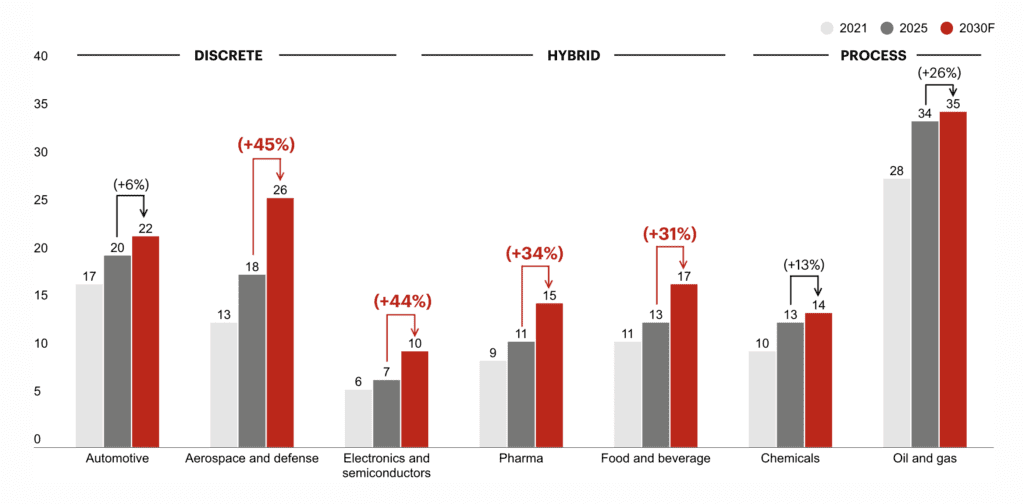
Regardless, the pattern is still clear: all the boats rise, and AI sensing and AI sense-making capture and expand the traditional investment flow in a pincer movement. Bain says the shift is visible most clearly already in “hybrid industry verticals”, which mix elements of process manufacturing (continuous or batch production, often liquids, chemicals, or ingredients) and discrete manufacturing (assembly of distinct physical units) – notably pharmaceuticals and food and beverage, which will allocate a higher share of spending to automation (34 percent and 31 percent, versus 2025). 
Bain industrial AI 4
Notes: Market and profit pool size are estimates; field categories include sensors, actuators, drives, industrial robots, conveyors, and machine vision; smart field includes equipment with Internet of Things (IoT)–enabled intelligence, compute, and native connectivity; other software includes historian software, advanced process control (APC), simulation software, and digital twins; I/O is input/output; PLC is programmable logic controller; DCS is distributed control system; SCADA is supervisory control and data acquisition; HMI is human-machine interface; MC is motion control; MOM is manufacturing operations management; MES is manufacturing execution system. Sources: Bain analysis; ARC Advisory Group Automation Report

But discrete verticals and process verticals will quickly come online, with the aerospace and electronics sectors pumping in about 45/44 percent more, and oil and gas going 26 percent higher. Bain also observes a trend towards vertical integration. “The industry shifts toward software, smart devices, and vertical depth,” it says. “As margins tighten, value accrues to those who own the decision layer – not just the systems that execute instructions.” This marks a “clear break from the past”, it says – process intelligence versus just process automation.

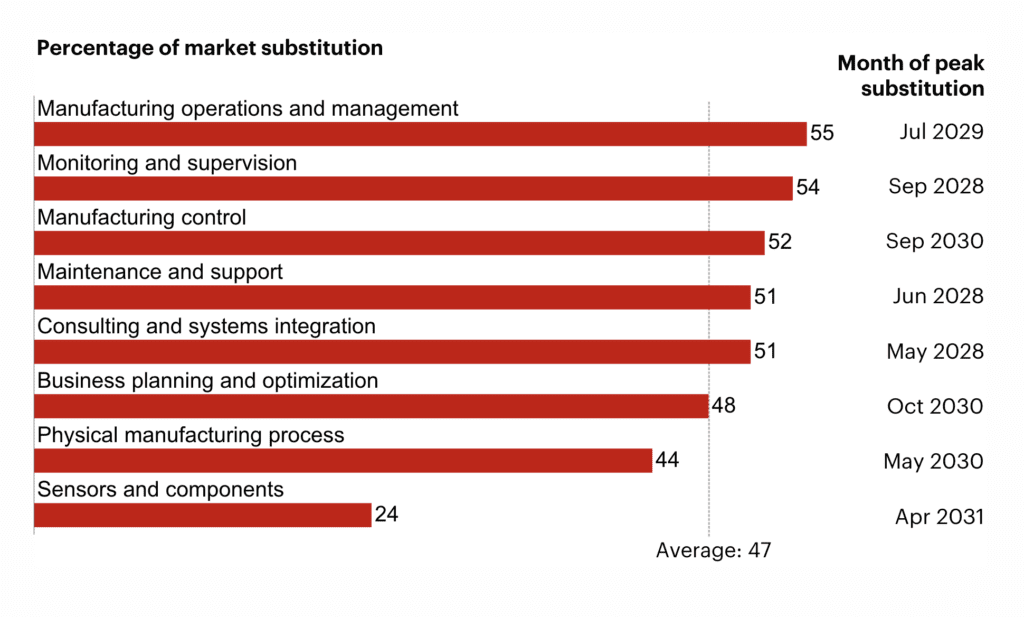
Interestingly, it also suggests a timeline for when AI will be swapped-into different industrial use cases, effectively. “AI’s first wave of impact will also be far more concentrated – and time-bound – than many leaders expect.” While a small number of use cases account for a “disproportionate share of AI’s upside” (adaptive robotics, predictive maintenance), nearly half (47 percent) of industry revenues will rely on “AI-enabled offerings” by 2030, with “substitution pressure” above 50 percent in several core use cases. 
Bain industrial AI 5
Source: Bain Industrial Automation Executive Survey 2026 (n=26)

“AI is no longer a differentiator – it is a prerequisite for market access… Much of the value will materialize in the next one to five years, leaving little room for incremental or experimental approaches,” it says. It lists them, as below: “peak substitution” in mid/late-2028 (consulting and integration, maintenance and support, monitoring and supervision), mid-2029 (manufacturing operations), and mid/late-2030 (physical manufacturing, manufacturing control, business optimization), with a mid-2031 schedule for IoT-related sensors and components. 

You Might Also Like
  • SIMCom Webinar: Scaling your next deployment – from plastic to provisioning
  • Wednesday (telco diary) | Mobility matters for physical AI
  • How the FCC can protect IoT innovation and GPS resilience in the 900 MHz band (Reader Forum)
  • Tuesday (telco diary) | AI hub and spoke, cloud to edge
  • Wednesday | Telco agents and smash hits (Editorial Diary)
  • ‘You can’t tame it’ – private networks, open standards and the AI proof for IoT
Share 0 LinkedinEmail
James Blackman
James Blackman

James Blackman has been writing about the technology and telecoms sectors for over a decade. He has edited and contributed to a number of European news outlets and trade titles. He has also worked at telecoms company Huawei, leading media activity for its devices business in Western Europe. He is based in London.

previous post
Restoring trust in voice: The next generation of authenticated and branded communications (Reader Forum)
next post
China shifts 5G focus to monetization and enterprise growth

White Papers

  • Enea White Paper: Why Intelligent AAA is the Swiss Army Knife of Telecom

  • CSG White Paper: Telco AI Enabler: Mediation’s Defining Role

  • Enea White Paper: Scalable Database Design for 5G and Beyond

  • Supermicro and NVIDIA Whitepaper: Powering sovereign AI at scale

  • VIAVI Whitepaper: RAN scenario generators and their critical role for future-proofing AI-native RAN in Advanced 5G and 6G networks

Editorial Reports

  • Report: Scaling Optical Networks For The Hyperscale And AI Era

  • Test And Measurement Market Pulse Report

  • Editorial Report: Securing telecom infrastructure for the quantum era

Webinars

  • SIMCom Webinar: Scaling your next deployment – from plastic to provisioning

  • Webinar: Rethinking the RAN as AI, cloud and openness converge

  • Webinar: Scale-Up, Scale-Out, Scale-Across – Building AI-Era Network Fabrics

  • Webinar: NTN in motion – evolving standards, expanding services

  • Webinar: Noise-Figure Measurements with RFmx and PXI VSTs

Since 1982, RCR Wireless News has been providing wireless and mobile industry news, insights, and analysis to mobile and wireless industry professionals, decision makers, policy makers, analysts and investors.

Facebook Twitter Youtube Linkedin Envelope Rss

Useful Links

  • Subscribe
  • About RCR Wireless News
  • Contact Us
  • Advertise
  • Editorial Calendar
  • Archive
  • RSS
  • Wireless News Archive
  • Subscribe
  • About RCR Wireless News
  • Contact Us
  • Advertise
  • Editorial Calendar
  • Archive
  • RSS
  • Wireless News Archive

Edtior's Picks

OCUDU aims to resolve the ‘last bottlenecks of proprietary software’
Optical advances won’t eliminate need for new fiber, says Dell’Oro
SIMCom Webinar: Scaling your next deployment – from plastic to provisioning

Latest Articles

OCUDU aims to resolve the ‘last bottlenecks of proprietary software’
Optical advances won’t eliminate need for new fiber, says Dell’Oro
SIMCom Webinar: Scaling your next deployment – from plastic to provisioning
GSMA Industry Insight: Enabling seamless cellular wearable experiences

© 2026 RCR Wireless News All Right Reserved. Developed by Eight Hats.

Cookie Policy | Privacy Policy

RCR Wireless
  • News
  • Channels
    • 5G
    • 6G
    • BSS OSS
    • Carriers
    • IoT
    • Network Infrastructure
    • Open RAN
    • Private 5G
    • Telco AI
    • Telco Cloud
    • Test & Measurement
  • Resources
    • Reports
    • Webinars
    • White papers
    • AI Fundamentals
    • Analyst Angle
    • Editorial Calendar
    • Fundamentals
      • 5G NR Release 17
      • AI
        • Telco AI in 2025
    • Podcasts
      • Let’s Get Digital with Carrie Charles
      • Wireless Connectivity to Enable Industry 4.0 for the Middleprise
      • Well Technically…
      • Will 5G Change the World
      • Accelerating Industry 4.0 Digitalization
  • AI Infrastructure
  • Programs
  • Events
  • RCRtv
  • Advertise
  • Subscribe
RCR Wireless
  • News
  • Channels
    • 5G
    • 6G
    • BSS OSS
    • Carriers
    • IoT
    • Network Infrastructure
    • Open RAN
    • Private 5G
    • Telco AI
    • Telco Cloud
    • Test & Measurement
  • Resources
    • Reports
    • Webinars
    • White papers
    • AI Fundamentals
    • Analyst Angle
    • Editorial Calendar
    • Fundamentals
      • 5G NR Release 17
      • AI
        • Telco AI in 2025
    • Podcasts
      • Let’s Get Digital with Carrie Charles
      • Wireless Connectivity to Enable Industry 4.0 for the Middleprise
      • Well Technically…
      • Will 5G Change the World
      • Accelerating Industry 4.0 Digitalization
  • AI Infrastructure
  • Programs
  • Events
  • RCRtv
  • Advertise
  • Subscribe
@2020 - All Right Reserved. Designed and Developed by PenciDesign