

RCR Wireless
  • News
  • Channels
    • 5G
    • 6G
    • BSS OSS
    • Carriers
    • IoT
    • Network Infrastructure
    • Open RAN
    • Private 5G
    • Telco AI
    • Telco Cloud
    • Test & Measurement
  • Resources
    • Reports
    • Webinars
    • White papers
    • AI Fundamentals
    • Analyst Angle
    • Editorial Calendar
    • Fundamentals
      • 5G NR Release 17
      • AI
        • Telco AI in 2025
    • Podcasts
      • Let’s Get Digital with Carrie Charles
      • Wireless Connectivity to Enable Industry 4.0 for the Middleprise
      • Well Technically…
      • Will 5G Change the World
      • Accelerating Industry 4.0 Digitalization
  • AI Infrastructure
  • Programs
  • Events
  • RCRtv
  • Advertise
  • Subscribe
Monday, September 14, 2026
RCR Wireless
  • News
  • Channels
    • 5G
    • 6G
    • BSS OSS
    • Carriers
    • IoT
    • Network Infrastructure
    • Open RAN
    • Private 5G
    • Telco AI
    • Telco Cloud
    • Test & Measurement
  • Resources
    • Reports
    • Webinars
    • White papers
    • AI Fundamentals
    • Analyst Angle
    • Editorial Calendar
    • Fundamentals
      • 5G NR Release 17
      • AI
        • Telco AI in 2025
    • Podcasts
      • Let’s Get Digital with Carrie Charles
      • Wireless Connectivity to Enable Industry 4.0 for the Middleprise
      • Well Technically…
      • Will 5G Change the World
      • Accelerating Industry 4.0 Digitalization
  • AI Infrastructure
  • Programs
  • Events
  • RCRtv
  • Advertise
  • Subscribe
Add RCR Wireless as a preferred source on Google
  • Qualcomm 6G Insights
  • Huawei Content Hub
  • Qualcomm – 6G Vision
  • OSS/BSS Channel
  • RCRTech Roundtable: AI Infrastructure
RCR Wireless
RCR Wireless
  • Advanced Mimo
  • Mobile mmWave
  • 5G Positioning
  • Green Networks
  • Metaverse
  • Automotive
  • Industrial and Wide-area IoT
Copyright 2021 - All Right Reserved
Home - Steady, and still ahead – Nokia’s private 5G quarter in review
Private 5GIndustry 4.0Internet of Things (IoT)IoTPrivate Networks

Steady, and still ahead – Nokia’s private 5G quarter in review

by James Blackman July 23, 2024
written by James Blackman July 23, 2024 Share
LinkedinEmail
Share 0LinkedinEmail
Ooredoo nokia
364

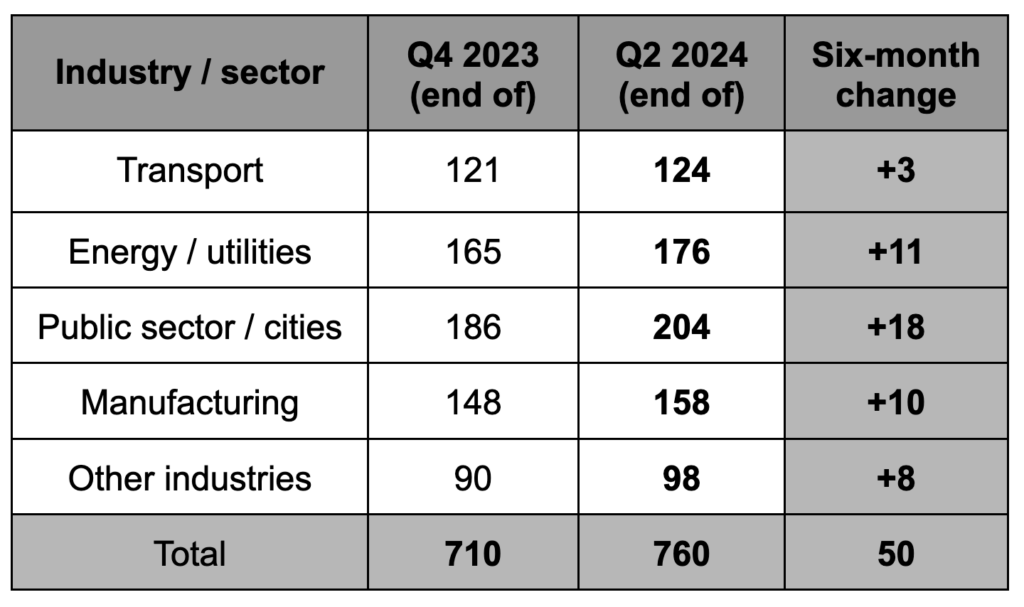
Finnish vendor Nokia has added some colour to its quarterly private 4G/5G enterprise sales, after not saying much at all in its official results announcement last week. The firm added around 30 new enterprise ‘logos’ in the three months to the end of June 30, it said, and 50-odd in the first six months of 2024. As a frame of reference (which is all it is), Ericsson claimed 20 new enterprise customers for private 4G/5G networks last week in the same second-quarter review – meaning, in one sense at least, Nokia outran its Swedish counterpart by about 50 percent in the period. 

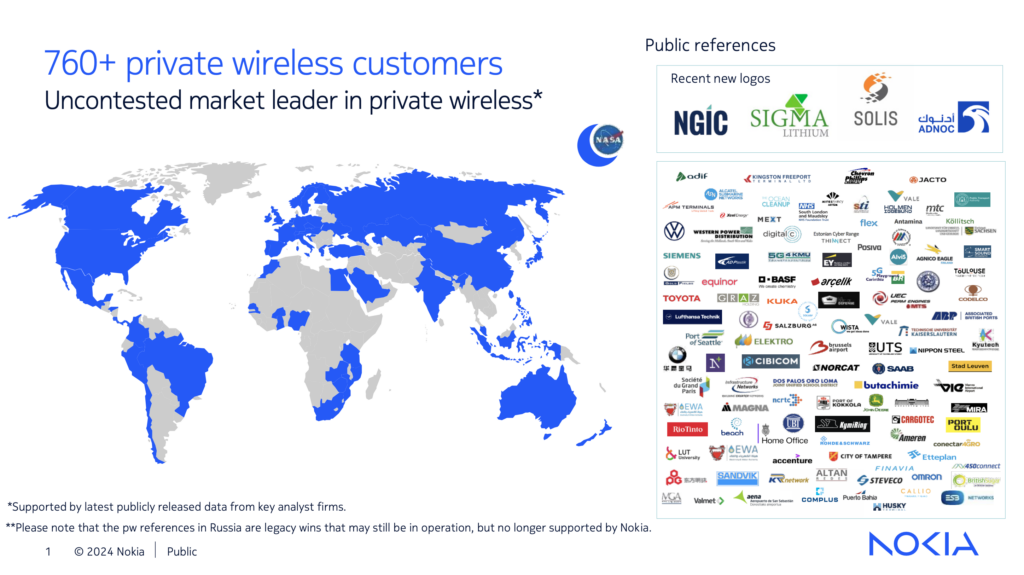
Nokia’s latest additions leave it with around 760 customers, as it stands. Ericsson is trailing in terms of its total customer count and also its run-rate, it seems. But Nokia has been at it for longer than most vendors in the space, including Ericsson – in terms of its strategic intent, product development, enterprise engagement, and channel activity. Nokia claims a 50-odd percent share of GSA’s recorded private 4G/5G installations, as contributed by (certain) members of the vendor community. Ericsson is playing catch-up; but Ericsson is also shaping up, perhaps.
Nokia Q2 PW

There are a few other things to note about the numbers, too – and also to say about this useful, but somewhat forced, Scandi-faceoff. It is understood (but not clear) that both outfits are counting the same way – commercial deployments by customer, by country. This is the metric the GSA uses to chart progress in the market. It means only proper engagements are counted. Proofs and trials are not; neither is repeat business, which covers multi-site expansions with existing customers – whether multiplying client deployments at single sites or to other sites in the same country. 

As such, this logo-count – really a per-country customer count – is not a sure sign of success. Nokia could easily have had a better first quarter in revenue terms when it posted 20 new logos than it did in the second quarter when it recorded 30 – just by selling more networks to fewer customers. Ericsson may even have sold more in the second; such details have not been shared. But this seems unlikely, given their form. The indication from Nokia is that where it matters – on the top line, anyway – its first quarter was very good and its second quarter was pretty good. 

Which bucks the trend, perhaps, if the talk about a seasonal ramp-up through the calendar year is correct, but also possibly follows it exactly if logo-counts rise through the third and fourth quarters. In terms of ‘logos’, anything above 40 would count as a bumper period, it seems. In review, Nokia told RCR Wireless that it was “not a very eventful quarter”, in the end, which largely “aligned” with the same period last year. “Growth remains strong and steady,” it said, also referring to “more multi-site deals” and “signs of increased penetration into smaller sites”.

It shared a couple of slides, including one with an asterisked subheader about its “uncontested leader(ship)” in the market (say “key analyst firms”, it noted), and a quartet of major new public wins in the period. Some of these have been covered in these pages (see here for its deal with mining firm Sigma Lithium in Brazil, and here for its deal with oil company ADNOC in the UAE). But a couple haven’t: contracts with Solis Tower Telecom do Brasil to connect the agricultural industry in Brazil, and with various partners to build a shared nationwide 5G network in Ghana.
Nokia Q2 PW Slide 1
Steady, and still ahead – Nokia’s private 5G quarter in review 9

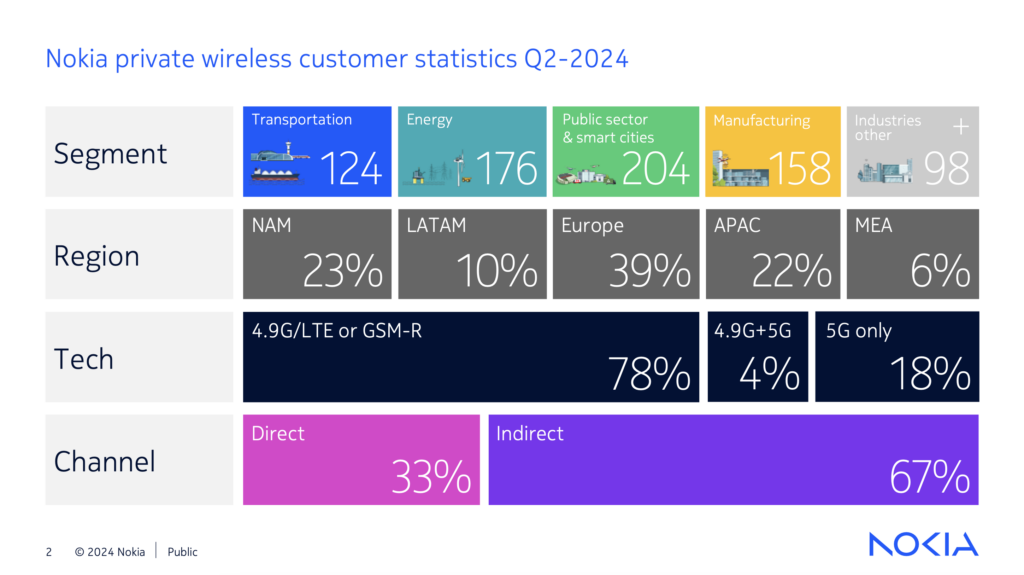
In the end, the whole shakedown clearly requires more data and closer analysis. But what Nokia’s appended quarterlies do show is that it is adding most new-customers in the vast public sector and smart cities space (18 in the quarter), which ranges from quick-fire deployments with schools and universities, where deals are small and quick, to bureaucratic entanglements with national and local government operations, where they are slow, but also big. It also covers the defence, public safety, and healthcare sectors, where they are somewhere in-between.

Besides, Nokia signed 11 new logos in the period in the energy and utilities market, and 10 in the (process and discrete) manufacturing sector; by contrast, new-client sales to the transport and logistics industry, covering mainline and urban railways, plus also airports and shipping ports (and possibly warehousing), look like they fell off a cliff in the quarter (plus three) – although Nokia would likely say the ports industry was a forerunner in the private networks game, and that a handful of operators control the world’s ports, and that it is upselling and cross-selling all the while.

Logic says the same, actually. The other quote from Nokia, in response to questions about its quarterly private 4G/5G sales, is that it did well in the quarter for “more and more bundled sales”. This is, arguably, the biggest plus for the Finnish firm, which has, over the last eight quarters or more, constructed a rather comprehensive looking edge package around its essential (and multi-tiered) edge 4G/5G offer for enterprises. This includes a portfolio of edge computing hardware, specialist devices, industrial applications, and smart interplay with house Wi-Fi systems.
Nokia Q2 PW Slide 2
Steady, and still ahead – Nokia’s private 5G quarter in review 10

This is Nokia’s advantage, it reasons – and an explanation, also, of why periodic logo-additions will count for less and less in the market. That, and because creeping maturity in the market will see integrators and resellers increasingly farm existing business, while the long Industry 4.0 harvest for new clients continues on a slow cycle. It is where – as suggested, on reviewing Ericsson’s quarterlies, and as logic also says – that Ericsson will be required to raise its game. The irony is that, of all its rivals, Ericsson – without much effort, and with rivals faltering (Metaswitch) or integrating (HPE/Athonet), or hardly registering (Samsung, even Huawei outside of China) – remains Nokia’s closest competitor.


You Might Also Like
  • Nokia campus strategy – from private 5G to private AI? (Telco Diary)
  • Nokia hints at new campus-AI strategy, raises questions about its old campus-5G one
  • Private 5G docks in Hamburg – as Deutsche Telekom and Ericsson scratch a seven-year itch
  • VodafoneThree intros tiered 5G SA slicing portfolio for consumers, enterprises, critical services
  • Fighting talk (and team spirit) – Celona preps private 5G/Wi-Fi for AI scramble in Industry 4.0
  • Wednesday (telco diary) | Smells like team spirit – and that tech-bro Musk
Share 0 LinkedinEmail
James Blackman
James Blackman

James Blackman has been writing about the technology and telecoms sectors for over a decade. He has edited and contributed to a number of European news outlets and trade titles. He has also worked at telecoms company Huawei, leading media activity for its devices business in Western Europe. He is based in London.

previous post
Hong Kong regulator opens process to assign new spectrum for 5G
next post
Early adoption of 3GPP Release 18 to drive 5G-Advanced market dominance (Analyst Angle)

White Papers

  • Norton eBook: The 2026 Telco Playbook

  • Enea White Paper: Why Intelligent AAA is the Swiss Army Knife of Telecom

  • CSG White Paper: Telco AI Enabler: Mediation’s Defining Role

  • Enea White Paper: Scalable Database Design for 5G and Beyond

  • Supermicro and NVIDIA Whitepaper: Powering sovereign AI at scale

Editorial Reports

  • Report: Building 6G — Aligning technology, policy and purpose

  • Report: Rethinking the RAN

  • Report: Building AI-Era Network Fabrics

Webinars

  • Appledore Webinar: Closing the Agent-Ready Data Gap for Autonomous Networks

  • Mimosa Webinar – Build the Right Network

  • Webinar: Building 6G — aligning technology, policy and purpose

  • SIMCom Webinar: Scaling your next deployment – from plastic to provisioning

  • Webinar: Rethinking the RAN as AI, cloud and openness converge

Since 1982, RCR Wireless News has been providing wireless and mobile industry news, insights, and analysis to mobile and wireless industry professionals, decision makers, policy makers, analysts and investors.

Facebook Twitter Youtube Linkedin Envelope Rss

Useful Links

  • Subscribe
  • About RCR Wireless News
  • Contact Us
  • Advertise
  • Editorial Calendar
  • Archive
  • RSS
  • Wireless News Archive
  • Subscribe
  • About RCR Wireless News
  • Contact Us
  • Advertise
  • Editorial Calendar
  • Archive
  • RSS
  • Wireless News Archive

Edtior's Picks

American Tower sees European consolidation as growth opportunity
Day one justification – why scaling network APIs requires smaller, faster commercial wins...
Telcos, remember your roots! (Telco Diary)

Latest Articles

American Tower sees European consolidation as growth opportunity
Day one justification – why scaling network APIs requires smaller, faster commercial wins (Reader Forum)
Telcos, remember your roots! (Telco Diary)
Nokia campus strategy – from private 5G to private AI? (Telco Diary)

© 2026 RCR Wireless News All Right Reserved. Developed by Eight Hats.

Cookie Policy | Privacy Policy

RCR Wireless
  • News
  • Channels
    • 5G
    • 6G
    • BSS OSS
    • Carriers
    • IoT
    • Network Infrastructure
    • Open RAN
    • Private 5G
    • Telco AI
    • Telco Cloud
    • Test & Measurement
  • Resources
    • Reports
    • Webinars
    • White papers
    • AI Fundamentals
    • Analyst Angle
    • Editorial Calendar
    • Fundamentals
      • 5G NR Release 17
      • AI
        • Telco AI in 2025
    • Podcasts
      • Let’s Get Digital with Carrie Charles
      • Wireless Connectivity to Enable Industry 4.0 for the Middleprise
      • Well Technically…
      • Will 5G Change the World
      • Accelerating Industry 4.0 Digitalization
  • AI Infrastructure
  • Programs
  • Events
  • RCRtv
  • Advertise
  • Subscribe
RCR Wireless
  • News
  • Channels
    • 5G
    • 6G
    • BSS OSS
    • Carriers
    • IoT
    • Network Infrastructure
    • Open RAN
    • Private 5G
    • Telco AI
    • Telco Cloud
    • Test & Measurement
  • Resources
    • Reports
    • Webinars
    • White papers
    • AI Fundamentals
    • Analyst Angle
    • Editorial Calendar
    • Fundamentals
      • 5G NR Release 17
      • AI
        • Telco AI in 2025
    • Podcasts
      • Let’s Get Digital with Carrie Charles
      • Wireless Connectivity to Enable Industry 4.0 for the Middleprise
      • Well Technically…
      • Will 5G Change the World
      • Accelerating Industry 4.0 Digitalization
  • AI Infrastructure
  • Programs
  • Events
  • RCRtv
  • Advertise
  • Subscribe
@2020 - All Right Reserved. Designed and Developed by PenciDesign