

RCR Wireless
  • News
  • Channels
    • 5G
    • 6G
    • BSS OSS
    • Carriers
    • IoT
    • Network Infrastructure
    • Open RAN
    • Private 5G
    • Telco AI
    • Telco Cloud
    • Test & Measurement
  • Resources
    • Reports
    • Webinars
    • White papers
    • AI Fundamentals
    • Analyst Angle
    • Editorial Calendar
    • Fundamentals
      • 5G NR Release 17
      • AI
        • Telco AI in 2025
    • Podcasts
      • Let’s Get Digital with Carrie Charles
      • Wireless Connectivity to Enable Industry 4.0 for the Middleprise
      • Well Technically…
      • Will 5G Change the World
      • Accelerating Industry 4.0 Digitalization
  • AI Infrastructure
  • Programs
  • Events
  • RCRtv
  • Advertise
  • Subscribe
Sunday, July 12, 2026
RCR Wireless
  • News
  • Channels
    • 5G
    • 6G
    • BSS OSS
    • Carriers
    • IoT
    • Network Infrastructure
    • Open RAN
    • Private 5G
    • Telco AI
    • Telco Cloud
    • Test & Measurement
  • Resources
    • Reports
    • Webinars
    • White papers
    • AI Fundamentals
    • Analyst Angle
    • Editorial Calendar
    • Fundamentals
      • 5G NR Release 17
      • AI
        • Telco AI in 2025
    • Podcasts
      • Let’s Get Digital with Carrie Charles
      • Wireless Connectivity to Enable Industry 4.0 for the Middleprise
      • Well Technically…
      • Will 5G Change the World
      • Accelerating Industry 4.0 Digitalization
  • AI Infrastructure
  • Programs
  • Events
  • RCRtv
  • Advertise
  • Subscribe
Add RCR Wireless as a preferred source on Google
  • Qualcomm 6G Insights
  • Huawei Content Hub
  • Qualcomm – 6G Vision
  • OSS/BSS Channel
  • RCRTech Roundtable: AI Infrastructure
RCR Wireless
RCR Wireless
  • Advanced Mimo
  • Mobile mmWave
  • 5G Positioning
  • Green Networks
  • Metaverse
  • Automotive
  • Industrial and Wide-area IoT
Copyright 2021 - All Right Reserved
Home - Four challenges for in-building public safety communications
FundamentalsFeaturedpublic safety

Four challenges for in-building public safety communications

by Kelly Hill June 10, 2024
written by Kelly Hill June 10, 2024 Share
LinkedinEmail
Share 0LinkedinEmail
safer buildings event
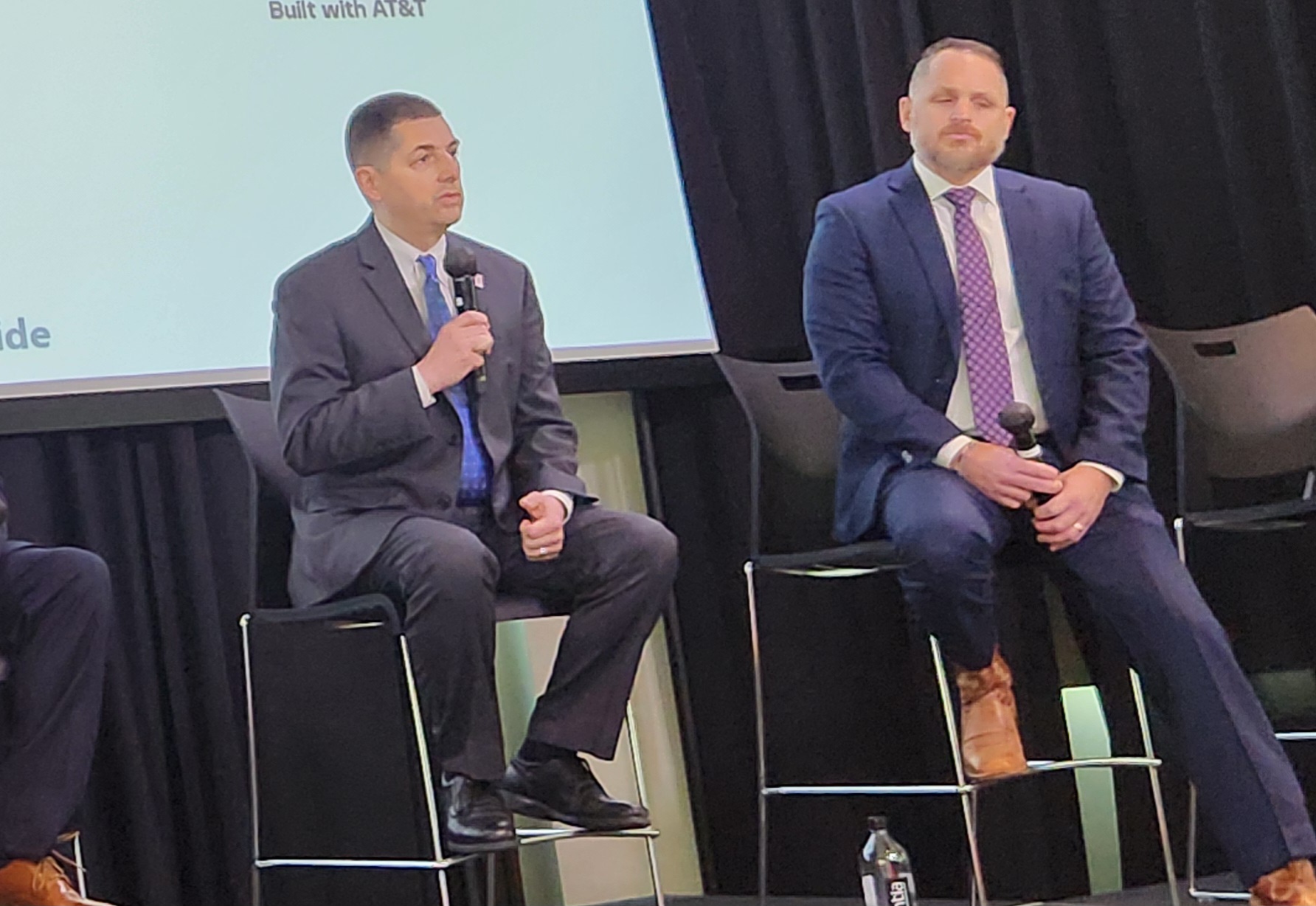
John Chiarmonte, president of Mission Critical Partners (left) and Tim Hay, executive director of the Florida Dept. of Education's Office of Safe Schools, were among the panelists. (Image: RCR Wireless News/K. Hill)
188

WASHINGTON, D.C.—While in-building coverage for cellular and public safety Land Mobile Radio (LMR) systems is a challenge across building use types, it is a particularly urgent one in schools. At last week’s Safer Buildings Coalition Tech and Policy Summit, the issues surrounding first responder communications in school buildings were the front-and-center focus, with Lori Alhadeff, co-founder of the Make Our Schools Safe organization, bringing the matter home by sharing the story of her daughter, Alyssa Alhadeff, who was killed during the 2018 shooting massacre at Marjory Stoneman Douglas High School in Parkland, Florida. Alhadeff and her husband have since been advocating for better school emergency communications through mandating the availability of silent panic buttons in schools, with a number of states adopting or considering “Alyssa’s Law.”

In a panel discussion during the event, some of the many specific challenges facing in-building communications in schools were outlined, including:

-The scale of the problem of wireless and LMR coverage in schools. Most schools are built of materials such as cinder block that block radio frequency signals—cellular, land-mobile radio or otherwise—from effectively penetrating deep inside the buildings, said Chief Alan Perdue, executive director of the Safer Buildings Coalition and a retired fire chief and fire marshal. However, he continued, “Most people aren’t aware that there’s a serious problem. If you talk to school resource officers within the school, they will tell you, our radios don’t work. We see that day in, day out. It’s common,” said Perdue.

-School buildings are often not covered by new fire codes or building standards, which only apply to new construction. So strategies for improving communications coverage that focus on making changes to building or fire codes have limited value in improving the situation for existing buildings that do not have to be brought up to code, and other avenues have to be explored if coverage in those buildings is actually going to be improved.

-When implementing new technology or infrastructure to try to address communication issues in schools, there is also a risk of unintended consequences, panelists agreed, where new technology could conflict or be ineffective in real-world situations if there hasn’t been enough planning or discussion with all of the stakeholders, including local first responder agencies. “It can’t just be a school district wants to do something, they want to comply with an Alyssa’s Law-type piece of legislation, and they acquire a vendor solution and they just expect that it’s going to work. … In many cases, the technology is the easy part. We can install it, we know how to connect wires,” said John Chiarmonte, president of Mission Critical Partners. But there aren’t necessarily official standards for any given safety solution, which may or may not interoperate with other alert systems or give first responders the most useful and relevant data to ensure a fast and appropriate response. New solutions “[have] to be integrated to get the best outcome, the best response,” Chiarmonte said.

-Unfunded mandates also pose an indirect challenge to improving in-building communications for schools, several panelists said. 911 call centers are funded through taxes or fees that often do not fully cover the cost of providing emergency call services, so requiring that new communications features or technology simply be added with no additional funding to make them a reality, ultimately only makes it harder for first responders and public safety telecommunicators to do their jobs effectively.

Still, panelists agreed that between natural disasters, day-to-day issues and frequent mass shootings in schools, it isn’t a matter of “if” a major emergency occurs, it is a question of “when”. And starting conversations with all of the relevant players before legislative mandates come down is part of both making a difference in emergency readiness before a disaster happens and ensuring that if any new school safety mandate does come to fruition, that they can be readily addressed at the local and state levels, said Tim Hay, executive director of the Florida Dept. of Education’s Office of Safe Schools.


You Might Also Like
  • What is AI-RRM in Wi-Fi 7?
  • Why Wi-Fi 7 strengthens Wi-Fi/5G convergence
  • Three reasons 2026 is Wi-Fi 7’s breakout year, according to Cisco
  • What is unequal modulation (UEQM) in Wi-Fi 8?
  • What is VoWiFi — and why are operators still investing in Wi-Fi calling?
  • FR3 explained — why it matters in Release 18
Share 0 LinkedinEmail
Avatar of Kelly Hill
Kelly Hill

Kelly Hill reports on network test and measurement, AI infrastructure and regulatory issues, including spectrum, for RCR Wireless News. She began covering the wireless industry in 2005, focusing on carriers and MVNOs, then took a few years’ hiatus and returned to RCR Wireless News to write about heterogeneous networks (remember those?) and network infrastructure. Kelly is an Ohio native with a masters degree in journalism from the University of California, Berkeley, where she focused on science writing and multimedia. She has written for the San Francisco Chronicle, The Oregonian and The Canton Repository. She lives in northern Virginia, not far from Data Center Alley.

previous post
Three telecom training initiatives focused on fiber
next post
‘It’s all about speed’—Georgia-Pacific on gen AI at the industrial edge

White Papers

  • Enea White Paper: Why Intelligent AAA is the Swiss Army Knife of Telecom

  • CSG White Paper: Telco AI Enabler: Mediation’s Defining Role

  • Enea White Paper: Scalable Database Design for 5G and Beyond

  • Supermicro and NVIDIA Whitepaper: Powering sovereign AI at scale

  • VIAVI Whitepaper: RAN scenario generators and their critical role for future-proofing AI-native RAN in Advanced 5G and 6G networks

Editorial Reports

  • Report: Scaling Optical Networks For The Hyperscale And AI Era

  • Test And Measurement Market Pulse Report

  • Editorial Report: Securing telecom infrastructure for the quantum era

Webinars

  • Webinar: Building 6G — aligning technology, policy and purpose

  • SIMCom Webinar: Scaling your next deployment – from plastic to provisioning

  • Webinar: Rethinking the RAN as AI, cloud and openness converge

  • Webinar: Scale-Up, Scale-Out, Scale-Across – Building AI-Era Network Fabrics

  • Webinar: NTN in motion – evolving standards, expanding services

Since 1982, RCR Wireless News has been providing wireless and mobile industry news, insights, and analysis to mobile and wireless industry professionals, decision makers, policy makers, analysts and investors.

Facebook Twitter Youtube Linkedin Envelope Rss

Useful Links

  • Subscribe
  • About RCR Wireless News
  • Contact Us
  • Advertise
  • Editorial Calendar
  • Archive
  • RSS
  • Wireless News Archive
  • Subscribe
  • About RCR Wireless News
  • Contact Us
  • Advertise
  • Editorial Calendar
  • Archive
  • RSS
  • Wireless News Archive

Edtior's Picks

Webinar: Building 6G — aligning technology, policy and purpose
Vodafone at the heart of Euro telco reset as Iliad owner buys e&...
How operations leaders see 5G as vital for mission-critical workflows (Reader Forum)

Latest Articles

Webinar: Building 6G — aligning technology, policy and purpose
Vodafone at the heart of Euro telco reset as Iliad owner buys e& stake for $5.9bn
How operations leaders see 5G as vital for mission-critical workflows (Reader Forum)
Thursday (telco diary) | The plumbing is the product

© 2026 RCR Wireless News All Right Reserved. Developed by Eight Hats.

Cookie Policy | Privacy Policy

RCR Wireless
  • News
  • Channels
    • 5G
    • 6G
    • BSS OSS
    • Carriers
    • IoT
    • Network Infrastructure
    • Open RAN
    • Private 5G
    • Telco AI
    • Telco Cloud
    • Test & Measurement
  • Resources
    • Reports
    • Webinars
    • White papers
    • AI Fundamentals
    • Analyst Angle
    • Editorial Calendar
    • Fundamentals
      • 5G NR Release 17
      • AI
        • Telco AI in 2025
    • Podcasts
      • Let’s Get Digital with Carrie Charles
      • Wireless Connectivity to Enable Industry 4.0 for the Middleprise
      • Well Technically…
      • Will 5G Change the World
      • Accelerating Industry 4.0 Digitalization
  • AI Infrastructure
  • Programs
  • Events
  • RCRtv
  • Advertise
  • Subscribe
RCR Wireless
  • News
  • Channels
    • 5G
    • 6G
    • BSS OSS
    • Carriers
    • IoT
    • Network Infrastructure
    • Open RAN
    • Private 5G
    • Telco AI
    • Telco Cloud
    • Test & Measurement
  • Resources
    • Reports
    • Webinars
    • White papers
    • AI Fundamentals
    • Analyst Angle
    • Editorial Calendar
    • Fundamentals
      • 5G NR Release 17
      • AI
        • Telco AI in 2025
    • Podcasts
      • Let’s Get Digital with Carrie Charles
      • Wireless Connectivity to Enable Industry 4.0 for the Middleprise
      • Well Technically…
      • Will 5G Change the World
      • Accelerating Industry 4.0 Digitalization
  • AI Infrastructure
  • Programs
  • Events
  • RCRtv
  • Advertise
  • Subscribe
@2020 - All Right Reserved. Designed and Developed by PenciDesign