

Wi-Fi 7 introduces the concept of priority channels and the ability to schedule traffic
The Wi-Fi Alliance is expected to certify the Wi-Fi 7 (or 802.11be) standard sometime around the end of 2023 or the beginning of 2024. However, despite its yet-to-be-certified status, the latest generation of Wi-Fi is off to a strong start, with a handful of compatible products already on the market, including several handsets and access points (APs).
A recent Wireless Broadband Alliance (WBA) report revealed that Wi-Fi 6, 6E and 7 will be among the top technology priorities for network operators, ISPs, device and chipset vendors, enterprises and others in 2024, beating out other contenders including CBRS, DAS and even private networks. Specifically, more than 41% of respondents said they plan to deploy Wi-Fi 7 by the end of 2024, up from the 33% that said the same one year ago.
The report also found that confidence in Wi-Fi investment is on rise, with 58% of respondents saying they are more confident in investing in the technology, compared to 46% last year. Two-thirds also stated that 6 GHz spectrum availability is an important issue for 2024.
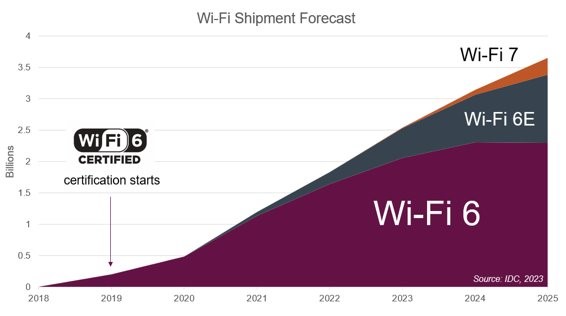
“While only accounting for .4% of Wi-Fi device shipments this year, Wi-Fi 7 will begin seeing broader technology adoption aligned with Wi-Fi Alliance certification availability, which typically serves as an inflection point in the industry,” stated the Wi-Fi Alliance. “Wi-Fi 7 delivers advanced experiences using 2.4 and 5 GHz spectrum that is globally available today, and countries opening the full 6 GHz band to Wi-Fi will benefit from the maximum potential of Wi-Fi 7.”
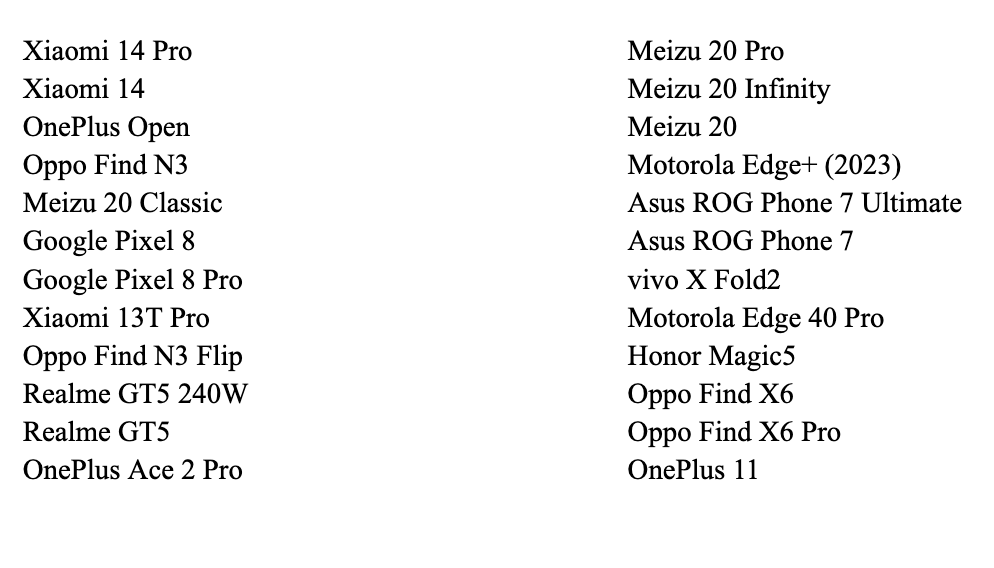
Wi-Fi 7 handsets (as of October 2023)
Making Wi-Fi ‘deployable’ again
“The sexy features of Wi-Fi 7 are the wide channels, the fast data rates, the namesake extremely high throughput,” said Adam Smith, LitePoint’s director of marketing. “But for me, what is really exciting about Wi-Fi 7 is that it’s taking the cool ideas introduced in Wi-Fi 6 and making them easier to deploy, or feasible to deploy at all.”
What he means by this is that the introduction of Wi-Fi 6’s multi-user functionality presented a bigger challenge than the industry expected. “Peaceful coexistence between Wi-Fi 5 and Wi-Fi 6 is kind of a joke right now,” Smith told RCR Wireless News previously, arguing that in order for a device to be use in a multi-user fashion, it has to be a Wi-Fi 6 device, meaning Wi-Fi 5 or earlier devices will always be single user. “If you’re trying to lay a Wi-Fi 6 network on top of it, you either need to rip-and-replace or you need to somehow figure out how to coexist,” he added.
Several standards for Wi-Fi 7, however, will directly address the multi-user challenges of Wi-Fi 6. While Wi-Fi 7 boasts a number of notable features like support of both 320 MHz transmissions — double the 160 MHz of Wi-Fi 6 — and 4096-QAM, which delivers significant speed increases, one of its most exciting features, and the one that most delivers reliability, might be Multi-Link Operation (MLO). With MLO, a device connected in the 5 GHz band that is suffering from degraded performance due to another device popping up on the network will automatically — and very quickly — switch over to the 6 GHz band. In this way, Wi-Fi 7 will actually enable the promised multi-user capabilities first outlined in Wi-Fi 6 standards.
“Wi-Fi 7 is making Wi-Fi deployable again because Wi-Fi 6 broke it,” Smith quipped.
MLO also better positions Wi-Fi 7 as an IoT technology — for both enterprise and residential environments — because it is more than a speed feature; it delivers redundancy and low-latency capabilities by enabling the concept of priority channels and the ability to schedule traffic.
Wi-Fi 6 to 7: ‘An evolution from throughput to deterministic throughput’
Wi-Fi 7 being about more than throughput and speed was a common thread throughout RCR Wireless News’ conversations. Steve Shearer, chief scientist at Spirent Communications, for instance, said that for enterprises and end users, “throughput is not the major consideration; it’s reliability… Having more spectrum available is really an important thing.”
He further noted that while 320 megahertz is an impressively wide swath of spectrum, most applications won’t need such a wide channel. Instead, users want guaranteed low latency, meaning that more than anything, they want to prevent interference. “You’ve now got 6 GHz, where you have effectively multiple 20-megahertz channels that you can choose from, so choose one where there is nobody else operating,” he said. “It’s sort of a reverse way to look at it because everyone talks about 320 megahertz, but for many applications probably a clean 20-megahertz channel is a blessing.”
As Broadcom’s Director of Product Marketing Chris Szymanski explained it, Wi-Fi 7 can be thought of as an “evolution from getting throughput to reliable, latency sensitive deterministic throughput.” The combination of 320-megahertz channels and MLO, he continued, enables the ability to schedule traffic, making it suitable for homes with several connected devices running at once. And it’s this that matters, not ensuring that a single application has a full 320-megahertz channel in which to operate. “It’s really just providing reliable, almost integrated wireless broadband,” he summarized.
Because of this, service providers are moving away from an emphasis on speed in their marketing campaigns. According to Kevin Narimatsu, Broadcom’s associate director of product marketing, carriers no longer boast about gigabit Wi-Fi speeds and faster WAN speeds, and instead focus on messaging around full Wi-Fi coverage with the promise of delivering “a gigabit in every corner of your house.”
“We are hearing that there is a true cost benefit there in the sense that if the Wi-Fi is stable within their customer base, they get lower churn,” he added. “MLO can drive a better user experience.” In residential mesh network deployments, for example, MLO provides redundancy in the backhaul “automatically.”
“Historically, in the backhaul you would either have to dedicate one band or share a band, whereas here you get the best of both worlds; you can have two bands in the backhaul and use whichever one is available,” Narimatsu explained.
Wi-Fi 7’s high reliability in terms of throughput but also latency makes it more suitable for the most demanding applications in the enterprise space as well. Enterprise applications — which are already challenging because of the density of APs, number of users and diversity of applications — will become even more complex as they continue to add AR/VR, IoT and IIoT applications to their workflows, all of which require deterministic latency, high reliability and quality of service (QoS).
“Most of the Wi-Fi 7 advantages that are specific to the standard and not 6 GHz are related to MLO,” said Broadcom’s Director of Product Marketing for Enterprise Wireless Communications and Connectivity Mike Powell, explaining that this feature offers two “big things” from an enterprise perspective: overall latency reduction and enhanced efficiency.
“By bringing 6 GHz onto an AP, they’ve added a ton of additional spectrum, which also tends to mean more channels and wider channels for more bandwidth. But the bigger pieces is that they’ve got more spectrum on a per location basis. By having MLO where you can rapidly switch between these different links, it means the overfall channel capacity can be utilized much better — that’s the big use case,” said Powell.
Table of Contents

