

RCR Wireless
  • News
  • Channels
    • 5G
    • 6G
    • BSS OSS
    • Carriers
    • IoT
    • Network Infrastructure
    • Open RAN
    • Private 5G
    • Telco AI
    • Telco Cloud
    • Test & Measurement
  • Resources
    • Reports
    • Webinars
    • White papers
    • AI Fundamentals
    • Analyst Angle
    • Editorial Calendar
    • Fundamentals
      • 5G NR Release 17
      • AI
        • Telco AI in 2025
    • Podcasts
      • Let’s Get Digital with Carrie Charles
      • Wireless Connectivity to Enable Industry 4.0 for the Middleprise
      • Well Technically…
      • Will 5G Change the World
      • Accelerating Industry 4.0 Digitalization
  • AI Infrastructure
  • Programs
  • Events
  • RCRtv
  • Advertise
  • Subscribe
Sunday, July 26, 2026
RCR Wireless
  • News
  • Channels
    • 5G
    • 6G
    • BSS OSS
    • Carriers
    • IoT
    • Network Infrastructure
    • Open RAN
    • Private 5G
    • Telco AI
    • Telco Cloud
    • Test & Measurement
  • Resources
    • Reports
    • Webinars
    • White papers
    • AI Fundamentals
    • Analyst Angle
    • Editorial Calendar
    • Fundamentals
      • 5G NR Release 17
      • AI
        • Telco AI in 2025
    • Podcasts
      • Let’s Get Digital with Carrie Charles
      • Wireless Connectivity to Enable Industry 4.0 for the Middleprise
      • Well Technically…
      • Will 5G Change the World
      • Accelerating Industry 4.0 Digitalization
  • AI Infrastructure
  • Programs
  • Events
  • RCRtv
  • Advertise
  • Subscribe
Add RCR Wireless as a preferred source on Google
  • Qualcomm 6G Insights
  • Huawei Content Hub
  • Qualcomm – 6G Vision
  • OSS/BSS Channel
  • RCRTech Roundtable: AI Infrastructure
RCR Wireless
RCR Wireless
  • Advanced Mimo
  • Mobile mmWave
  • 5G Positioning
  • Green Networks
  • Metaverse
  • Automotive
  • Industrial and Wide-area IoT
Copyright 2021 - All Right Reserved
Home - Careful or care-free – BT and Vodafone split the difference over generative AI
Telco Cloud5GCarriersIndustry 4.0

Careful or care-free – BT and Vodafone split the difference over generative AI

by James Blackman September 20, 2023
written by James Blackman September 20, 2023 Share
LinkedinEmail
Share 0LinkedinEmail
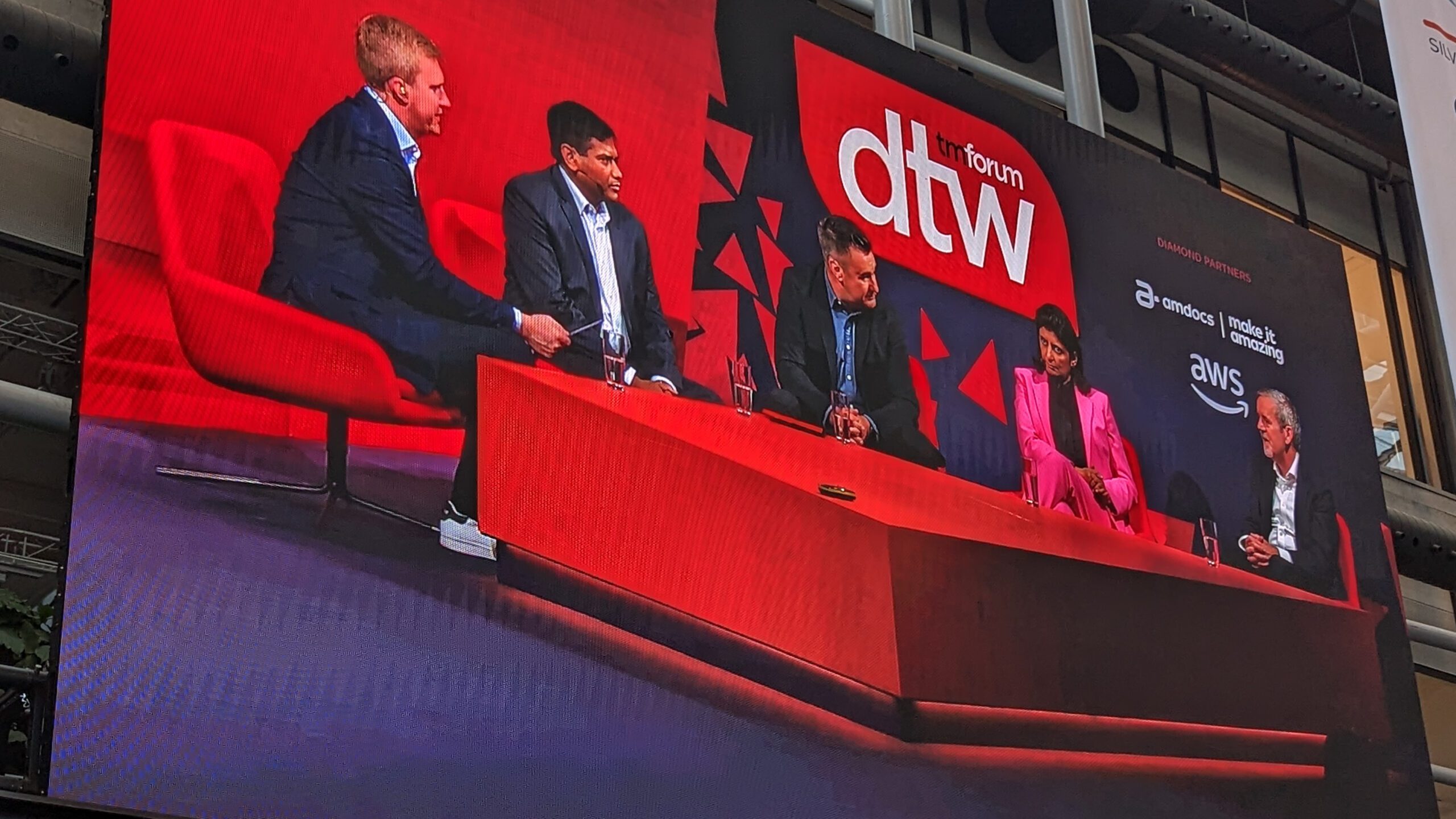
Front row seat -- in front of the big screen at DTW23, outside of the (packed) main auditorium
157

A good panel session at Digital Transformation World in Copenhagen yesterday (September 19), rounding out the first early-morning keynotes, saw chief digital and technology officers from BT and Vodafone, plus others, variously discuss the rise of generative artificial intelligence (AI) within telecoms. In particular, the exchanges between the two UK operators about the cultural approach to AI experimentation were (almost) spicy, with the former suggesting operators just have to get stuck in and the latter suggesting some institutional care is required. 

At least, it sounded like disagreement; their messages were actually similar, perhaps just reflective of the positions and remits of the two speakers. Harmeen Mehta, chief digital and information officer at BT Group, had just issued a 20-minute call-to-arms in a solo slot on the main stage, urging telcos to “reimagine the world” and “reimagine your organisation” (to “leap forward [and]… dare to dream”). She continued in the panel where she’d left off before. “Allow yourself to reimagine, rethink – really just throw something at it and see what it does,” she said.

By contrast, Scott Petty, in charge of the whole technology estate (as chief technology officer) at Vodafone Group, was more pragmatic, if no less enthusiastic, about the potential of generative AI. He responded to a question about how to manage the risk associated with AI in telecoms data, and suggested, effectively, there is enough low-hanging fruit for operations teams to harvest with new AI tools currently to leave the higher-risk pickings for internal councils and committees to debate in the meantime. “Focus on those,” he said. 

“There are so many places that you can apply AI where the risk is really low, which can generate immense value. There are areas we [also] have to be careful about. Explainability is really important if you’re going to make decisions that impact people. We have to be clear that those models are working… It’s not about being negative or slowing down. There’s so much opportunity… [There will be] far more demand than you can execute on. But let’s not ignore the risks either… We need to… build them into our frameworks. But that doesn’t mean stop; it just means focus.” 

There was further tension, of sorts. Mehta’s digital unit within BT was originally tasked with creating £500 million in annual cost savings by shifting to the public cloud and deploying AI tools in various functions, plus other internal digital-change gambits; the business said in May it will slash 55,000 jobs – about 40 percent of its workforce – by 2030, with around 10,000 likely be replaced by AI, notably in customer and network management. In Copenhagen, Mehta said the £500 million target was in-hand, and will be extended to £1 billion at least in new savings and gains.

“A billion is what we’re seeing and, in the next few months, our job is to unlock it,” she said. But Petty, whose employer announced equivalent job cuts the same month (but never mentioned AI), of 11,000 across its operations by 2030, argued for a change of focus. “If you’re talking about cost, you’re talking about the wrong thing, and you end up in a very uncomfortable place. We are really talking about velocity. IT is the bottleneck in every telco [and] there is far more demand for new capabilities than we can deliver. Generative AI can unlock that velocity.”

Petty went on: “The second big benefit is quality… [which translates into] the number of incidents, the mean-time for repairs, the customer experience… If you end up in a cost-play, you will find you are totally outsourced… If you’re talking cap-ex and op-ex – in technology as a whole – then you’re using the wrong language. It’s got to be about the value, and the pace you’re delivering it… Which is what drove us to in-source 7,000 software engineers. It wasn’t just about cost… but [about] the quality and the speed, compared with third parties. The dialogue has to change.”

Mehta acknowledged, as well, that operators cannot “cut their way to growth”.

Actually, all of the generative AI use cases referenced by BT and Vodafone at Digital Transformation World, are fairly run-of-the-mill – in terms of their reach within their telecoms operations, if not their impact on their businesses. Mehta talked about a new Sweeper application, just six weeks old, which helps Openreach engineers optimise fibre rollout, which is already realising £20 million in efficiencies for the business. She suggested another example, a little regressive sounding, to use AI to somehow culturally match call centre staff to their customer locales.

Petty at Vodafone offered up a couple as well, mentioned in the group’s tech day with journalists a couple of months back, including usage of AI to remove 120-odd OSS tools in its backend systems, and reduce major incidents in its UK network by 50 percent, plus examples of AI in customer services to more accurately summarise chatbot interactions and recommend products and services. Petty made the point that its foundational AI models are imperfect, but also helpful for call agents – and that a “human co-pilot” is required in the mix. 

Mehta noted that the “workforce will change”. She said: “You are still going to need sales, but if they can’t work with AI, then it is a worry. You need a different kind of sales. It is an opportunity to upskill.” BT has hired a bunch of engineering graduates for whom “life had gotten in the way” on a “year-long experiment” at a shop in Belfast, she said, and handed them a low-code platform and let them loose. “Six months in and we are hiring all of them,” she said, also suggesting that, if Covid-19 should teach us anything, it is that “people and culture” are underestimated. 

“The amazing thing about people is we tend to adapt quickly… No business school ever told us we would have to run entire organisations from home,” she said. In the same spirit, she warned against conservatism. “We are at a tipping point for the AI revolution. Blink and you’ll miss it – because it has already started,” she said in her solo address. Discussing use cases during the panel, she said: “Certain use cases… are very obvious – for AI ops, or resolution of customer queries. Absolutely, they are no-brainers… But beyond that, allow yourself to reimagine, rethink.” 

Throw it at the wall, and see what sticks, the message went – and you might just be surprised by the results, often enough, to keep at it. “Even if it has 20 percent accuracy, that 20 percent augments the 70 percent [human accuracy]. So there is never a wrong answer. And even if you discover that, oops, it misunderstood something, well humans misunderstand all the time and learn from that,” said Mehta. As per the climb-down at the start, there was a little tension, perhaps, but the conclusion was broadly the same. “It is going to be big,” rejoined Petty.


You Might Also Like
  • Huawei sees Mobile AI driving new wave of uplink network investment
  • Spectrum supercycle – US opens floodgates; UK shares it out
  • Thursday (telco diary) | Telco pieces in the AI jigsaw
  • The Agentic Network — Rakuten Mobile on turning data into outcomes
  • Wednesday (telco diary) | What AT&T and Lumen tell us about the AI fiber build-out
  • South Korea launches AI-RAN project to advance industrial AI
Share 0 LinkedinEmail
James Blackman
James Blackman

James Blackman has been writing about the technology and telecoms sectors for over a decade. He has edited and contributed to a number of European news outlets and trade titles. He has also worked at telecoms company Huawei, leading media activity for its devices business in Western Europe. He is based in London.

previous post
The Role of Cloud and Generative AI in the Telco Industry with Ishwar Parulkar of Amazon Web Services (AWS)
next post
TotalEnergies taps Unabiz for Sigfox IoT sensors in service stations in Europe, Africa

White Papers

  • Norton eBook: The 2026 Telco Playbook

  • Enea White Paper: Why Intelligent AAA is the Swiss Army Knife of Telecom

  • CSG White Paper: Telco AI Enabler: Mediation’s Defining Role

  • Enea White Paper: Scalable Database Design for 5G and Beyond

  • Supermicro and NVIDIA Whitepaper: Powering sovereign AI at scale

Editorial Reports

  • Market Pulse Report: Telco AI in 2026 – Trends, Challenges and Opportunities

  • Nvidia Report: The State of AI in Telecommunications: 2026 Trends

  • Report: Scaling Optical Networks For The Hyperscale And AI Era

Webinars

  • Webinar: Building 6G — aligning technology, policy and purpose

  • SIMCom Webinar: Scaling your next deployment – from plastic to provisioning

  • Webinar: Rethinking the RAN as AI, cloud and openness converge

  • Webinar: Scale-Up, Scale-Out, Scale-Across – Building AI-Era Network Fabrics

  • Webinar: NTN in motion – evolving standards, expanding services

Since 1982, RCR Wireless News has been providing wireless and mobile industry news, insights, and analysis to mobile and wireless industry professionals, decision makers, policy makers, analysts and investors.

Facebook Twitter Youtube Linkedin Envelope Rss

Useful Links

  • Subscribe
  • About RCR Wireless News
  • Contact Us
  • Advertise
  • Editorial Calendar
  • Archive
  • RSS
  • Wireless News Archive
  • Subscribe
  • About RCR Wireless News
  • Contact Us
  • Advertise
  • Editorial Calendar
  • Archive
  • RSS
  • Wireless News Archive

Edtior's Picks

AT&T says its network is already built for the agentic AI wave
AT&T and Ericsson use network sensing to spot drones with ordinary 5G towers
Huawei sees Mobile AI driving new wave of uplink network investment

Latest Articles

AT&T says its network is already built for the agentic AI wave
AT&T and Ericsson use network sensing to spot drones with ordinary 5G towers
Huawei sees Mobile AI driving new wave of uplink network investment
Spectrum supercycle – US opens floodgates; UK shares it out

© 2026 RCR Wireless News All Right Reserved. Developed by Eight Hats.

Cookie Policy | Privacy Policy

RCR Wireless
  • News
  • Channels
    • 5G
    • 6G
    • BSS OSS
    • Carriers
    • IoT
    • Network Infrastructure
    • Open RAN
    • Private 5G
    • Telco AI
    • Telco Cloud
    • Test & Measurement
  • Resources
    • Reports
    • Webinars
    • White papers
    • AI Fundamentals
    • Analyst Angle
    • Editorial Calendar
    • Fundamentals
      • 5G NR Release 17
      • AI
        • Telco AI in 2025
    • Podcasts
      • Let’s Get Digital with Carrie Charles
      • Wireless Connectivity to Enable Industry 4.0 for the Middleprise
      • Well Technically…
      • Will 5G Change the World
      • Accelerating Industry 4.0 Digitalization
  • AI Infrastructure
  • Programs
  • Events
  • RCRtv
  • Advertise
  • Subscribe
RCR Wireless
  • News
  • Channels
    • 5G
    • 6G
    • BSS OSS
    • Carriers
    • IoT
    • Network Infrastructure
    • Open RAN
    • Private 5G
    • Telco AI
    • Telco Cloud
    • Test & Measurement
  • Resources
    • Reports
    • Webinars
    • White papers
    • AI Fundamentals
    • Analyst Angle
    • Editorial Calendar
    • Fundamentals
      • 5G NR Release 17
      • AI
        • Telco AI in 2025
    • Podcasts
      • Let’s Get Digital with Carrie Charles
      • Wireless Connectivity to Enable Industry 4.0 for the Middleprise
      • Well Technically…
      • Will 5G Change the World
      • Accelerating Industry 4.0 Digitalization
  • AI Infrastructure
  • Programs
  • Events
  • RCRtv
  • Advertise
  • Subscribe
@2020 - All Right Reserved. Designed and Developed by PenciDesign