


RCR Wireless
  • News
  • Channels
    • 5G
    • 6G
    • BSS OSS
    • Carriers
    • IoT
    • Network Infrastructure
    • Open RAN
    • Private 5G
    • Telco AI
    • Telco Cloud
    • Test & Measurement
  • Resources
    • Reports
    • Webinars
    • White papers
    • AI Fundamentals
    • Analyst Angle
    • Editorial Calendar
    • Fundamentals
      • 5G NR Release 17
      • AI
        • Telco AI in 2025
    • Podcasts
      • Let’s Get Digital with Carrie Charles
      • Wireless Connectivity to Enable Industry 4.0 for the Middleprise
      • Well Technically…
      • Will 5G Change the World
      • Accelerating Industry 4.0 Digitalization
  • AI Infrastructure
  • Programs
  • Events
  • RCRtv
  • Advertise
  • Subscribe
Saturday, July 18, 2026
RCR Wireless
  • News
  • Channels
    • 5G
    • 6G
    • BSS OSS
    • Carriers
    • IoT
    • Network Infrastructure
    • Open RAN
    • Private 5G
    • Telco AI
    • Telco Cloud
    • Test & Measurement
  • Resources
    • Reports
    • Webinars
    • White papers
    • AI Fundamentals
    • Analyst Angle
    • Editorial Calendar
    • Fundamentals
      • 5G NR Release 17
      • AI
        • Telco AI in 2025
    • Podcasts
      • Let’s Get Digital with Carrie Charles
      • Wireless Connectivity to Enable Industry 4.0 for the Middleprise
      • Well Technically…
      • Will 5G Change the World
      • Accelerating Industry 4.0 Digitalization
  • AI Infrastructure
  • Programs
  • Events
  • RCRtv
  • Advertise
  • Subscribe
Add RCR Wireless as a preferred source on Google
  • Qualcomm 6G Insights
  • Huawei Content Hub
  • Qualcomm – 6G Vision
  • OSS/BSS Channel
  • RCRTech Roundtable: AI Infrastructure
RCR Wireless
RCR Wireless
  • Advanced Mimo
  • Mobile mmWave
  • 5G Positioning
  • Green Networks
  • Metaverse
  • Automotive
  • Industrial and Wide-area IoT
Copyright 2021 - All Right Reserved
Home - Dedicated AI hardware is the route to optimized performance, enhanced user experience (Analyst Angle)
Analyst AngleAI-Machine-Learning

Dedicated AI hardware is the route to optimized performance, enhanced user experience (Analyst Angle)

by David McQueen, ABI Research July 26, 2023
written by David McQueen, ABI Research July 26, 2023 Share
LinkedinEmail
Share 0LinkedinEmail
nuclear InvestAI
167

The cellular radio system for mobile devices has seen a substantial transformation over the past few years from one that is based on individual component assembly to a complete, modem-to-antenna, Radio Frequency (RF) system design. The latest wave of development has brought Artificial Intelligence (AI)-assisted capabilities at the radio system level to boost performance, improve the user experience, enhance the efficiency of wireless communications and enable new use cases.

Under such an environment, using AI enables improvements and enhancements in optimization and accuracy, while also reducing power consumption. When used in tandem with 5G, their complementary strengths help create optimal solutions and accelerate wireless innovations that can improve wireless communications challenges. The end device user experience is also enhanced with AI mainly thanks to higher system throughput, while improving overall spectral efficiency.

Part of the rationale behind adding AI to the radio system is providing additional help to combat the rapidly changing and challenging physical environment in which 5G devices are used, such as dealing with new multiple frequencies, handling new foldable device form factors and coping with nearby interferences. Specifically, power management can be improved, while other benefits derived from adding AI include improved system performance and better radio security, creating more opportunities for higher and more precise connectivity and enhancing reliability of the connection to improve the user experience.

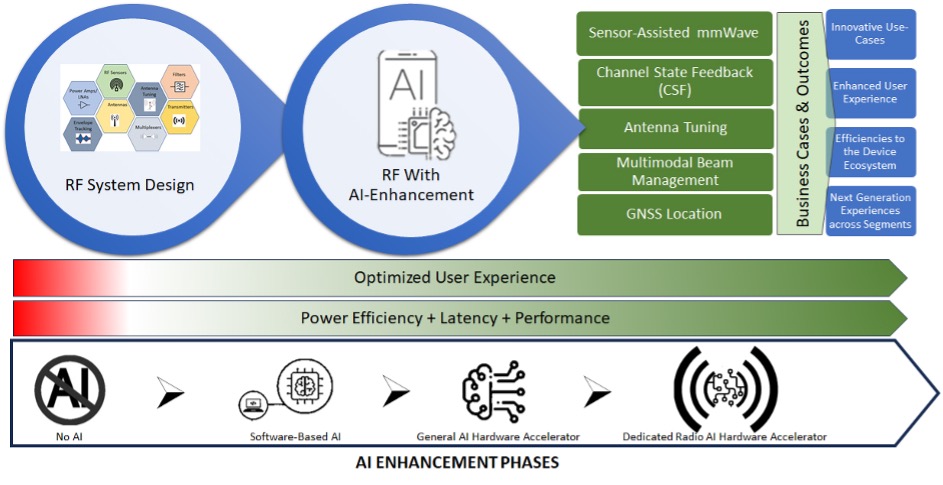
The AI enhancement of the radio system is manifest through several phases with each successive implementation providing better attributes and features to improve overall performance and connectivity. Initially, software-based AI allowed for a more optimized user experience to achieve better speeds, coverage, mobility, link robustness and location accuracy, while improving power efficiency and performance. Such an approach, however, has meant that it must share resources with other features on the Central Processing Unit (CPU), so it does not perform optimally for the radio system.

Figure 1: AI Evolution in the Radio System
Picture1
Credit: ABI Reserch

The next phase of AI enhancement is to introduce centralized AI hardware accelerators, which is an improvement on software-based solutions in terms of performance and efficiencies, but it is a compromise phase that again shares hardware resources with other functions. A more essential step further is the provision of dedicated radio AI hardware accelerators. This approach not only adds better user experiences, power and performance than its predecessors, while also enabling superior 5G performance, but it allows for a number of other key applications as follows:

  • Sensor-Assisted Millimeter Wave (mmWave) Beam Management: For superior connectivity reliability improving mmWave connection robustness and data speeds and AI-based location accuracy enhancements.
  • Channel State Feedback (CSF): Uses AI to predict channel state feedback and connects the smartphone with the base station, using the most suitable RF channels. Plays an important role in the improvement of link performance in current wireless communication systems, notably 5G.
  • AI-Enhanced Antenna Tuning: Leverages AI-based antenna tuning and beamforming to improve coverage and link robustness, helping reach higher average throughput speeds and reducing device power consumption.
  • Global Navigation Satellite System (GNSS) Tracking Accuracy Enhancements: Offers AI-enhanced precise positioning even for locations with lower Global Positioning System (GPS) coverage.

Applying AI to the wireless radio system and adding innovations, such as hardware accelerated AI, still has its challenges and is very much in its infancy, but it holds undoubted benefits and promise for the wireless arena.  While any level of AI enhancement can bring these efficiencies, it is the provision of dedicated AI hardware that brings greater performance, more focus, accuracy, precision and power for operating AI on-device. Notably, taking this approach allows for advancement in business cases and outcomes, including:

  • Enables innovative new use cases.
  • Enhances the user experience.
  • Improves efficiencies in the device ecosystem.
  • Provides next-generation experiences across segments, including smartphones, mobile broadband, automotive, compute, Industrial Internet of Things (IIoT) and fixed wireless.

Several companies and organizations have been researching the use of AI in the radio system, including Qualcomm Technologies, MediaTek and Intel, as well as the OpenRF industry consortium. Specifically, Qualcomm Technologies has been at the forefront of AI-assisted radio systems and was the first to launch AI-based solutions, including the Snapdragon X70 5G Modem-RF System with a dedicated AI processor. In an industry first, the company has since added to its solutions with the Snapdragon X75 Modem-RF System, which includes a dedicated AI (tensor) hardware accelerator and features the Qualcomm 5G AI Processor Gen 2 and Qualcomm 5G AI Suite Gen 2. Designed for superior 5G and location performance, the upgrade enables improved AI performance by more than 2.5X compared to Gen 1 and provides innovations, such as the world’s first sensor-assisted, AI-based mmWave beam management technology and AI-enhanced GNSS Location Gen2 for precise positioning.

As iterations and more use cases will be added to the Qualcomm lineup, evolving AI-enhanced RF systems further, this will likely be buoyed by emerging products from the likes of MediaTek and Intel, while also taking the experience across segments. Moreover, as the market continues its shift to 5G and beyond, the importance of connectivity becomes ever more vital, with the addition of AI promising opportunities for higher and more precise connectivity. Entrenching AI in the RF design should, therefore, become a de facto-development phase if the industry is to enable optimized user experiences, unlock new use cases and make significant improvements to 5G performance.


You Might Also Like
  • Netgear’s quiet reinvention as a B2B and SaaS company (Analyst Angle)
  • Fifteen years on, how did that 1,000x mobile broadband forecast fare? (Analyst Angle)
  • Elisa says AI automation has cut network incidents by over 80%
  • Why consolidation will reshape MDU connectivity (part 3/3) – Analyst Angle
  • Why consolidation will reshape MDU connectivity (part 2/3) – Analyst Angle
  • Consolidation is reshaping MDU connectivity (part 1/3) – Analyst Angle
Share 0 LinkedinEmail
Avatar of ABI Research
David McQueen, ABI Research

previous post
America Movil increases ownership in Telekom Austria
next post
AT&T Q2 results show net profit growth, despite slowing sub adds

White Papers

  • Norton eBook: The 2026 Telco Playbook

  • Enea White Paper: Why Intelligent AAA is the Swiss Army Knife of Telecom

  • CSG White Paper: Telco AI Enabler: Mediation’s Defining Role

  • Enea White Paper: Scalable Database Design for 5G and Beyond

  • Supermicro and NVIDIA Whitepaper: Powering sovereign AI at scale

Editorial Reports

  • Nvidia Report: The State of AI in Telecommunications: 2026 Trends

  • Report: Scaling Optical Networks For The Hyperscale And AI Era

  • Test And Measurement Market Pulse Report

Webinars

  • Webinar: Building 6G — aligning technology, policy and purpose

  • SIMCom Webinar: Scaling your next deployment – from plastic to provisioning

  • Webinar: Rethinking the RAN as AI, cloud and openness converge

  • Webinar: Scale-Up, Scale-Out, Scale-Across – Building AI-Era Network Fabrics

  • Webinar: NTN in motion – evolving standards, expanding services

Since 1982, RCR Wireless News has been providing wireless and mobile industry news, insights, and analysis to mobile and wireless industry professionals, decision makers, policy makers, analysts and investors.

Facebook Twitter Youtube Linkedin Envelope Rss

Useful Links

  • Subscribe
  • About RCR Wireless News
  • Contact Us
  • Advertise
  • Editorial Calendar
  • Archive
  • RSS
  • Wireless News Archive
  • Subscribe
  • About RCR Wireless News
  • Contact Us
  • Advertise
  • Editorial Calendar
  • Archive
  • RSS
  • Wireless News Archive

Edtior's Picks

Red Hat outlines AI-RAN roadmap
Ericsson wins role in £8bn UK’s defense upgrade as private 5G moves to...
Thursday (telco diary) | Satellite versus terrestrial

Latest Articles

Red Hat outlines AI-RAN roadmap
Ericsson wins role in £8bn UK’s defense upgrade as private 5G moves to frontline
Thursday (telco diary) | Satellite versus terrestrial
The Agentic Network — Deutsche Telekom on APIs for trusted AI

© 2026 RCR Wireless News All Right Reserved. Developed by Eight Hats.

Cookie Policy | Privacy Policy

RCR Wireless
  • News
  • Channels
    • 5G
    • 6G
    • BSS OSS
    • Carriers
    • IoT
    • Network Infrastructure
    • Open RAN
    • Private 5G
    • Telco AI
    • Telco Cloud
    • Test & Measurement
  • Resources
    • Reports
    • Webinars
    • White papers
    • AI Fundamentals
    • Analyst Angle
    • Editorial Calendar
    • Fundamentals
      • 5G NR Release 17
      • AI
        • Telco AI in 2025
    • Podcasts
      • Let’s Get Digital with Carrie Charles
      • Wireless Connectivity to Enable Industry 4.0 for the Middleprise
      • Well Technically…
      • Will 5G Change the World
      • Accelerating Industry 4.0 Digitalization
  • AI Infrastructure
  • Programs
  • Events
  • RCRtv
  • Advertise
  • Subscribe
RCR Wireless
  • News
  • Channels
    • 5G
    • 6G
    • BSS OSS
    • Carriers
    • IoT
    • Network Infrastructure
    • Open RAN
    • Private 5G
    • Telco AI
    • Telco Cloud
    • Test & Measurement
  • Resources
    • Reports
    • Webinars
    • White papers
    • AI Fundamentals
    • Analyst Angle
    • Editorial Calendar
    • Fundamentals
      • 5G NR Release 17
      • AI
        • Telco AI in 2025
    • Podcasts
      • Let’s Get Digital with Carrie Charles
      • Wireless Connectivity to Enable Industry 4.0 for the Middleprise
      • Well Technically…
      • Will 5G Change the World
      • Accelerating Industry 4.0 Digitalization
  • AI Infrastructure
  • Programs
  • Events
  • RCRtv
  • Advertise
  • Subscribe
@2020 - All Right Reserved. Designed and Developed by PenciDesign