

The Virtualized Radio Access Network (vRAN) is becoming the next innovation ground in 5G Radio Access Networks (RANs), attracting challengers, new entrants, and Tier One incumbent vendors. vRAN is introducing a paradigm shift, with 5G processing moving from proprietary silicon to more open Common-off-the-Shelf (COTS) computing platforms. Previous 5G networks relied on proprietary, monolithic solutions that meant limited reconfiguration, vendor lock-in, and overall lower flexibility in terms of choosing vendors and suppliers.
With the advent of Functional Splits (FSs), 5G splits the Baseband Unit (BBU) into the Distributed Unit (DU) and the Centralized Unit (CU). This brings multiple benefits to the network, including resource pooling, increased resiliency and reconfigurability, better energy efficiency and cost savings, and better interoperability due to open interfaces in the case of Open vRAN. It also enables cloud-native capabilities for better system management and accelerates Mobile-access Edge Computing (MEC) deployment using a single processor for both computing and telecommunications functions. This is what the market now refers to as vRAN, the next evolution in 5G cellular network deployment, which is tightly coupled with Open RAN architecture.
Splitting the BBU into a CU and a DU presents many choices, as well as challenges, especially when considering Massive Multiple Input, Multiple Output (mMIMO) 5G, a very computationally demanding air interface. The most popular split has always been the ORAN Alliance 7.2x, which places parts of the Layer 1 (high PHY) processing at the DU, taking them away from the RU. This makes DUs computationally-intensive appliances, regardless of their deployment location.
Incumbent vendors, including Ericsson, Huawei, Samsung, Nokia, and ZTE, have designed their DUs—or previously, their BBUs—using proprietary silicon, Application Specific Integrated Circuits (ASICs) designed specifically for this purpose. However, custom silicon requires a long and expensive development process and often requires very long lead times (sometimes up to 36 months) before chipsets are mature. Therefore, the industry is now moving to COTS servers, using x86 servers to power DUs. Until 2022, x86 processors could not handle the computationally demanding part of 5G New Radio (NR) Layer 1, which needed custom accelerators. However, this is about to change with the introduction of the 4th Gen Intel Xeon, enabling RAN specialized accelerators to be embedded right in the Central Processing Unit (CPU).
The importance of Layer 1 acceleration
Layer 1 acceleration was a hot topic of discussion and debate at MWC23, a surprising development that saw even incumbent vendors shifting their strategies and announcing new deployment processes. The following list summarizes some of these announcements:
- Ericsson announced its Cloud RAN strategy at MWC23, followed by x86 partnerships in May 2023. Ericsson will also use custom silicon, but aims to offer x86 options to its clients, claiming that its RAN software has been designed from the ground up to be portable between custom silicon and x86.
- Nokia announced that it will be agnostic to servers powering its 5G DUs and CUs in the future, if the server includes a Nokia accelerator card that houses its ReefShark chipset.
- Both Huawei and ZTE claim commitments to Cloud RAN, but neither company has discussed a strategy to use x86 servers in 5G RAN extensively.
- Samsung also announced its vRAN 3.0 product line that uses general-purpose servers for DU/CU.
At the same time, the accelerator infrastructure market is becoming more competitive with AMD, Marvell, NVIDIA, Qualcomm and others competing for vendor partnerships. Nevertheless, there is another announcement that captured our interest, one that was not discussed extensively and, in our view, could accelerate the migration of cellular network infrastructure to vRAN: Intel’s vRAN Boost.
The capabilities of Intel vRAN Boost
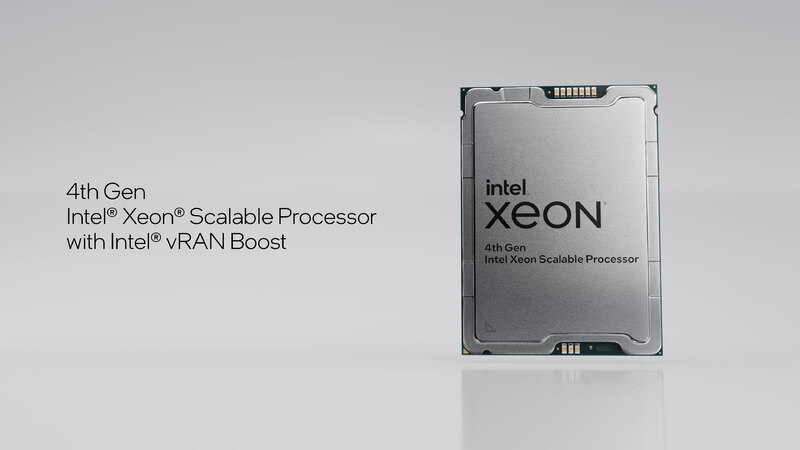
Intel’s latest server processors, Xeon Gen 4 (formerly code-named Sapphire Rapids), include a configuration tailored for cellular networks. This Sapphire Rapids Stock Keeping Unit (SKU) includes multiple improvements over Gen 3 Xeon processors: Performance is improved by up to 2X without increasing the power envelope, and, in fact, the new processor offers ~20% additional compute power savings. However, the most important improvement over previous generations is the introduction of vRAN Boost, which embeds acceleration functions in the processor itself. According to Intel, the processor is now capable of handling all Layer 1 functionality, even at high-end mMIMO configurations.
The Sapphire Rapids processor line includes multiple configurations that include dozens of acceleration engines for different workloads. For cellular networks, there are multiple extensions, two of which are the following:
- The Advanced Vector Extensions (AVX) for vRAN consist of a processor instruction set that supports specific RAN signal processing. Intel claims that its AVX results in an organic 2X performance increase over previous processor platforms.
- vRAN Boost is another feature that includes acceleration directly in the CPU, eliminating the need for a separate accelerator card. Intel’s performance tests compared an Intel Gen 4 CPU with an Intel Gen 3 CPU + dedicated 5G accelerator card, the results of which showed that the new CPU has ~20% better performance compared to the previous generation.
The Sapphire Rapids platform offers a significant technical upgrade over previous platforms, but also creates the foundation to transform the supply chain for Layer 1 acceleration.
vRAN Boost capabilities to simplify the supply chain
The new Intel processors, like their predecessors, use a Data Plane Development Kit (DPDK) for packet processing and the Baseband Device (BBDev) Application Programming Interface (API) to send information upstream to the DPDK. Both tools are well established in the industry and widely used, not only by the companies that have developed their products using Intel FlexRAN reference architecture. Built on x86 processors, this reference architecture is used by the majority of vRAN vendors, so far, to rapidly create products without long development cycles. On the other hand, accelerator cards are built using proprietary software and tools, making their portability between hardware platforms impossible—this also goes against the purpose of custom silicon on which these accelerators are built.
vRAN Boost removes the need for a separate accelerator, which can revolutionize the 5G supply chain. Instead of intense partnerships between infrastructure vendors and custom silicon developers that often take years to produce a commercial, large-scale product, Sapphire Rapids CPUs can reduce this development time to a matter of months, accelerating time to innovation and infrastructure vendors’ differentiation. In addition, large-scale deployments of COTS with embedded acceleration capabilities significantly reduces the cost of infrastructure compared to custom hardware used by incumbent players to date. This can be done using open-source tools and standard APIs that have been endorsed by the O-RAN Alliance.
vRAN Boost lowers the barrier of entry for entrants and startups to develop innovative 5G products. At the same time, less reliance on custom silicon also means that existing vendors may be able to iterate their equipment faster, without relying on long development cycles and custom silicon, but on open platforms, COTS processors, and prevalent Software Development Kits (SDKs). This will ultimately translate to faster time to innovation, cost reduction, interoperability, power efficiency, and open development environments.
The commercial deployment of this will not likely come overnight, as there are multiple challenges to overcome for a structural change in the way 5G networks are being deployed. For example, there is market inertia regarding accelerator integration and switching to these new processors may take time for Information Technology (IT) and infrastructure vendors. However, vRAN is still in its infancy, making x86 servers with vRAN Boost a viable and interesting alternative to custom silicon. The only certainty is that this will remain a very competitive space, especially when Layer 1 processing likely becomes more complex with 5G-Advanced and 6G. Intel’s involvement in developing the next-generation cellular standards and its visibility of a cellular network’s roadmap will enable Intel to align the development of the next wave of Xeon chips with the requirements of future generation cellular networks.
Table of Contents


