


The mobile industry is witnessing a fundamental shift in the way in which Radio Frequency (RF) systems are handled. In no small part, this is mostly due to the shift to 5G and its related use cases, which brings with it a massive burden on the RF, a growing number of new frequency ranges, and the exponential increase of frequency combinations used in the marketplace. This development leads to an extensive increase in the number of components. The design and choice of appropriate RF Front End (RFFE) modules has, therefore, become key for device vendors to differentiate their products, solving the issue of integrating the entire 5G cellular system design in their devices, from the antenna to the modem.
As the first step to overcoming these challenges, vendors are moving away from RF and RFFE assembly and adopting system-level radio designs, which are backed by numerous companies and organizations, including Qualcomm and MediaTek. This approach can help maximize device performance without compromising overall device design, time to market, or cost. The next wave of development is bringing Artificial Intelligence (AI) to the radio system level to help boost performance, improve wireless communication and enable new use cases in the following main areas:
- Accurate RF-based sensing
- Mobility management
- Smart signaling
- Interference management
- Positioning
Current methods for providing these solutions, such as active positioning, have limitations and the use of AI improves accuracy, while also reducing power consumption. Using this approach combines the complementary strengths of Machine Learning (ML) with the 5G domain to solve or improve difficult wireless communications challenges, which can create optimal solutions and accelerate wireless innovations. This AI enhancement can enrich end devices, improve the overall spectral efficiency of wireless networks and enable new user experiences.
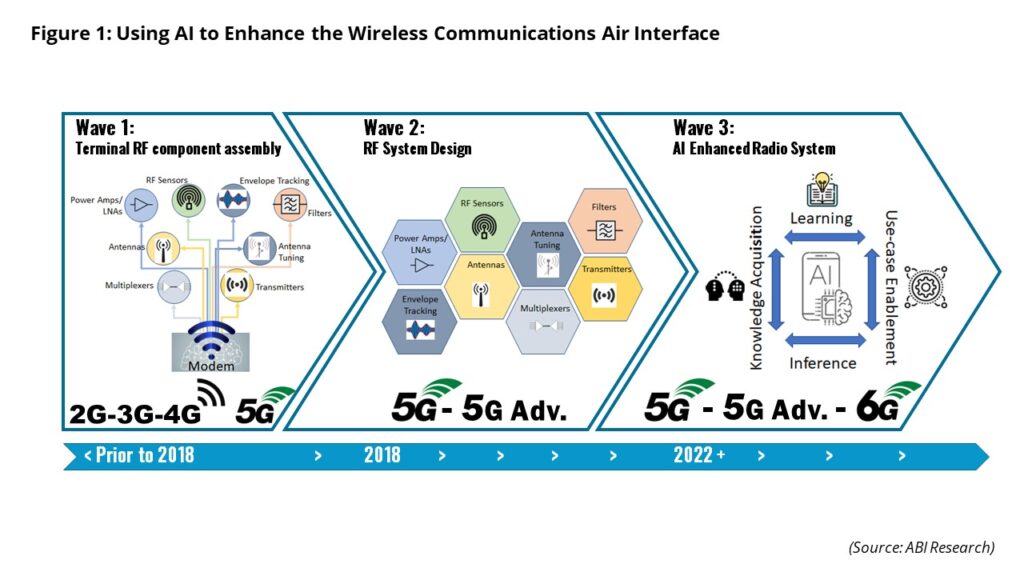
While AI is already being used in a number of applications, such as automotive, machine vision, intelligent voice control and cybersecurity, it has recently found relevance in The 3rd Generation Partnership Project (3GPP) wireless 5G Releases 16 and 17, which started from 2020. With wireless communications and RF sensing technologies continuing to advance, AI/ML is set to play an expanding role as the industry moves to new 3GPP releases and as it eventually transitions from 5G to 6G. The use of AI enhanced radio can enable better device-network collaboration because, by incorporating AI/ML methods within the 5G wireless standard, it promises autonomous network behavior and ultra-low-latency reconfiguration. However, to optimally exploit the capabilities of AI requires an innate knowledge of the wireless environment.
Better collaboration between the network and the device means that AI can enhance certain facets of wireless technology capabilities, mainly through optimizing transmit waveforms to reduce the Peak-to-Average Power Ratio (PAPR), improving mobility management and handovers, sensing and localization, smart signaling and interference management. Under such an environment, using AI enables improvements in the following major areas:
- Power savings
- Positioning accuracy
- Spectral efficiency
- Reduced network loading
- Higher system throughput
- Intelligent beamforming/beam management
- Optimization
The collaboration and complementary processing of data between cloud AI and device AI can provide enhanced end-to-end radio efficiency and experiences through environmental and contextual sensing. This reduces access overhead and latency, while allowing for better privacy, reliability and efficient use of network bandwidth.
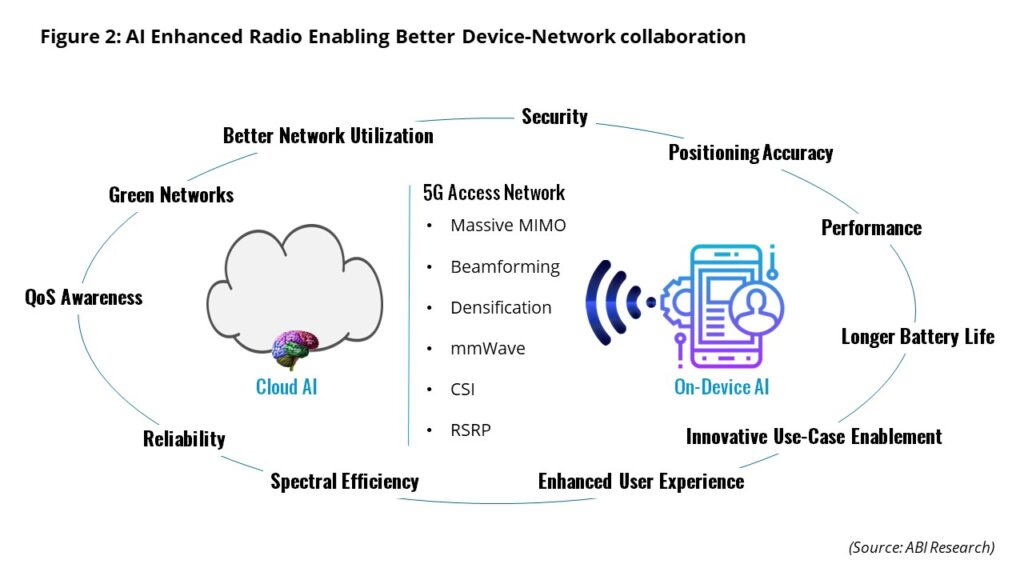
Part of the rationale behind adding AI to the radio system is providing additional help to combat the rapidly changing and challenging physical environment in which 5G devices are being used, both in terms of users’ locations and their handling of a device. This latter issue has been exacerbated by the growing availability of folding smartphones that brings an additional dimension to antenna coverage due to their changeable form factor. Addressing these issues through AI will help mitigate dropped calls or degraded signal quality, while also conserving battery life.
Such an approach will result in the key benefits of providing a better quality of network experience and enhancement of the user experience through more intelligent beamforming/beam management, while improving power management by taking advantage of better contextual awareness on the device. Other benefits derived from adding AI include improved system performance and better radio security, while the computation of metrics, such as location, travel speed and other aspects of environmental and application awareness, helps improve signal robustness and data throughput.
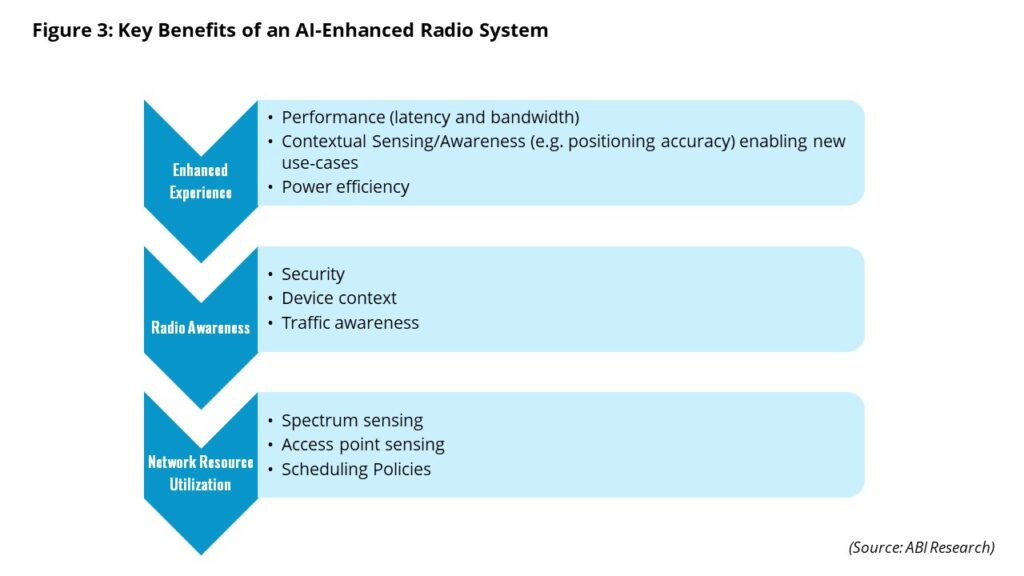
Adding AI to the radio system ensures greater accuracy and sensing for current solutions that often do not perform well in real-world conditions or are not easily scalable. A variety of uses cases can, therefore, be improved and derive benefits from active positioning with RF sensing, which can facilitate any number of events from presence detection and sleep monitoring, touchless control for devices and indoor navigation, to Simultaneous Location and Mapping (SLAM) services. In addition, spectrum sensing and access can improve 5G performance through network resource utilization, while contextual awareness can improve the device experience.
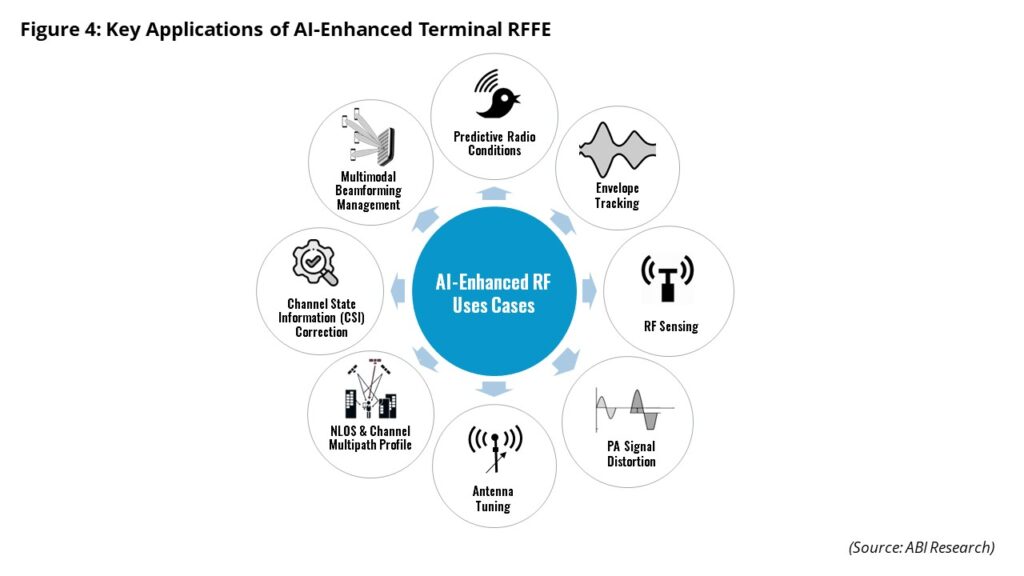
Moreover, environment (RF) sensing can detect gestures, movements and objects by monitoring signal reflection patterns to enable new use cases. In tandem, these enhancements ultimately lead to better user experiences with improved communications to and from devices to provide a better understanding of the operating environment. Other key applications of an AI-enhanced terminal are as follows:
- Multimodal Beamforming Management: Helps speed up connections and reduce interference from nearby devices, while improving signal quality, notably for 5G Millimeter Wave (mmWave). Helps dynamically select the best transmit and receive paths based on signal conditions to improve performance, coverage and link robustness.
- RF Sensing: Allows accurate positioning both indoors and in locations without clear line-of-sight. It has a variety of use cases, from touchless control for devices to presence detection, sleep monitoring, fall detection, SLAM, etc.
- Power Amplifier (PA): AI-assisted signal recovery from potential distortions when the signal is transmitted in the non-linear PA gain region.
- Predictive Radio Conditions: Uses contextual awareness to select the predict transceiver/receiver strengths, Reference Signal Received Power (RSRP), power saving management, link adaptation and handovers (e.g., between cellular and/or Wi-Fi).
- Channel State Information (CSI) Correction: Can be used to learn the precise positioning and geometry of an environment.
- Non-Line-of-Sight (NLOS) and Channel Multipath Profile: Enables better Global Navigation Satellite System (GNSS) positioning, for example.
- Antenna Tuning: Leverages AI-based antenna tuning and beamforming to improve coverage and link robustness, helping reach higher average throughput speeds. Can also optimize the antennas of a device to dynamically detect user interaction and positioning of hand grip.
- Envelope Tracking: AI could be used to optimize transmit waveforms to reduce PAPR.
Applying AI to wireless still has its challenges, and it is still very much in its infancy, but it offers definite benefits and promise to the wireless arena. Several companies and organizations along the wireless value chain, such as Qualcomm, MediaTek and Intel, as well as the OpenRF consortium, have been researching the intersection of these technologies and are aiming to tackle advancing wireless communications and RF sensing.
Specifically, Qualcomm has launched a number of AI-based solutions, including the Snapdragon X70 5G modem-RF with dedicated AI processor; AI-Enhanced Signal Boost, a 5G adaptive antenna tuning solution to improve context-based antenna performance; a 5G AI Suite designed for AI-powered optimizations of 5G sub-6 Gigahertz (GHz) and mmWave links for improved speeds, coverage, mobility and link robustness; and WiCluster, a passive positioning technique. Each of these solutions is set to provide enhanced user experiences and efficiencies to the device ecosystem. However, further iterations and more use cases will be added to the lineup, providing an evolution in AI-enhanced RF systems, buoyed further by emerging products from companies like MediaTek and Intel, the latter targeting non-handset applications.
The industry is on the cusp of embracing AI as the next wireless frontier, as it enables a number of improvements in performance. As the market continues its shift to 5G and beyond, the promise of sustained device and network enhancements, including enabling new use cases, faster data speeds, high signal performance, call reliability and quality, power efficiencies, and improved coverage, all point to a technology that is set to revolutionize RF design and drastically improve consumer experiences and use cases.

