


This is article is taken from a recent editorial report on Industrial 5G Innovation – From Setting Standard to Becoming Standard; the previous instalment in this serialised version of the report is available here. Subsequent instalments are listed below (linking either to the original report, or to web articles, as they are available). The report includes additional features and interviews, and is available here. A webinar on the same topic is also available, here, with speakers from ABI Research, MFA, Schneider Electric, and Vodafone.
The discussion shifts, necessarily, to the ‘co-creation’ process around application development and system design. Because for the market to hum, it has to get easier. To this end, NTT has a deal with US software firm ServiceNow to introduce “AI-enabled end-to-end workflow automation” to its private 5G proposition. The problem, it says, is most OT engineers can show a process on a scrap of paper, but not in a digital file – and certainly not in a digital twin.
Says NTT’s Devin Yaung: “You just can’t throw a technology in there and expect people to adopt it. You have to understand how it fits. We’re talking to a logistics warehouse, and one of the ideas is to use computer vision for miss-picks, and for tracking goods. But you have to understand the process first – before you can know where to put the cameras, and how to trust the technology. Because why, otherwise, would OT buy into it – and open up and connect its systems?”
Shahid Ahmed at NTT rejoins: “We don’t want to build and pilot private 5G just for the sake of it. A lot of others are doing that, but it is not the right way; they are just deploying these private networks, and they are literally just sitting there. The factory manager is stuck with this network the IT folks pushed through. They are worried about security, as their number-one requirement, and they’re like, ‘What is this box on my factory floor? What is it even doing here?’
 “We are focused on the business outcome and the business process. Because on the factory floor, these guys roll up their sleeves and have a set of tasks to complete. And if they don’t complete them, it is a supply chain issue, a manufacturing process issue, a P&L problem. I mean, it percolates across the organisation. So we were very cognizant of that. But it is less about the use case at the start, and more about the workflow.”
He goes on: “And often the factory manager does not even know that – it is jotted down on a two-by-four yellow card on the wall, or in somebody’s Excel spreadsheet on a ruggedized iPad. It is not even digitised. And you can’t enable a machine vision camera to detect jitter on a conveyor belt if you don’t know the process behind it. You can’t just connect a camera and not follow it up with what-happens-next.”
The idea is that enterprises can digitise and migrate workflows into the cloud with the ServiceNow platform, and set NTT’s 5G system (from Celona) to plug more effectively into their operations. Between the lines, the message is, as always, that the data required to drive transformation too-often gets stuck in silos, or fails to be made available in analytics software in the cloud – and that disjointed processes do not make the most of even eMBB-grade 5G.
Ahmed says: “It is not a cookie-cutter process – every factory is different. Usage of the public cloud is limited; OT just doesn’t like to go there. Which means a lack of sharing, which means a lack of uniformity with workflows – unlike in IT, where there is a common cloud infrastructure that everyone taps into, whether they are in Frankfurt or Greenville. In the OT space, the data is hyper-local; data protection is the main driver, much more than latency or coverage.”
Enterprises can, with properly-optimised 5G-connected workflows, solve business issues with “simple cloud-based economics, faster time to market, and an enhanced service management experience”, says NTT. Santa Clara-based ServiceNow calls its Now platform a “platform of platforms for the digital workflow revolution”. Analyst house Omdia has gone so far as to declare the partnership “a gold standard in 5G service delivery”.
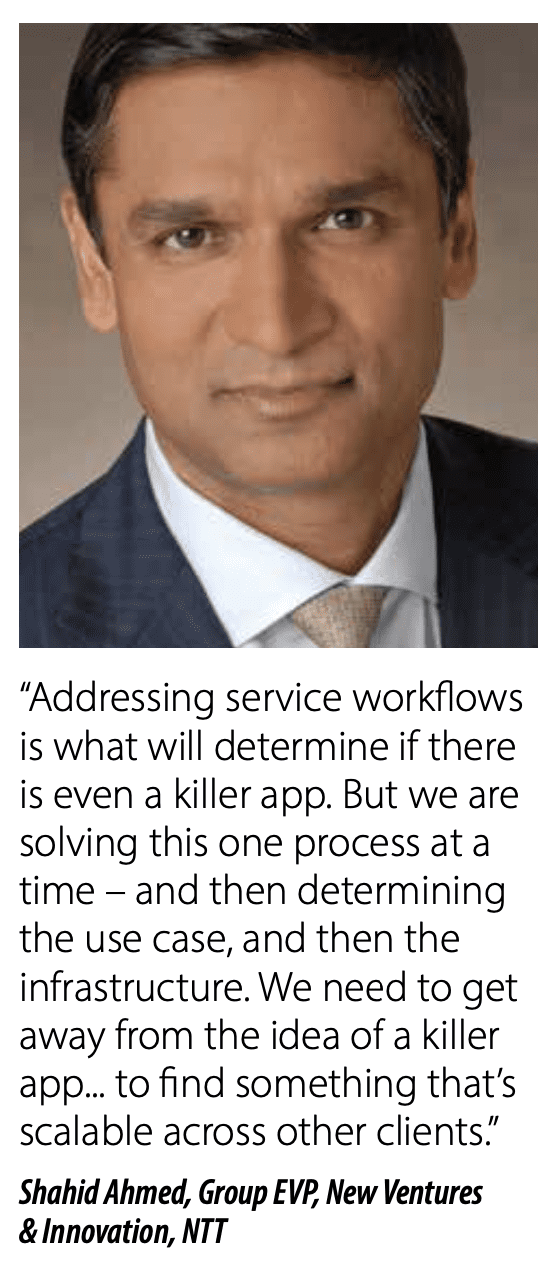
Ahmed says: “Addressing service workflows is what will determine if there is even a killer app out there. But we are solving this one business process at a time – and then determining the use case, and then the infrastructure to support it. But we need to get away from the notion of a killer app, and focus on the process – to find something that’s repeatable, scalable across other clients. That is what victory looks like.”
The point is to work small, and not just to dream big; the big stuff will happen by getting the small stuff right – kind of thing. “We’re not hung up on finding a repeatable solution that could become a killer app… By and large, every client, every factory, every vertical is different,” says Yaung, repeating the line. “I mean, I know it’s a cliché, but it is so true.” Equally, the future is around the corner, and Industry 4.0 should not settle for anything less than 5G.
That seems to be the message. “The killer app for 5G has not been developed yet. People don’t know until after – you never thought you’d be booking Uber and Airbnb on 4G, but here we are. [So] private 5G is the answer over everything else [as a platform for change] – and because it will bring new levels of automation, which will bring operational efficiency. And because you can’t get the labour anymore; there is a war on talent,” adds Yaung.
This is correct, of course; and would segue neatly into an entertaining discussion about supply-side mastery of over-the-top innovation in Industry 4.0. Because the pie is big, and 5G is just the gravy layer at the bottom, to bind the meat and veg of compute hardware and analytics software. Like Federated Wireless likes to say, or to quote; LTE/5G is a $3.2 billion opportunity in CBRS in the US, alone, but $15 will go on software for every $1 on 5G.
But we don’t have time for that, here (and we have discussed it before); instead we might look again at the idea that “every factory is different”, and may require root-level digital migration and some work in co-creation to scope the problem first. “It is not a cookie-cutter process,” says NTT, if we recall. What does Nokia – with a decent and developing record in the Industry 4.0 game, and a set of blueprints to untangle the mess of it – think of this?
Stephane Daeuble at Nokia responds: “After you’ve done 10 types of mine, you know the ecosystem – all the key players, all the integration. So we have a pre-tested solution, effectively, which means less service work, less system integration. The idea is to limit the amount of customisation, and then to replicate. Because, again, a 100,000 square-metre port looks the same in Singapore and Latvia.” This is the cookie-cutter approach, as far as possible.
The idea, he suggests, is to get 80 percent of the job done with a 5G matrix that plots edge infrastructure measures against use case characteristics, and to work out the other 20 percent as bespoke tailoring in boutique co-creation. Nokia reckons it has done the donkey work of industrial-learning and direct-selling during the past few years, and is in position now to take a well-worked private 5G system to market via third party sales channels.
This is article is taken from a recent editorial report on Industrial 5G Innovation – From Setting Standard to Becoming Standard; the previous instalment in this serialised version of the report is available here. Subsequent instalments are listed below (linking either to the original report, or to web articles, as they are available). The report includes additional features and interviews, and is available here. A webinar on the same topic is also available, here, with speakers from ABI Research, MFA, Schneider Electric, and Vodafone.
The trouble with private 5G for Industry 4.0 | Part 1 – the standard
The trouble with private 5G for Industry 4.0 | Part 2 – the devices
The trouble with private 5G for Industry 4.0 | Part 3 – the spectrum
The trouble with private 5G for Industry 4.0 | Part 4 – the features
The trouble with private 5G for Industry 4.0 | Part 5 – the system
The trouble with private 5G for Industry 4.0 | Part 6 – the channel


