

RCR Wireless
  • News
  • Channels
    • 5G
    • 6G
    • BSS OSS
    • Carriers
    • IoT
    • Network Infrastructure
    • Open RAN
    • Private 5G
    • Telco AI
    • Telco Cloud
    • Test & Measurement
  • Resources
    • Reports
    • Webinars
    • White papers
    • AI Fundamentals
    • Analyst Angle
    • Editorial Calendar
    • Fundamentals
      • 5G NR Release 17
      • AI
        • Telco AI in 2025
    • Podcasts
      • Let’s Get Digital with Carrie Charles
      • Wireless Connectivity to Enable Industry 4.0 for the Middleprise
      • Well Technically…
      • Will 5G Change the World
      • Accelerating Industry 4.0 Digitalization
  • AI Infrastructure
  • Programs
  • Events
  • RCRtv
  • Advertise
  • Subscribe
Tuesday, August 11, 2026
RCR Wireless
  • News
  • Channels
    • 5G
    • 6G
    • BSS OSS
    • Carriers
    • IoT
    • Network Infrastructure
    • Open RAN
    • Private 5G
    • Telco AI
    • Telco Cloud
    • Test & Measurement
  • Resources
    • Reports
    • Webinars
    • White papers
    • AI Fundamentals
    • Analyst Angle
    • Editorial Calendar
    • Fundamentals
      • 5G NR Release 17
      • AI
        • Telco AI in 2025
    • Podcasts
      • Let’s Get Digital with Carrie Charles
      • Wireless Connectivity to Enable Industry 4.0 for the Middleprise
      • Well Technically…
      • Will 5G Change the World
      • Accelerating Industry 4.0 Digitalization
  • AI Infrastructure
  • Programs
  • Events
  • RCRtv
  • Advertise
  • Subscribe
Add RCR Wireless as a preferred source on Google
  • Qualcomm 6G Insights
  • Huawei Content Hub
  • Qualcomm – 6G Vision
  • OSS/BSS Channel
  • RCRTech Roundtable: AI Infrastructure
RCR Wireless
RCR Wireless
  • Advanced Mimo
  • Mobile mmWave
  • 5G Positioning
  • Green Networks
  • Metaverse
  • Automotive
  • Industrial and Wide-area IoT
Copyright 2021 - All Right Reserved
Home - IoT is good for the planet, but trade-offs are necessary (Analyst Angle)
Analyst AngleChipsetsData AnalyticsEnergyEnterpriseInternet of Things (IoT)NB-IoTOpinionSensorsSmart CitiesSmart FactorySmart FarmSmart HomeWired Networks, Fiber

IoT is good for the planet, but trade-offs are necessary (Analyst Angle)

by James Blackman July 5, 2022
written by James Blackman July 5, 2022 Share
LinkedinEmail
Share 0LinkedinEmail
177

The use of IoT hardware and software applications will have a very positive impact on global sustainability but the trend masks significant variations between use cases, and over the lifecycle of the device. This was one conclusion from a recent report from Transforma Insights, ‘On balance, IoT is very beneficial from a sustainability perspective’. 

The report considers the overall sustainability implications of the deployment of IoT, including analysis of the impact on electricity consumption, (hydrocarbon) fuel consumption, water consumption, and CO2 emissions. This article highlights two of the key findings.

Jim Morrish

Morrish – IoT has the biggest green impact in power generation, grid operation and smart meters

Enterprise IoT applications are overwhelmingly beneficial…

Overall, IoT solutions are good for the planet, with sustainability benefits that significantly outweigh sustainability costs. Behind this high-level message are two clear dynamics which distinguish enterprise from consumer use cases. 

Enterprise IoT applications are generally deployed to increase efficiency and reduce costs, for instance in building automation or precision agriculture. Naturally these have associated net sustainability benefits. Meanwhile, many consumer-sector IoT-enabled solutions are more focused on improving and enhancing an overall user proposition, and so can often be associated with net negative sustainability impacts.

The most impactful enterprise IoT applications in terms of electricity consumption are illustrated in the figure below, with savings below the line (negative figures) and incremental consumption above the line (positive figures). The top energy savers are those related to energy generation and distribution, including smart grid and smart meters. IoT sustainability 1 scaled 1
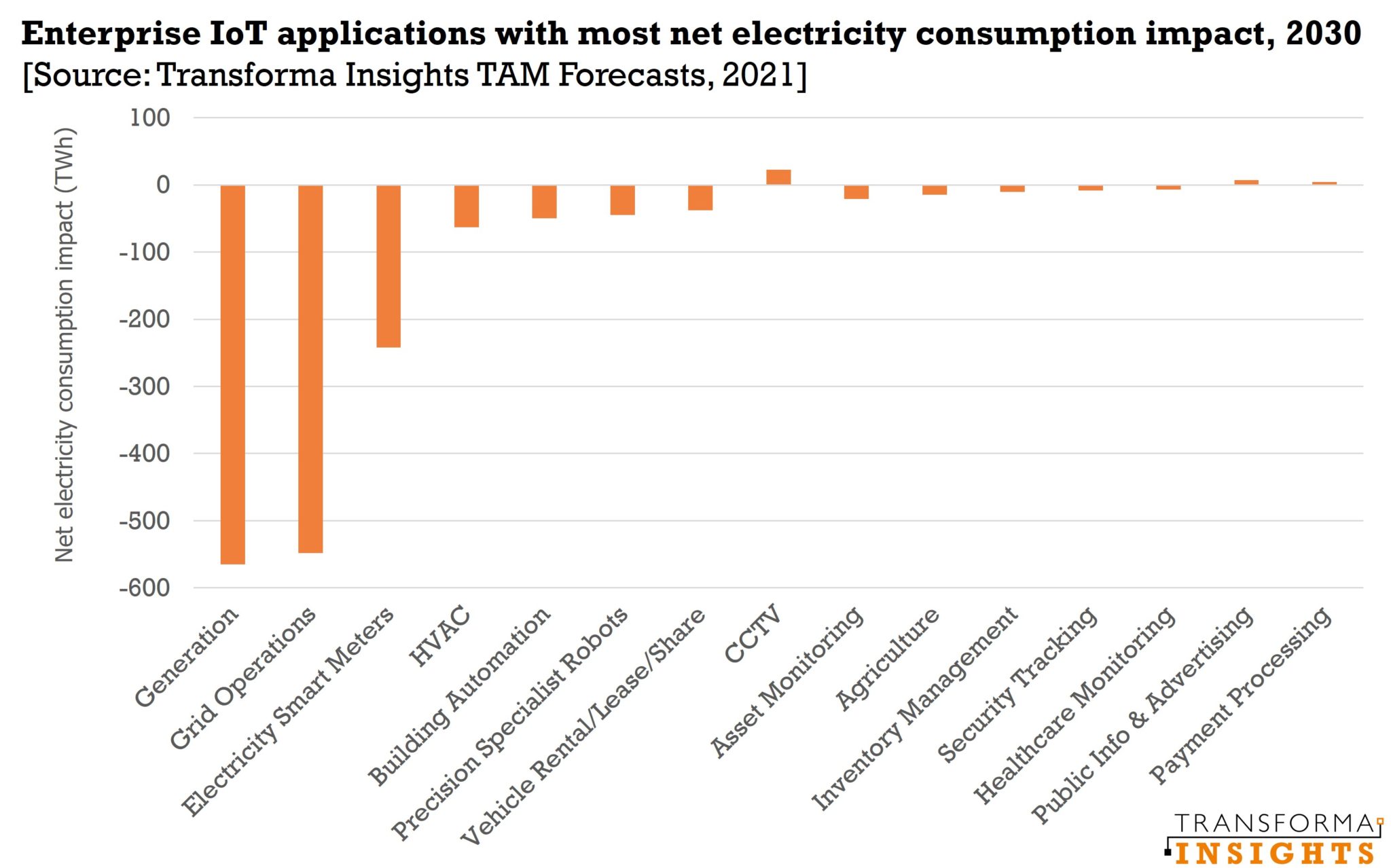
There is some nuance to considerations over energy consumption from IoT devices. In many cases it can represent a trade-off against a positive sustainability impact elsewhere. Several IoT applications which have a net cost in terms of increasing electricity consumption are actually particularly beneficial from a net sustainability perspective by reducing (hydrocarbon) fuel consumption. 

The calculation of the trade-off needs to also take account of the fact that electricity can be more readily generated from renewable sources.

…but are offset by manufacturing, distribution, and end-of-life disposal

The relationship between new technology and sustainability is complex. One of the key trends highlighted by the report is the need to consider the full lifespan of the IoT device when calculating the impact. The report includes consideration of the impact of associated manufacturing, distribution processes, and also end-of-life disposal to develop a whole-lifecycle picture of sustainability impact.

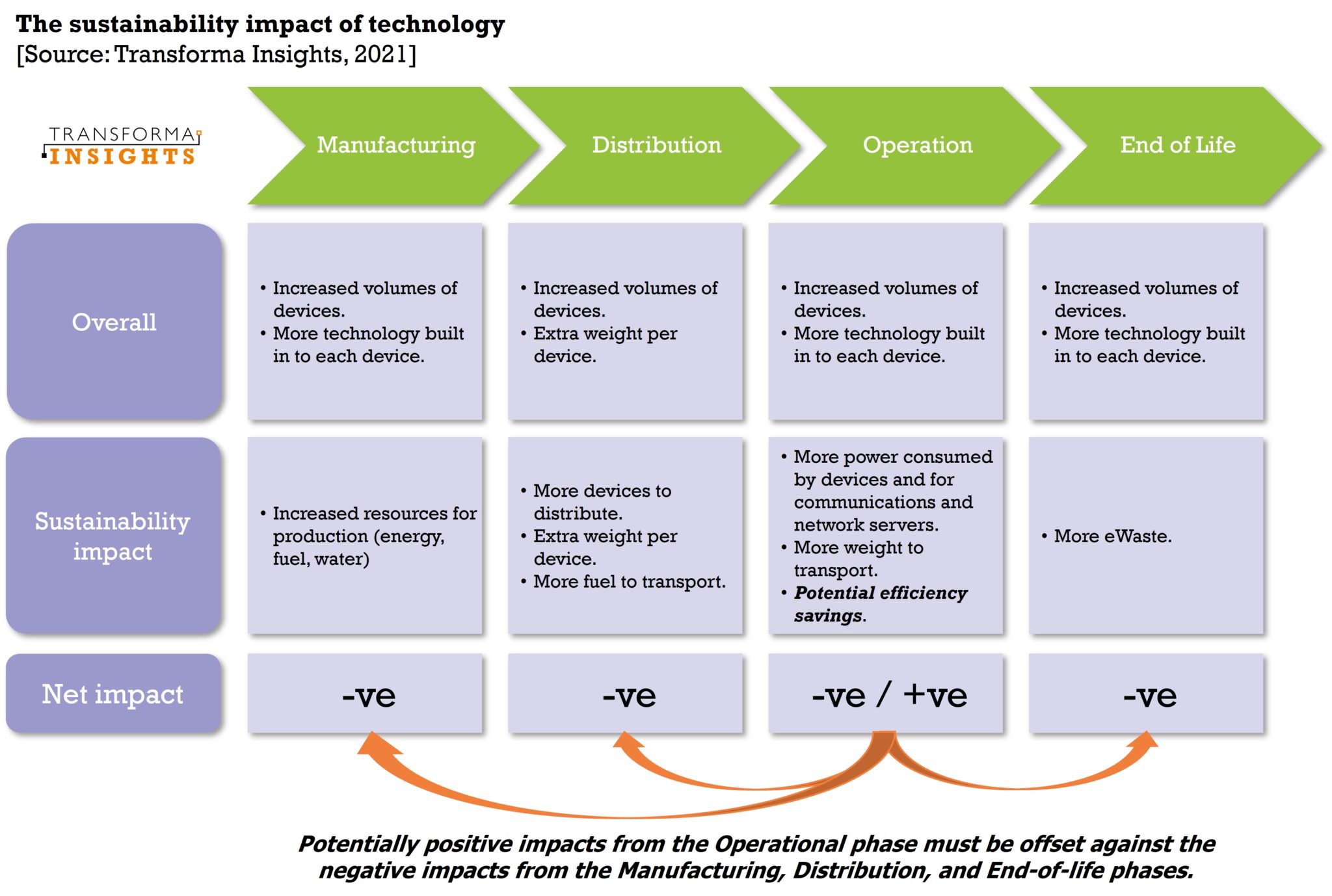
This sustainability impact across the lifecycle elements, illustrated in the figure below, is, with few exceptions, consistent across all new technology deployments: the net impact of new technologies in the ‘manufacturing’, ‘distribution’, and ‘end-of-life’ phases is generally negative (although exceptions include, for instance, the advent of shared car schemes resulting in an overall reduced level of vehicle manufacturing). 

There is a significant sustainability cost in creating, distributing and disposing of these devices. The key to calculating the overall sustainability impact is in the ‘operation’ phase, where solutions may generate a net benefit.IoT sustainability 2 scaled 1
Some use cases have very little benefit. IoT-enabled televisions supporting on-demand content mostly simply contribute to e-waste and power consumption (for local content engines, remote servers, and connectivity). This is offset by a negligible impact in terms of manufacturing and distribution; we would expect people to buy new televisions whether or not there are connected models available.

Contrast this with other IoT solutions which are explicitly or implicitly aimed at conserving resources, such as road vehicle fleet management or smart connected heating, ventilation and air-conditioning (HVAC) systems. These rack up considerable benefits in terms of fuel and/or electricity consumption over the lifespan of the device, more than compensating for the costs incurred in their overall lifecycle. 

Jim Morrish has over 20 years of experience in strategy consulting, operations management, and telecoms research. He was a Founder and the Chief Research Officer of Machina Research, acquired by Gartner in 2016. He is responsible for the addition of the term Low Power Wide Area (LPWA) networking to the IoT lexicon, and is a co-author of the Ignite|IoT project management framework for IoT. He has served as Co-Chair of the Digital Transformation Working Group of the Industrial Internet Consortium, and is a member of the advisory boards for a number of digital transformation industry conferences.


You Might Also Like
  • Europe’s AI ambitions will fail without sovereign cloud infrastructure (Reader Forum)
  • Monday (telco diary) | Digging in, moving up – lessons from Lumen
  • ‘We think of them as hometown ISPs’ – WISPA chief on BEAD, Starlink, CBRS
  • Friday (telco diary) | Friday night fare – private 5G to go
  • Bell advances AIDC strategy as fiber and enterprise AI drive Q2
  • Thursday (telco diary) | APAC telcos pile into AI infrastructure
Share 0 LinkedinEmail
James Blackman
James Blackman

James Blackman has been writing about the technology and telecoms sectors for over a decade. He has edited and contributed to a number of European news outlets and trade titles. He has also worked at telecoms company Huawei, leading media activity for its devices business in Western Europe. He is based in London.

previous post
Umlaut opens private 5G SA Open RAN test network in Germany
next post
Virgin Media O2 and Nokia deploy private 5G network for NHS hospital in UK

White Papers

  • Norton eBook: The 2026 Telco Playbook

  • Enea White Paper: Why Intelligent AAA is the Swiss Army Knife of Telecom

  • CSG White Paper: Telco AI Enabler: Mediation’s Defining Role

  • Enea White Paper: Scalable Database Design for 5G and Beyond

  • Supermicro and NVIDIA Whitepaper: Powering sovereign AI at scale

Editorial Reports

  • Report: NTN in motion — evolving standards, expanding services

  • Market Pulse Report: Telco AI in 2026 – Trends, Challenges and Opportunities

  • Nvidia Report: The State of AI in Telecommunications: 2026 Trends

Webinars

  • Webinar: Building 6G — aligning technology, policy and purpose

  • SIMCom Webinar: Scaling your next deployment – from plastic to provisioning

  • Webinar: Rethinking the RAN as AI, cloud and openness converge

  • Webinar: Scale-Up, Scale-Out, Scale-Across – Building AI-Era Network Fabrics

  • Webinar: NTN in motion – evolving standards, expanding services

Since 1982, RCR Wireless News has been providing wireless and mobile industry news, insights, and analysis to mobile and wireless industry professionals, decision makers, policy makers, analysts and investors.

Facebook Twitter Youtube Linkedin Envelope Rss

Useful Links

  • Subscribe
  • About RCR Wireless News
  • Contact Us
  • Advertise
  • Editorial Calendar
  • Archive
  • RSS
  • Wireless News Archive
  • Subscribe
  • About RCR Wireless News
  • Contact Us
  • Advertise
  • Editorial Calendar
  • Archive
  • RSS
  • Wireless News Archive

Edtior's Picks

Europe’s AI ambitions will fail without sovereign cloud infrastructure (Reader Forum)
Monday (telco diary) | Digging in, moving up – lessons from Lumen
Deutsche Telekom expands AI, fiber investment as growth continues

Latest Articles

Europe’s AI ambitions will fail without sovereign cloud infrastructure (Reader Forum)
Monday (telco diary) | Digging in, moving up – lessons from Lumen
Deutsche Telekom expands AI, fiber investment as growth continues
‘We think of them as hometown ISPs’ – WISPA chief on BEAD, Starlink, CBRS

© 2026 RCR Wireless News All Right Reserved. Developed by Eight Hats.

Cookie Policy | Privacy Policy

RCR Wireless
  • News
  • Channels
    • 5G
    • 6G
    • BSS OSS
    • Carriers
    • IoT
    • Network Infrastructure
    • Open RAN
    • Private 5G
    • Telco AI
    • Telco Cloud
    • Test & Measurement
  • Resources
    • Reports
    • Webinars
    • White papers
    • AI Fundamentals
    • Analyst Angle
    • Editorial Calendar
    • Fundamentals
      • 5G NR Release 17
      • AI
        • Telco AI in 2025
    • Podcasts
      • Let’s Get Digital with Carrie Charles
      • Wireless Connectivity to Enable Industry 4.0 for the Middleprise
      • Well Technically…
      • Will 5G Change the World
      • Accelerating Industry 4.0 Digitalization
  • AI Infrastructure
  • Programs
  • Events
  • RCRtv
  • Advertise
  • Subscribe
RCR Wireless
  • News
  • Channels
    • 5G
    • 6G
    • BSS OSS
    • Carriers
    • IoT
    • Network Infrastructure
    • Open RAN
    • Private 5G
    • Telco AI
    • Telco Cloud
    • Test & Measurement
  • Resources
    • Reports
    • Webinars
    • White papers
    • AI Fundamentals
    • Analyst Angle
    • Editorial Calendar
    • Fundamentals
      • 5G NR Release 17
      • AI
        • Telco AI in 2025
    • Podcasts
      • Let’s Get Digital with Carrie Charles
      • Wireless Connectivity to Enable Industry 4.0 for the Middleprise
      • Well Technically…
      • Will 5G Change the World
      • Accelerating Industry 4.0 Digitalization
  • AI Infrastructure
  • Programs
  • Events
  • RCRtv
  • Advertise
  • Subscribe
@2020 - All Right Reserved. Designed and Developed by PenciDesign