

Telecom operators have been building cellular networks for more than four decades. During that time, four generations have passed, many technologies have come and gone, numerous innovations and advances have occurred. Cellular smartphones have even fundamentally changed how we live, work and play. All the while, how the cellular networks are built has hardly changed. But now, the industry is on the cusp of a major transformation that will entirely change how cellular networks are orchestrated, deployed, and managed, all enabled by a new approach brought by the culmination of virtual RAN (vRAN), Open RAN, and cloudification.
In this article, I will take a fresh look at what is involved in building a modern cellular network, the opportunities and challenges, and how the landscape is changing. A follow-on article will dive deeper into what is needed to address those challenges and win.
A new modern approach
The fundamental change in building cellular networks has resulted from three independent yet dominant trends in the larger tech industry: virtualization, open ecosystems, and cloudification. These concepts are not new, but the cellular industry has slow-peddled their adoption. The virtualization of the core network is complete. All the focus now is on virtualizing RAN. That was thought to be impossible just a few years ago, mainly because of the extremely low latency needed. But the impressive growth of computing and the relentless industry efforts are making it possible now. The idea of Open RAN goes back to 3G or even 2G. Again, the intense desire to expand the ecosystem and unprecedented geopolitical developments are hastening the move to Open RAN. When such fundamental shifts are afoot, moving away from the traditional node-based architecture to a highly successful, well-understood, widely used, modern cloud-native architecture (aka cloudification) is all but natural.
There has been some confusion about vRAN and Open RAN. Many mistakenly use them as synonyms. Although related, they are different—vRAN disaggregates the RAN software and hardware and unshackles the dependency between the two that has been there since the first day of cellular. On the other hand, Open RAN allows the software, the hardware, and different functional components to be from different vendors, while ensuring seamless interworking. That is, again, unlocking the single vendor lock-in that has been there since the first day.
More than these three individual trends, what is forcing the new approach is their culmination, which can bring scalability, cost-efficiency, and ecosystem diversification to 5G networks.
The building blocks
The first step in defining the new approach is to have an architecture conducive to all three trends. And the proposed vRAN/Open RAN architecture has three functional blocks: virtual Central Unit (vCU), Distributed Unit (DU), and Radio Unit (RU). vCU is responsible for non-real-time functions, such as radio resource management, ciphering, retransmission, etc. On the other hand, DU manages real-time functions such as demodulation, beamforming, channel coding, etc., and RU contains the RF functions such as amplification, filtering, etc. Typically, a single vCU can manage many DUs, and a single DU can connect to multiple RUs.
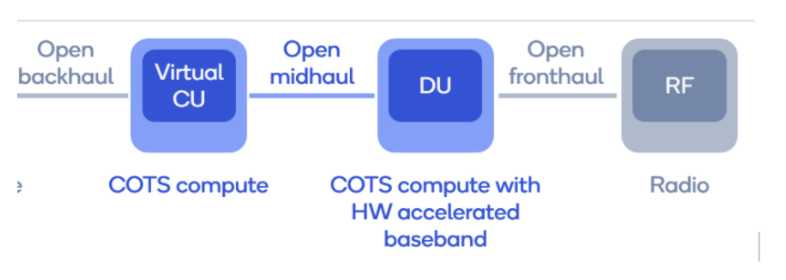
vCU primarily runs on Commercial Off-the-Shelf (COTS) compute hardware. DU runs on a combination of COTS and specialized hardware accelerators. RU purely has analog components without any digital blocks. The hardware, software, accelerators could all be coming from different vendors. All of these adopt a cloud-native architecture, meaning they utilize Kubernetes or Hypervisor for software and hardware disaggregation. As you can see, vRAN, Open RAN, and cloudification are complementary, enabling and improving the value of each other as well as that of the entire system.
From a deployment perspective, vCU and DU could be collocated and running on the same hardware (centralized mode) or on different hardware located at separate places (distributed mode), depending on use cases. For example, it makes sense to collocate vCU and DU at a central location in dense and high-traffic parts of the network. That is because, they can be run on large server clusters to achieve higher cost, processing, and energy efficiency. On the other hand, for small cell or mmWave deployments, it might make sense to collocate DU and RU. That is because mmWave’s beamforming/beamsteering and wide bandwidths (200 MHz – 2 GHz) require low-latency and very tight coupling between the digital (aka baseband) functions in the DU and the RF in RU. The cellular specifications body 3GPP has defined many different split configurations of vCU, DU, and RU to address various use cases.
Among all these blocks, the most challenging is DU, mainly because it controls the real-time functions. That is the very reason vRAN has taken so long to materialize. Additionally, fully virtualized multi-vendor Open RAN is still very much “work-in-progress,” especially for the advanced features such as massive MIMO, carrier aggregation, and others. The industry has realized that it is highly inefficient and almost impossible to run all DU on COTS, and hence specialized dedicated hardware accelerators are necessary. Those could be FPGAs (Field Programmable Gate Arrays), ASICs (Application Specific ICs), GPUs, or a combination thereof. And for best performance, they need to be in what is called “in-line” configuration. I will discuss more on this in a separate follow-up article.
Opportunities, challenges, and changing landscape
The best way to understand the opportunities of this novel approach is to compare IT/cloud and cellular ecosystems. The former has expanded tremendously in the last decade, resulting in a vast, diverse, and rich ecosystem of large and small players out-innovating each other. In contrast, the latter has seen severe shrinkage in the infrastructure space. Many infra vendors are needing governmental support, even when the cellular industry has thrived and prospered on the success of smartphones.
Although virtualization, open ecosystem, and cloudification seemed like a piped dream a few years ago, they have quickly become the only way forward for the industry. That is mainly because operators have realized the tremendous value they can bring, in terms of scale, flexibility, vendor diversity, speed of innovation, and most importantly, substantial cost-savings.
With the new approach, the cellular infra landscape is very rapidly changing. Prominent cloud players like Microsoft, Amazon, Facebook, Google, IBM, enterprise players like Dell, HPE, chipset vendors such as Qualcomm, Marvell, Intel, and scores of smaller, nimble yet innovative and disruptive companies are joining the traditional players like Ericsson, Nokia, Samsung, Huawei, ZTE.
Pivoting an industry thriving for more than four decades is easier said than done. Although there have been impressive early successes, more work needs to be done to ensure the performance of the new approach meets or exceeds the traditional one, especially in dense deployments with advanced features. The transformation will be gradual and must be methodical.
In terms of deployments, greenfield deployments are easy targets. All of them will start with the new architecture as that offers the most benefits with the minimum downside. However, existing networks, often referred to as “brownfield,” will probably transition in phases. First, moving to virtual and cloud-native architectures, even with open interfaces, but implemented with a single vendor. Soon after, moving to a fully open, fully interoperable, multi-vendor deployment.
In the following article, I will do a deep dive on how to build these modern 5G networks with the new approach, what is needed, from infrastructure, software, hardware, and especially DU accelerator perspective, and what it takes to ensure that these networks deliver on the grand promise of 5G.
In the meanwhile, for more articles like this, and for an up-to-date analysis of the latest mobile and tech industry news, sign-up for our monthly newsletter at TantraAnalyst.com/Newsletter, and listen to our Tantra’s Mantra podcast.
Table of Contents

