

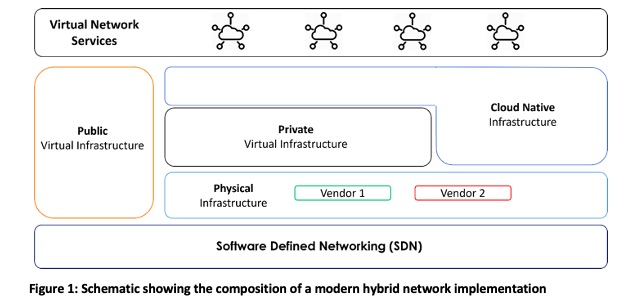
The arrival of virtualization has brought about a new era for the telecommunications sector. It has led to heightened degrees of flexibility and better utilisation of available assets than would have been imaginable on the purely hardware-centric networks of the past, alongside increased uptime. That said, it presents an array of major engineering obstacles for operators to overcome, as they need to be able to efficiently maintain the operation of networks that will be inherently more complex.
Virtualization will not be possible to roll out across networks in their entirety since there will still be legacy elements present – and this is where one of the main problems lies. Though there will be ample scope for new virtualised elements to be brought in, financial realities and the existence of legacy equipment will prevent the implementation of infrastructure completely from scratch. Operators have to be aware of the budgetary constraints they are subject to. It is therefore clear that existing equipment which has already been heavily invested in will still need to be utilised.
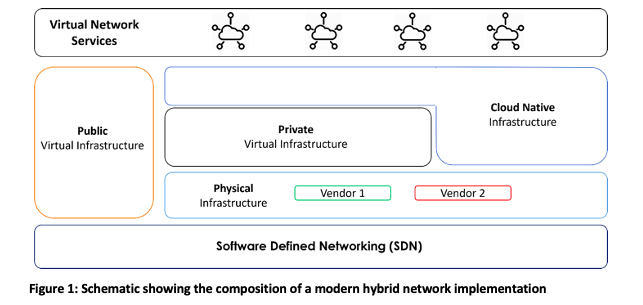
The management and orchestration of converged infrastructure implementations of this kind will be dependent on physical network functions (PNFs) and virtual network functions (VNFs) being able to coexist with one another. Furthermore, Business Support Systems (BSSs) and Operational Support Systems (OSSs) cannot be replaced on every evolution of network infrastructure due to the substantial economic investment required to replace them and the possible disruption of network services. Instead, they must be adapted so that they can interact with both the legacy and newly deployed infrastructure elements.
To simplify network management it will be advisable to utilise a series of hierarchical management domains through increased abstraction with respect to the detailed control of each network function. These hierarchical management domains should then be integrated to build a single, complete network management plane over which core, access and edge workloads may all be dealt with.
Network functions virtualization (NFV) management and orchestration (MANO) systems will be pivotal when it comes to dealing with the more convoluted network architectures that will be implemented in the years ahead. The effectiveness of these systems is going to be dependent on their ability to cope with the key challenges faced by network operators. Among the most prominent of these will be:
· The hybrid nature of infrastructure moving forward – With particular difficulties being witnessed in relation to managing a network that consists of a mixture of VNFs and PNFs.
· The opportunity of multi-vendor dimension – This will permit operators to benefit from innovations being made throughout the industry and not remain tied down to vertically integrated solutions from a single vendor. Since infrastructure will be based on the sourcing of solutions from numerous different vendors, operators need to have total confidence that everything will be fully interoperable.
· Migration from vertically integrated solutions to open source solutions – With the need for an open and fully interoperable ecosystem to be established to support this.
Managing multi-vendor infrastructure with horizontal MANO solutions
Until now, network infrastructure has predominantly relied on proprietary hardware-based technology that are managed by specific (and usually custom) vertically integrated solutions. Vendors are usually offering these solutions that are intended solely for their products. It is highly unlikely that they will have the flexibility needed to allow integration with products supplied by other vendors.
In this case, operators have to run several orchestrators, each one managing a specific element from a different vendor, then issues will clearly arise. Such orchestrators are localized, managing their own particular network functions with a specific allocation of hardware resources being assigned to them at the provisioning stage. Taking this route will mean that there will be limitations about how resources can be shared with other parts of the network infrastructure. There are also going to be major restrictions as the network continues to evolve, which could pose problems as new services need to be added further down the line.
Rather than sticking with vertically integrated solutions, operators are now increasingly keen to explore the possibilities of horizontal MANO solutions, which offer the possibility to manage the deployment and operations of multiple vendors and technologies from a single management plane. This can unleash the potential of a virtualized infrastructure, which resources can be shared among several vendor solutions, with reduced CAPEX and OPEX and the management is simplified.
At the heart of horizontal orchestration is the adoption of open source technology. If operators are going to embrace an open-source strategy, they need to be able to ascertain the viability of the different solutions available. There are various factors they will need to consider. These include software maturity and readiness for production environments, scope for solution customisation, interoperability with solutions sourced from other suppliers, and the ability to interface with existing OSS/BSS systems.
Open Source MANO – horizontal orchestration at glance
Driven by ETSI, and drawing on the NFV work done by the organisation in collaboration with other key stakeholders, the Open Source MANO (OSM) project is providing a production-ready solution for open source horizontal orchestration. OSM provides a single management plane based on standard interfaces and models (e.g. ETSI ISG NFV SOL specifications) for both an NFV infrastructure and Network Functions (NF). The interaction with NFV infrastructures is achieved by implementing specific adapters (e.g. VIM connectors in OSM), while the interaction with NFs exploits package artifacts (e.g. charms in OSM) that instruct the orchestrator how to modify the Day 1/2 configurations of NFs.
Now on its tenth release, OSM has support for a greater breadth of cloud platforms, both public, such as Amazon AWS and Azure and private, such as OpenStack. The distributed configuration embedded into the latest release results in better resilience to different failure scenarios, while the Juju operational dashboard provides operators with heightened levels of visibility.
OSM also provides a set of advanced features, some of them available from the first release: (i) the orchestration of both VNFs and CNFs, (ii) the management of Physical Network Functions (PNFs), (iii) the integration with SDN controllers, (iv) slicing, (v) support of high-performance deployments with SR-IOV interfaces, (vi) VNF autoscaling, and (vii) management of Day 0, Day 1 and Day 2 configurations. These features are important for network operators and the community demonstrated them using real use cases, such as the management of virtual Evolved Packet Core (EPC), based on the open source project Magma.
Conclusion
The intricacy of networks will continue to increase, with an unprecedented array of different technologies being incorporated. The need to get a return on investments that have already been made means that networks will be hybrid arrangements. These networks will feature physical devices alongside virtual ones. Some parts will be cloud-based (on either public or private clouds), while others will be containerised.
There is another dynamic at play too. With pressures to bring in new services at a faster pace and adapt their business models to address emerging trends, operators are finding reliance on vertically integrated solutions provided by single vendors to be too restrictive. They want to be able to look at what else is out there, and select optimised solutions from multiple vendors that offer assured interoperability through the use of open interfaces.
How to successfully manage all the different elements incorporated into these increasingly complex next-generation networking environments will present huge technical challenges for operators, so they need to find an effective way of tackling these. OSM offers the means for doing this. Through it, operators will be able to future proof their new installations and still benefit from previous infrastructure investments too. They will have the scope to incorporate solutions from various vendors, avoiding the expense and inflexibility that specialized vertical integrated solutions have associated with them.
ETSI has published a white paper, which describes the work that has been done to date on OSM. It gives a thorough explanation of how OSM will be able to attend to the needs of operators looking to make use of the open-source ecosystem as it continues to gain momentum. Architectural details are outlined, with use case examples included that show how implementations can be undertaken.

