

5G is set to have a significant impact on backhaul networks in the coming years. From ABI Research’s own research on the top 30 markets, 5G mobile subscriptions are expected to grow by a 41.2% Compound Annual Growth Rate (CAGR) between 2021 and 2027, increasing from 378 million subscribers in 2021 to 4.2 billion in 2027. Similarly, the traffic in those markets is estimated to increase to 6,268 exabytes annually by 2027, with 5G accounting for 83% of total traffic.
Backhaul needs to respond to 5G
While fiber will play an important role, microwave backhaul will account for the majority of global backhaul links from 2021 to 2027, with around 65% market share. However, the continued use of wireless backhaul will require an evolution toward higher frequency bands, especially the E-band, which can support wider channels and has a greater total amount of spectrum available.
Figure 1. Installed Backhaul Links by Platform
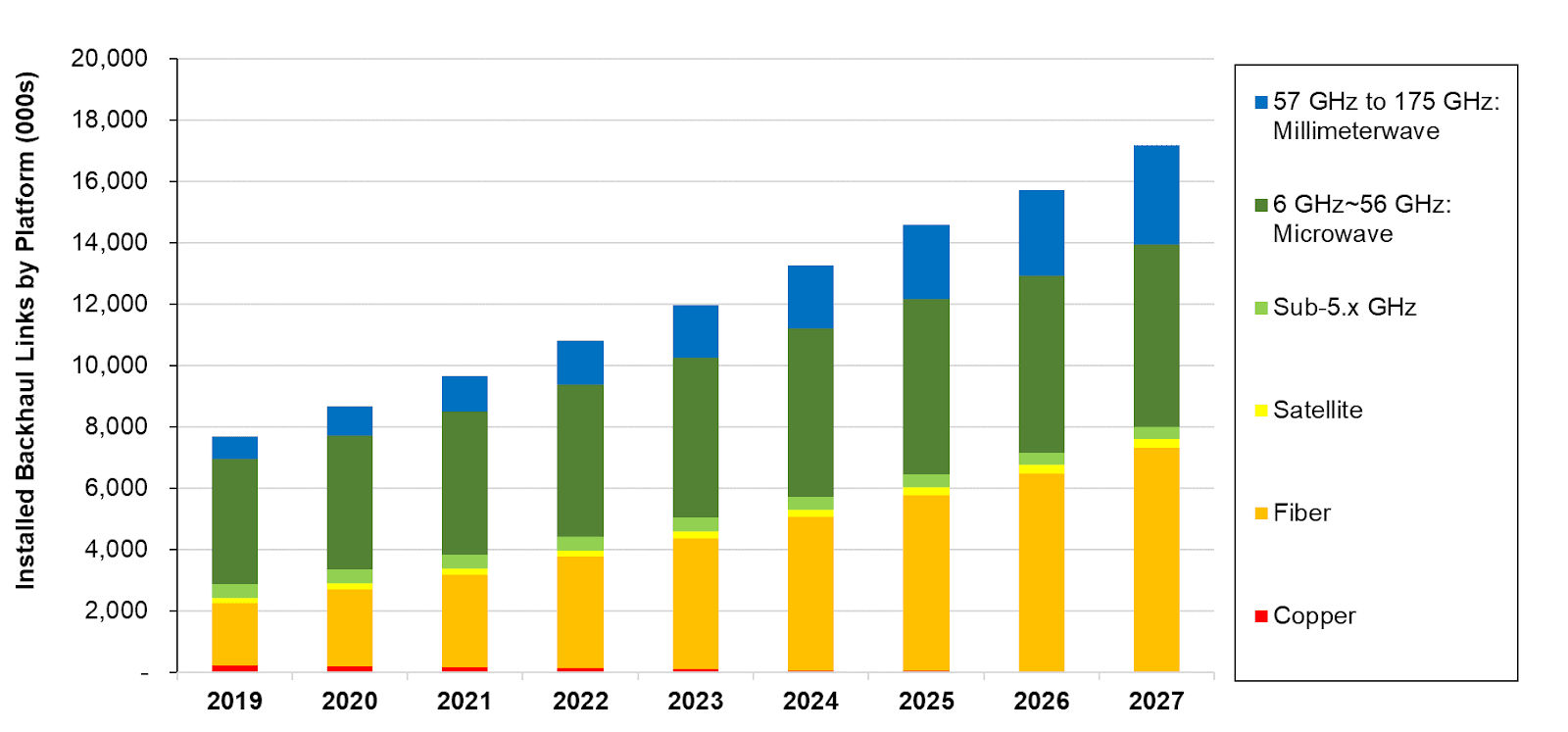
The need to further densify the network to support 5G will result in additional macro cells, and small cells in particular, being deployed in urban areas to handle the traffic. Macro cell links will increase from around 8.1 million links in 2021 to 11.1 million links in 2027, while the number of small cell backhaul links will increase from 1.6 million links in 2021 to 6.1 million in 2027 at a CAGR of 25.8%.
While fiber will be deployed, not all urban cell sites can be supported by fiber. Microwave and Millimeter wave (mmWave) backhaul links are versatile and can support significant data rates. The E-band can handle between 15X and 20X more traffic than the typical mid-microwave band (14 Gigahertz (GHz) to 25 GHz) backhaul links. Microwave backhaul has the advantages of immediacy of deployment, a moderate cost profile, and accessibility.
There is a migration toward the higher frequency bands within traditional microwave and within the mmWave bands. In general, regulators are gradually migrating backhaul links toward higher frequencies, as the sub-7 GHz becomes increasingly congested and largely purposed for access-related services—both cellular and Wi-Fi.
Evolution in architecture
As mobile telcos densify their networks, the underlying architectures are also shifting. The evolution of the macro cell backhaul network for 5G and the evolution of “ring/tree” topologies to “star” topologies is being driven by three factors:
- Network densification requires optimizing overall network capacity and latency performance
- RAN sharing and consolidation of operators
- Increased fiber penetration from core networks to the edge
Figure 2. Star Topology
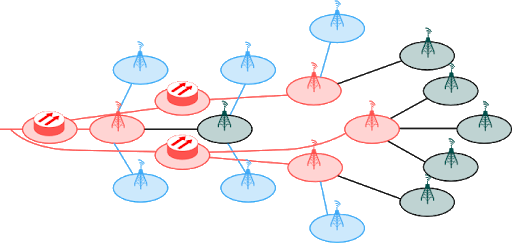
In a star topology, initial sites are connected using fiber-optic links, which subsequently support Point-to-Multipoint (P2MP) microwave and mmWave backhaul links.
Other strategies for boosting microwave and mmWave capacity include the following:
Secondary Polarization, or Cross-Polarization Interference Cancellation (XPIC), is a technique that can double the spectral efficiency by propagating two signals in a horizontal and vertical plane over the same channel. Nodal configuration and Cross-Polar Discrimination (XPD) are key issues to address for XPIC configurations. The European Telecommunications Standards Institute (ETSI) Class 4 antennas allow better performance of directly adjacent channels by lowering angle discrimination and helping in optimal nodal configurations. XPIC technology, on the other hand, can help reduce XPD by isolating polarizations and compensating for any link or propagation-induced coupling.
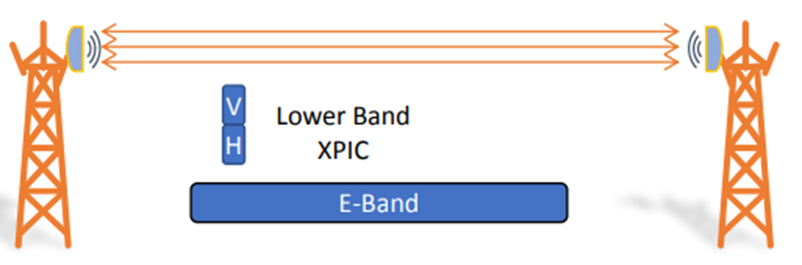
Bands and Carriers Aggregation (BCA) for backhaul involves bonding multiple channels across different frequency bands to build higher capacity Point-to-Point (PTP) connections. BCA for backhaul comes in many variations, with different frequency pairings catering to different deployment scenarios. For BCA combinations that support long-haul coverage with boosted capacity, channels within the International Telecommunication Union (ITU) traditional microwave frequencies (6 GHz to 42 GHz) can be combined with channels in the E-band frequencies (71 GHz to 86 GHz).
The link in the lower band is used to meet the carrier-grade availability (i.e., 99.995%); ensuring that high-priority traffic meets with the availability requirements of the network (especially in instances of links in higher band fading). Combining lower bands with the E-band using dual-band antennas would allow links to cover 7 Kilometers (km) to 10 km with capacities that can substantially exceed 10 Gigabits per Second (Gbps).
Figure 3. BCA with E-Band
Multiple In, Multiple Out (MIMO) has become an essential technology in several wireless applications and backhaul is no exception. Mobile operators can deploy wireless backhaul links in a 2×2 or 4×4 Line of Sight (LOS) MIMO configuration. A LOS 2×2 MIMO wireless link consists of two transmitters and receivers that are connected to two antennas on each side. A 4×4 MIMO link can also be executed in this setup by using four transmitters and receivers in both H and V polarization. Optimal antenna separation between signals is achieved by having them arrive separately, while maintaining a constant phase differential for the various antennas.
Role of the E-Band in backhaul
Wireless backhaul has been deployed in a swath of frequencies from 7 GHz to 44 GHz traditionally, but the introduction of the 71 GHz to 86 GHz band (or E-band) has been transformative. Due to the availability of E-band licensing in more than 86 countries and counting, the number of E-band links is expected to grow at a CAGR of 11.6% over the next 7 years. This uptick can be attributed to the increasing relevance of BCA solutions and the product maturity of the accompanying equipment that supports E-band link deployments. The total number of E-band links (2.3 million) could potentially account for 71% of overall mmWwave links (V, E, W, and D bands) by 2027.
While the E-band has large bandwidth (10 GHz) capabilities, transmission distances have historically been around 2 km to 3 km. However, autonomous beam tracking antennas with high-power E-band transmitters and larger antennas (0.6 meter and 0.9 meter) that serve to increase transmission distances to 3 km to 5 km, while supporting data rates up to 20 Gbps. Autonomous beam tracking enables intelligent algorithms to maintain the stability of transmission beams, thereby significantly reducing the stability requirements for E-band deployments on towers.
A light touch to licensing
Historically, backhaul spectrum has been kept on a short leash, with licenses usually renewed every 1 or 2 years. This suited the longer distance backhaul links, but as mobile operator cell sites have densified, operators need to install more links per 100 square km and need the flexibility to reconfigure links. Hybrid licensing approaches allow a band to be reserved on a block basis, but operators have the flexibility to self-organize within the block on a per link basis. This helps manage costs and helps coordinate with other users in adjacent bands.
Light licensing requirements reduces administrative filing requirements, and a longer tenure has been one of the success factors behind E-Band adoption. This lightly licensed approach to backhaul spectrum allocation does give the operator a high degree of service delivery assurance that the V-band unlicensed spectrum (60 GHz) does not have.
It is not just the number of links that is evolving, but also the amount of traffic they are carrying. Higher modulation schemes, wider channels, XPIC, and BCA have served to boost capacity. Licensing structures must evolve from their per link licensing fees to per block licensing fees with a lower administrative overhead approach. License fees that linearly scale with channel sizes serve as large financial barriers for operators. The current cost of spectrum per Megahertz (MHz) is mostly based on outdated formulas in which capacity throughput was not as important as the connection link itself.
In some countries, spectrum fees consider the amount of revenue being generated by the operator. This is problematic, as it can potentially penalize the operator that has a large subscriber base of lower-margin subscribers, such as lower-income households or rural communities. A straightforward pricing formula would be more favorable, as it gives an operator more control over budget planning.
Summary and conclusions
5G represents a tremendous upgrade opportunity for mobile telcos. Boosting data rates, reducing latency, and assuring reliability will have a transformative impact on existing cellular services and allow the introduction of new services. Fiber-optic will be a key backhaul technology platform for mobile telcos, but microwave and mmWave backhaul systems will prove to be vital solutions for a range of small cell and macro cell deployments in both urban centers and rural communities.
Governments and regulators will need to consider future backhaul spectrum needs carefully, so the right bands can be made available at the right time. In particular, the versatility of the E-band in terms of data throughput and the implementation of technologies, such as IBT, that boost transmission distances will make the E-band a valuable solution for mobile operators. Regulators will, therefore, need to evaluate backhaul spectrum pricing and ensure the formulas used to set fees are reasonable and do not disincentivize the use of wider channels, and encourage the use of advanced technologies.
Table of Contents


