


History
Software has been “eating the world” for a while now: from consumer, then enterprise and now the telecom value chains. Open RAN is a great example of how software is “eating” telco. What we have learned from the data center approach is that after creating reference designs (blueprints which took a little time) there was no additional complex integration needed – software took over, making the integration of the physical components and any upgrades easy. Yes, the hardware components still needed to be placed in the data center, cabled together, etc., but the initial integration was as simple as loading the software and/or powering on the hardware. Let’s call it “software integration nirvana” which happened in the enterprise market in the 2000s. Open RAN is becoming a disruptive trend that moves the telco infrastructure from a static, vertically integrated one with few players using proprietary solutions to a dynamic, horizontal architecture with many hardware and software players, like the innovative, dynamic, and software-driven personal computer and enterprise market.
Why
“The elephant in the room with regards to open RAN is, of course, integration,” Patrick Filkins, senior research analyst at IDC, said in a recent interview. He compared the journey to the NFV experience during its early days 12 years ago.
It doesn’t come as a surprise that recently Ericsson shared this slide stating integration concerns for Open RAN. At the end of this article, we will hear from mobile operators that have been integrating Open RAN for 5+ years, but for now, let us continue with our data center and software world comparison. Ericsson, or any legacy vendor for that matter, is looking at the integration of Open RAN through the lens of hardware, because this is all that they know, and this is how they have done business for years.
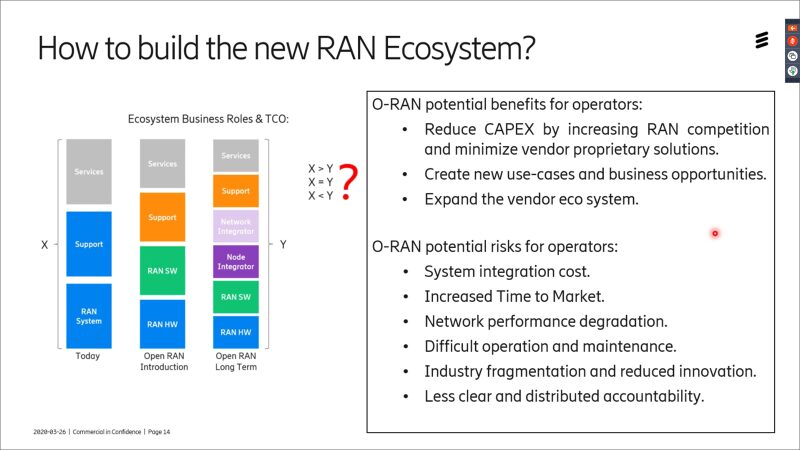
Source: Ericsson
We cannot expect that a hardware-centric and vertically integrated company of 144 years that uses system integrated principles of 50+ years will readily embrace how MNOs can integrate Open RAN components in the new software-driven world …
To integrate Open RAN, a new approach is needed, not from vertically integrated and hardware-centric companies, but from a software-driven, open and open-minded ecosystem of hardware vendors software vendors, system integrators, tower companies, real estate owners, regulators, industry bodies and mobile operators. Integration of Open RAN needs to be built for a software-centric world where software talks to all physical components, at any time, to deliver scalability, innovation and changing the game for how open networks are integrated.
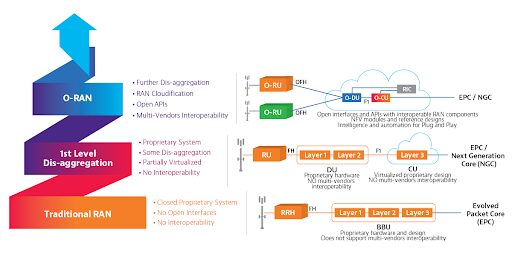
Source: Viavi
What is not going to change is how physical components (towers, antennas, batteries, servers) are installed. What will change is that software will make those components smarter and interoperable and will help those components to be integrated and maintained, in most cases remotely with just a software upgrade, no tower climbing required.
The main takeaway: Integration principles that are applied to traditional RAN cannot be applied to a software-driven one.
What
Nokia’s view on Open RAN integration is to “Integrate what you have to, open what you can.” The industry’s consensus is that interfaces between RU and DU/CU need to be open. We anticipate that open radios will be very capable within the next 2 years; DU infrastructure will evolve to be cost-effective as well.
Open RAN is of course about horizontal openness – with open interfaces enabling functions of the RAN to connect with other functions, from a radio unit to a baseband hosting Du/CU, or to the RIC (controller) element to the NMS/orchestrator and then to OSS/BSS system. Physical components will be located on-site and in the data center. What will make this horizontal system work is open interfaces between different components.
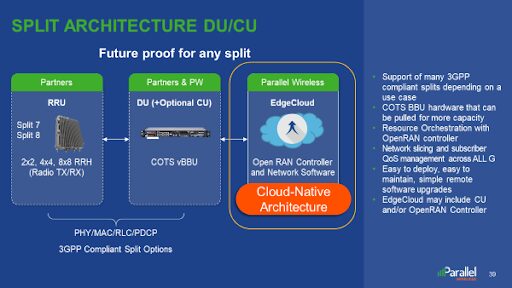
Source: Parallel Wireless
If we look at how RAN has been historically integrated, we can see three clear models: 1. Integrated and managed by an operator themselves, 2. Integrated and managed by one of the leading RAN hardware vendors (an example in the enterprise world would be IBM) and 3. Integrated and managed by a system integrator.
The RAN market in recent years has consolidated, and the three legacy vendors are not only dictating the hardware strategy, but also whether an operator decides to go with model 2, the integration strategy.
There are two levels of integration required when integrating Open RAN networks:
Open RAN ecosystem integration – the actual integration of the hardware and software with site and data centers infrastructure. In this case, the systems integrator will be responsible for integrating across the entire solution, including integrating open radios and the BBU software. The old model of RAN hardware vendors like Ericsson and Nokia being integrators might not work in the new world. “Asking vendors to integrate on behalf of their competitors did not pan out,” Filkins said in the same above-mentioned interview. The bulk of the system integration for the RAN is between the radio and the baseband, and if it comes from two different (competing) vendors, it might create issues. This is where TIP, the O-RAN Alliance with lab testing, and PlugFest will come in – a true community effort. To ensure the ecosystem thrives, if an MNO decides to go system integrator route, a chosen SI must be impartial and not aligned or associated with a specific hardware or software vendor.
System integration of the Open RAN software on COTS hardware. This level of integration is similar to what happens in the data center environment. In fact, many of the same DevOps tools and CD/CI principles are used, which further simplifies Open RAN integration through automation. This can be done for an MNO itself or a main SI that is responsible for a site build out. While some global system integrators are ready to become a neutral integrator, the responsibility between different vendors needs to be still figured out.
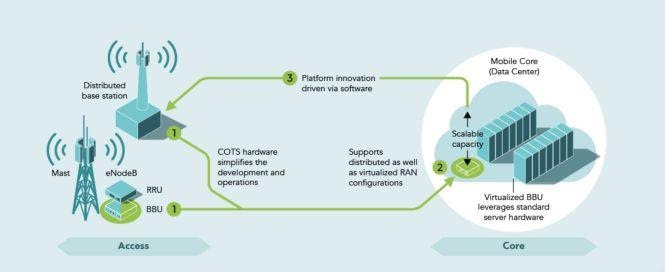
Source: TIP
In the past, software was tied to a physical element from a particular vendor, which created a vendor lock-in and required a hardware swap with any vendor changes. Today, hardware is COTS-based, and software can be not only remotely upgraded, but also swapped.
The main takeaway: Ease of integration is enabled through open interfaces.
When
Are we there yet? To quote Santiago Tenorio, Head of Network Strategy & Architecture, Vodafone who said in a recent webinar, “We haven’t even scratched the surface of system integration challenges.” Furthermore, a GSMAi mobile operator survey stated that 55% of responders see integration issues as the second largest challenge when asked about the major obstacles to introducing OpenRAN.
Open RAN is being currently deployed in multiple markets by multiple MNOs around the world and is entering commercialization stage. The pattern of innovation in Open RAN is similar to the Netflix model (below) — it puts the industry adoption of Open RAN at stage 2 – iterate and improve – and this is where integration comes in.
Here’s how are some of the early adopters of Open RAN have evolved traditional integration models:
Model 1 (MNO integrates themselves): Rakuten and Vodafone have proven to the world that overcoming Open RAN challenges is possible but requires strong and active operator involvement — the in-house vision, skills and capabilities are necessary for integrating new technologies successfully.
Model 2 (a hardware vendor integrates): Dish expects Fujitsu to provide support for radio and antenna integration and to ensure that the radio units and distributed units are fully interoperable.
Model 3 (using a system integrator): In Peru, Telefónica has relied on a Spanish systems integrator called Everis, which has a major presence in Latin America. In the future, the in-house resources will be implementing virtualization based on Whitestack for DevOps style with Continuous Development and Continuous Integration of the software to enable automation. The question is whether all this entails an increase in operational expenditure, especially if problems arise. “That is not the plan,” said del Val Latorre, Telefónica’s CEO of research and development, at TIP Summit 2019.
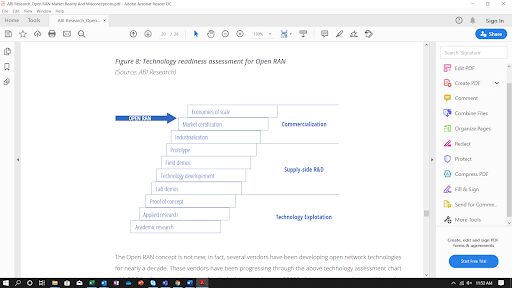
Source: ABI research
Main takeaway: It is important to note that even when an operator has the skills to integrate Open RAN, or has SI partners to help, hardware and software vendors need to implement their products as a solution, just like enterprise vendors currently do. This when Open RAN will reach the economics of scale.
How: Implementation and maintenance stage
As Open RAN steps in into the commercialization stage, it is clear that the implementation stage has been driven by the ecosystem and includes solution planning and design, supply chain management, shipping logistics, component testing, RF optimization and drive testing. Radio access products have much smaller tolerances than in the core network and require extensive testing before deployments. OpenRAN introduces a very foreign concept to MNOs — a “best of breed” RAN. Open RAN is that “best of breed” RAN.
Creating one is a work in progress, and this is where TIP and O-RAN Alliance and their members come in: to fulfill system integration, testing, and verification to create approved blueprints and reference designs, so operators can go out there and deploy tested, verified, “best of breed” RAN solutions. Vodafone is hoping that TIP can help steer the industry toward a more uniform approach to systems integration by creating a “central hub,” coordinated by TIP, which would allow mobile operators to share experiences. “This is one of our learnings from [TIP] trials”, said Tenorio in the above-mentioned webinar.
AT&T has been hosting the O-RAN Alliance Plugfests and proof of concept activities to demonstrate the multi-vendor compatible configuration, performance, and fault management capabilities. The O-RAN Alliance, for its part, publishes test and interoperability specifications alongside every interface it develops and is investing in open integration labs where different vendors and operators can come together to achieve interoperability goals to create “best of breed” RAN.
TIP and O-RAN Plugfests help hardware vendors, software vendors and system integrators to combine their integration efforts and get ready for field deployments.

Source: The Linux Foundation
While collaborative efforts continue, the success of Open RAN depends on the ecosystem’s ability to develop and execute a test and integration model. A Samsung paper states that many service providers believe that nearly 80 percent of the verification tasks are common across all MNOs.
In the past, the majority of contracts for integration or maintenance went to RAN suppliers, as they were specialists. As software makes network integration easier, we will see SIs that were in the past responsible for site build outs mostly of physical components, becoming software integrators as well. Near off-the-shelf, plug-and-play compatibility with mainstream deployments, tech maturity, and adoption of Open RAN standards helps to give that power to SIs and simplify the deployments.
In the maintenance stage, a single RAN vendor is an easy solution for support and can provide maintenance based on the service SLA to do performance monitoring, field services, and lifecycle support. But in Open RAN, any time a network failure occurs, it falls back on multiple parties: from the system integrator to suppliers of different hardware and software elements. There is no one neck to choke.
Software-based RAN and CD/CI implementation allows for more rapid deployment of upgraded features, thereby allowing the operator fine tune performance features for their network and roll out advanced new features like carrier-aggregation to boost performance. A DevOps approach with CD/CI can push updates quickly to many different sites, all automated and orchestrated. Also, mobile operators will begin implementing more flexible processes and operational models to take advantage of Open RAN with a migration plan that will include changing the way RAN is being procured, new software tools, OSSs, and upskilling workforce to manage software-enabled “best of breed” RAN.
The main takeaway: By getting reference designs and blueprints resulting from testing in the integrated Open Test and Integration Center (OTIC) environments and field trials, MNOs can gain more confidence in multi-vendor interoperability and focus their live network efforts on accelerating their Open RAN deployments by making “best of breed” RAN easier to purchase, deploy and maintain.
Table of Contents


