


RCR Wireless
  • News
  • Channels
    • 5G
    • 6G
    • BSS OSS
    • Carriers
    • IoT
    • Network Infrastructure
    • Open RAN
    • Private 5G
    • Telco AI
    • Telco Cloud
    • Test & Measurement
  • Resources
    • Reports
    • Webinars
    • White papers
    • AI Fundamentals
    • Analyst Angle
    • Editorial Calendar
    • Fundamentals
      • 5G NR Release 17
      • AI
        • Telco AI in 2025
    • Podcasts
      • Let’s Get Digital with Carrie Charles
      • Wireless Connectivity to Enable Industry 4.0 for the Middleprise
      • Well Technically…
      • Will 5G Change the World
      • Accelerating Industry 4.0 Digitalization
  • AI Infrastructure
  • Programs
  • Events
  • RCRtv
  • Advertise
  • Subscribe
Sunday, August 23, 2026
RCR Wireless
  • News
  • Channels
    • 5G
    • 6G
    • BSS OSS
    • Carriers
    • IoT
    • Network Infrastructure
    • Open RAN
    • Private 5G
    • Telco AI
    • Telco Cloud
    • Test & Measurement
  • Resources
    • Reports
    • Webinars
    • White papers
    • AI Fundamentals
    • Analyst Angle
    • Editorial Calendar
    • Fundamentals
      • 5G NR Release 17
      • AI
        • Telco AI in 2025
    • Podcasts
      • Let’s Get Digital with Carrie Charles
      • Wireless Connectivity to Enable Industry 4.0 for the Middleprise
      • Well Technically…
      • Will 5G Change the World
      • Accelerating Industry 4.0 Digitalization
  • AI Infrastructure
  • Programs
  • Events
  • RCRtv
  • Advertise
  • Subscribe
Add RCR Wireless as a preferred source on Google
  • Qualcomm 6G Insights
  • Huawei Content Hub
  • Qualcomm – 6G Vision
  • OSS/BSS Channel
  • RCRTech Roundtable: AI Infrastructure
RCR Wireless
RCR Wireless
  • Advanced Mimo
  • Mobile mmWave
  • 5G Positioning
  • Green Networks
  • Metaverse
  • Automotive
  • Industrial and Wide-area IoT
Copyright 2021 - All Right Reserved
Home - Opensignal analyzes US carriers’ 5G networks, decides winners
5GCarriersTest and Measurement

Opensignal analyzes US carriers’ 5G networks, decides winners

by Catherine Sbeglia Nin June 30, 2020
written by Catherine Sbeglia Nin June 30, 2020 Share
LinkedinEmail
Share 0LinkedinEmail
opensignal us map
230

Opensignal analyzed user experience across three 5G measures

In order to assess the current state of 5G services in the U.S., Opensignal presented its first-ever 5G awards after analyzing users’ experiences across three 5G measures: the average speed of the 5G connection when users have an active 5G link, or 5G download speed; the time users spend connected to 5G represented by 5G availability; and the overall speed our 5G users experience across different generations of mobile technology.

Because there’s a limited amount of mid-band wireless spectrum available in the U.S., American operators have approached 5G somewhat differently than other countries. AT&T and Verizon both went to market with millimeter wave-based 5G. Sprint launched 5G using its 2.5 GHz holdings and T-Mobile offers nationwide 5G using its 600 MHz spectrum. AT&T is also using its 850 MHz spectrum for 5G. Now that Sprint has become part of T-Mobile, the new combined carrier has an advantageous spectrum position.

However, the Federal Communications Commission (FCC) is preparing to auction mid-band spectrum (CBRS and C-band) later this year, the U.S.’s dearth of mid-band spectrum, sometimes called the goldilocks of spectrum, will come to an end.

While AT&T and T-Mobile, as just mentioned, launched mmWave 5G services, Opensignal reported that most of the time, instead of connecting to the carriers’ mmWave-based 5G services, subscribers are actually connecting to low-band 850 MHz or 600 MHz spectrum, which is also used for 4G service and offers good reach but more modest speeds. Opensignal said this indicates that the 5G experience in the U.S. is “very different to other countries and also differs greatly between U.S. carriers.”

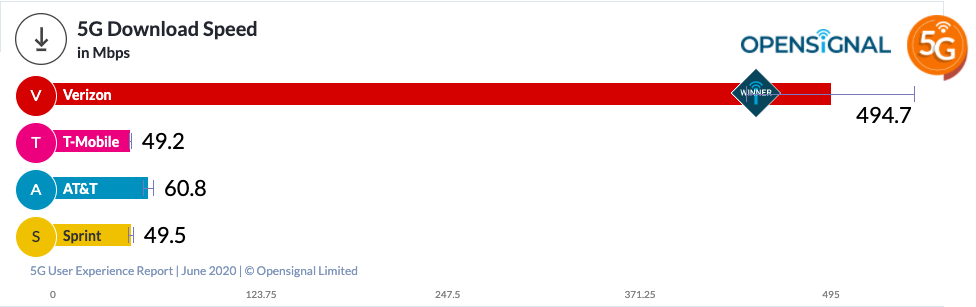
When it comes to the first award category, 5G download speed, Opensignal reported that users experienced average 5G Download Speed ranging from 494.7 Mbps on Verizon to 49.2 Mbps on T-Mobile, while AT&T’s users experienced slight faster 5G speeds than T-Mobile at 60.8 Mbps. The results were gathered from a variety of indoor and outdoor locations frequented by users, including at work, home or in public spaces like shops, parks and in transit locations.
Screen Shot 2020 06 29 at 3.00.22 PM

While most carriers’ 5G services delivered only moderately faster speeds than their 4G services, users on Verizon saw 5G speeds many times faster than users’ 4G speeds. In fact, Verizon users’ average 5G download speeds were 17.7 times faster than Verizon users’ average 4G speeds, compared with 1.8 times faster for AT&T and Sprint, and 1.7 times faster for T-Mobile.

According to Opensignal, Verizon’s drastic speed increase is due to the fact that the carrier Verizon is exclusively using very high capacity mmWave for its current 5G service which enables very high average speeds but smaller reach. On the other hand, the majority of AT&T and T-Mobile users’ 5G time is spent connected to 5G on lower spectrum bands where the reach is better, but the speeds are not considerably faster.

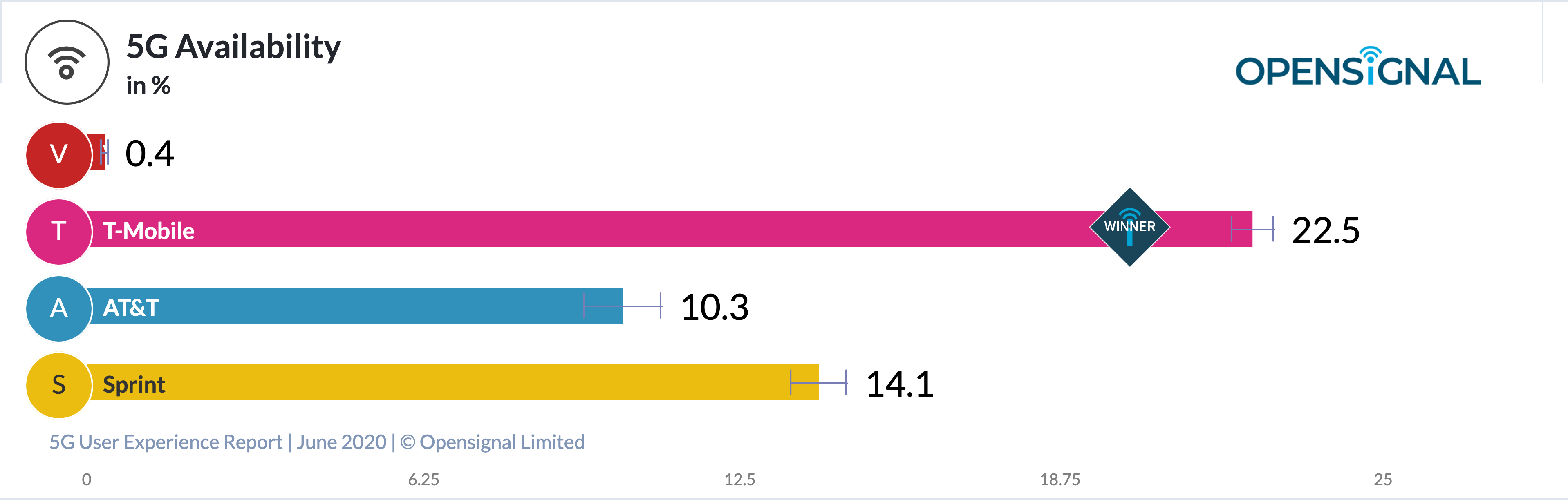
The second 5G network characteristic that Opensignal explored was 5G availability, astutely pointing out that “having very fast average 5G download speeds is only useful when users have a 5G connection.”

T-Mobile emerged as the clear winner in this category, with its users connecting on average to a 5G service for 22.5% of time. The other carriers, evident in the chart below, didn’t even put up a fight. Sprint users only connected to 5G services 14.1% of the time, while AT&T users connecting 10.3% of the tie and Verizon users connecting to 5G only 0.4% of time.
Opensignal chart 1

Again, Verizon’s use of mmWave is the reason behind these numbers, with Opensignal commenting that once Verizon starts to offer 5G on mid-band or other lower frequency spectrum, 5G availability on the carrier’s network will improve.

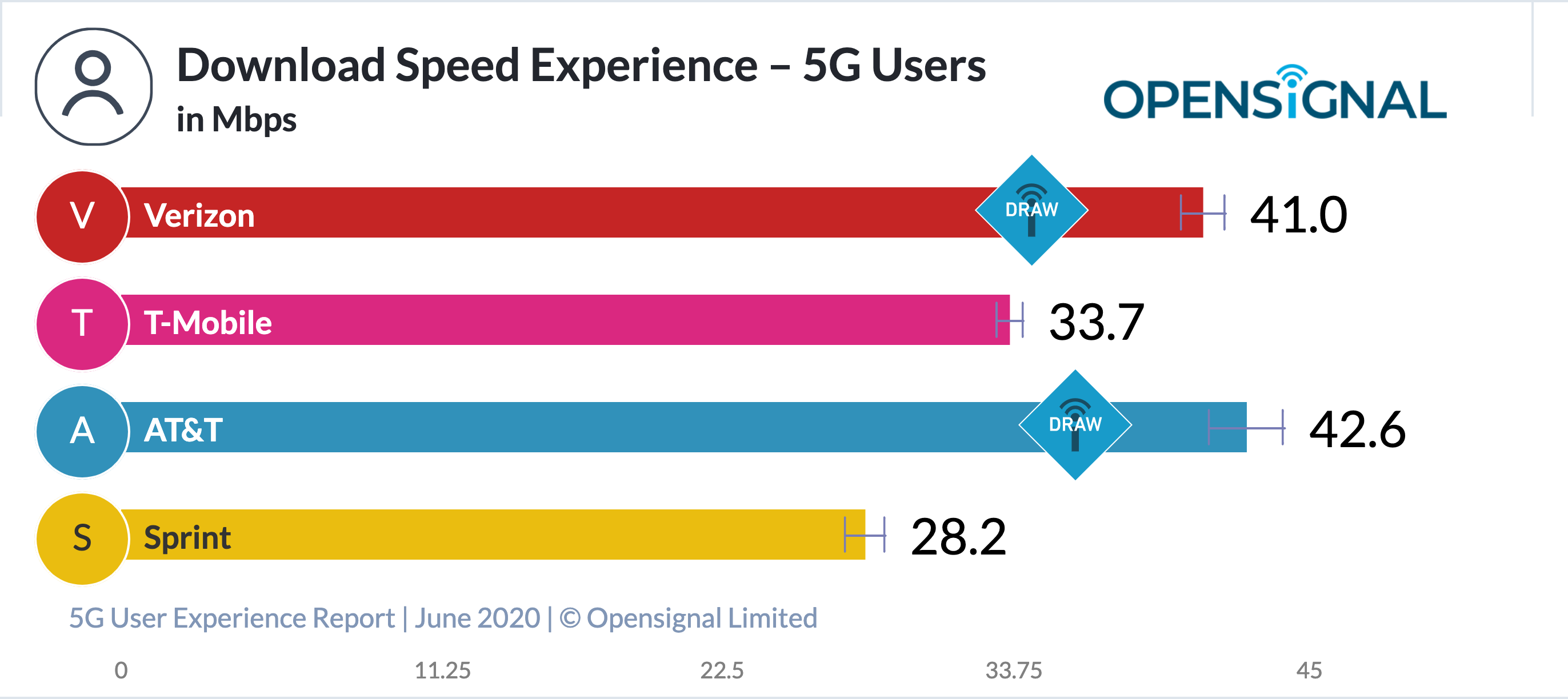
The final category under consideration, Download Speed Experience – 5G Users, combines the average speeds that 5G users experience on 3G or 4G when they are not connected to 5G, with their average 5G speeds, based on the amount of time they spend connected to each generation of mobile network technology.

AT&T and Verizon will share first place on this one, as they are statistically tied allowing for confidence intervals of 42.6 Mbps and 41.0 Mbps, respectively. While AT&T’s 5G users enjoy only the second fastest 5G connection speed, the combination of their fast 4G experience, as well as the 10.3% of time they spent connected to 5G on average, and a second placed 5G Download Speed, has generated an overall score that is the same as Verizon 5G users.
Opensignal chart 2 1

Similarly, despite the blazing fast speed of Verizon’s mmWave network, the carrier lost some momentum when it came to the amount of time users spend connected to 5G compared with AT&T’s users. When all of these features are taken into account, the two carriers become much more comparable in terms of user experience.


 

You Might Also Like
  • ZTE’s computing business drives H1 growth as carrier spending weakens
  • Omdia sees RAN growth outside China despite weak global market
  • Indosat, Nvidia launch AI center as telco expands AI infra
  • Telstra targets AI-driven growth with 5G, digital infrastructure push
  • Rakuten confirms KDDI roaming will be reduced as own network expands
  • KDDI expands AI, cloud, and data center investment
Share 0 LinkedinEmail
Catherine Sbeglia Nin

Catherine Sbeglia Nin is the Managing Editor for RCR Wireless News, where she covers topics such as Wi-Fi, network infrastructure, AI and edge computing. She also produced and hosted Arden Media's podcast Well, technically... After studying English and Film & Media Studies at The University of Rochester, she moved to Madison, WI. Having already lived on both coasts, she thought she’d give the middle a try. So far, she likes it very much.

previous post
AT&T makes 5G available in 28 new markets, expands DSS
next post
PropTech in the time of COVID-19

White Papers

  • Norton eBook: The 2026 Telco Playbook

  • Enea White Paper: Why Intelligent AAA is the Swiss Army Knife of Telecom

  • CSG White Paper: Telco AI Enabler: Mediation’s Defining Role

  • Enea White Paper: Scalable Database Design for 5G and Beyond

  • Supermicro and NVIDIA Whitepaper: Powering sovereign AI at scale

Editorial Reports

  • Report: Building AI-Era Network Fabrics

  • Quantum Safe Networks Market Pulse Report

  • Report: NTN in motion — evolving standards, expanding services

Webinars

  • Webinar: Building 6G — aligning technology, policy and purpose

  • SIMCom Webinar: Scaling your next deployment – from plastic to provisioning

  • Webinar: Rethinking the RAN as AI, cloud and openness converge

  • Webinar: Scale-Up, Scale-Out, Scale-Across – Building AI-Era Network Fabrics

  • Webinar: NTN in motion – evolving standards, expanding services

Since 1982, RCR Wireless News has been providing wireless and mobile industry news, insights, and analysis to mobile and wireless industry professionals, decision makers, policy makers, analysts and investors.

Facebook Twitter Youtube Linkedin Envelope Rss

Useful Links

  • Subscribe
  • About RCR Wireless News
  • Contact Us
  • Advertise
  • Editorial Calendar
  • Archive
  • RSS
  • Wireless News Archive
  • Subscribe
  • About RCR Wireless News
  • Contact Us
  • Advertise
  • Editorial Calendar
  • Archive
  • RSS
  • Wireless News Archive

Edtior's Picks

ZTE’s computing business drives H1 growth as carrier spending weakens
Planning for next: Black swans during an AI frenzy
AI infrastructure drives Keysight test demand

Latest Articles

ZTE’s computing business drives H1 growth as carrier spending weakens
Planning for next: Black swans during an AI frenzy
AI infrastructure drives Keysight test demand
KT unveils NPU LLM Station, a fully on-premise sovereign AI server

© 2026 RCR Wireless News All Right Reserved. Developed by Eight Hats.

Cookie Policy | Privacy Policy

RCR Wireless
  • News
  • Channels
    • 5G
    • 6G
    • BSS OSS
    • Carriers
    • IoT
    • Network Infrastructure
    • Open RAN
    • Private 5G
    • Telco AI
    • Telco Cloud
    • Test & Measurement
  • Resources
    • Reports
    • Webinars
    • White papers
    • AI Fundamentals
    • Analyst Angle
    • Editorial Calendar
    • Fundamentals
      • 5G NR Release 17
      • AI
        • Telco AI in 2025
    • Podcasts
      • Let’s Get Digital with Carrie Charles
      • Wireless Connectivity to Enable Industry 4.0 for the Middleprise
      • Well Technically…
      • Will 5G Change the World
      • Accelerating Industry 4.0 Digitalization
  • AI Infrastructure
  • Programs
  • Events
  • RCRtv
  • Advertise
  • Subscribe
RCR Wireless
  • News
  • Channels
    • 5G
    • 6G
    • BSS OSS
    • Carriers
    • IoT
    • Network Infrastructure
    • Open RAN
    • Private 5G
    • Telco AI
    • Telco Cloud
    • Test & Measurement
  • Resources
    • Reports
    • Webinars
    • White papers
    • AI Fundamentals
    • Analyst Angle
    • Editorial Calendar
    • Fundamentals
      • 5G NR Release 17
      • AI
        • Telco AI in 2025
    • Podcasts
      • Let’s Get Digital with Carrie Charles
      • Wireless Connectivity to Enable Industry 4.0 for the Middleprise
      • Well Technically…
      • Will 5G Change the World
      • Accelerating Industry 4.0 Digitalization
  • AI Infrastructure
  • Programs
  • Events
  • RCRtv
  • Advertise
  • Subscribe
@2020 - All Right Reserved. Designed and Developed by PenciDesign