


The arrival of RAN disaggregation and the corresponding standards for open interfaces, hardware, software decoupling, network intelligence and automation has led to the expansion of a diverse ecosystem of RAN component players, specifically Radio Unit (RU) vendors. While this ecosystem allows operators to pick from an array of solutions that meet their specific needs, there is one significant challenge that still remains for an operator planning to deploy multi-vendor Open RAN solutions: integrating these components from multiple vendors and making them deployment ready.
Operators have a keen interest in making sure that not only do these open components work with each other, but that they are also able to interoperate with their existing network infrastructure. In an old traditional system, an operator would buy from one to two vendors. If the integration process did not go well, they could go with the other vendor and implement a duplicate strategy. This turnkey approach afforded them some flexibility in their networks, but as we saw in our discussion about fronthaul, might have closed proprietary interfaces. However, operators only had one or two vendors to deal with. This “one throat to choke” approach afforded operators a certain level of confidence that any problems could be resolved.
Now, as the disaggregated RAN ecosystem has grown, the breadth of choices also means that operators have more vendors and products to coordinate. While this is a challenge, there are a number of existing elements in place that prevent this from becoming a roadblock in deploying Open RAN solutions. Let’s look at the different dimensions of this challenge in more detail.
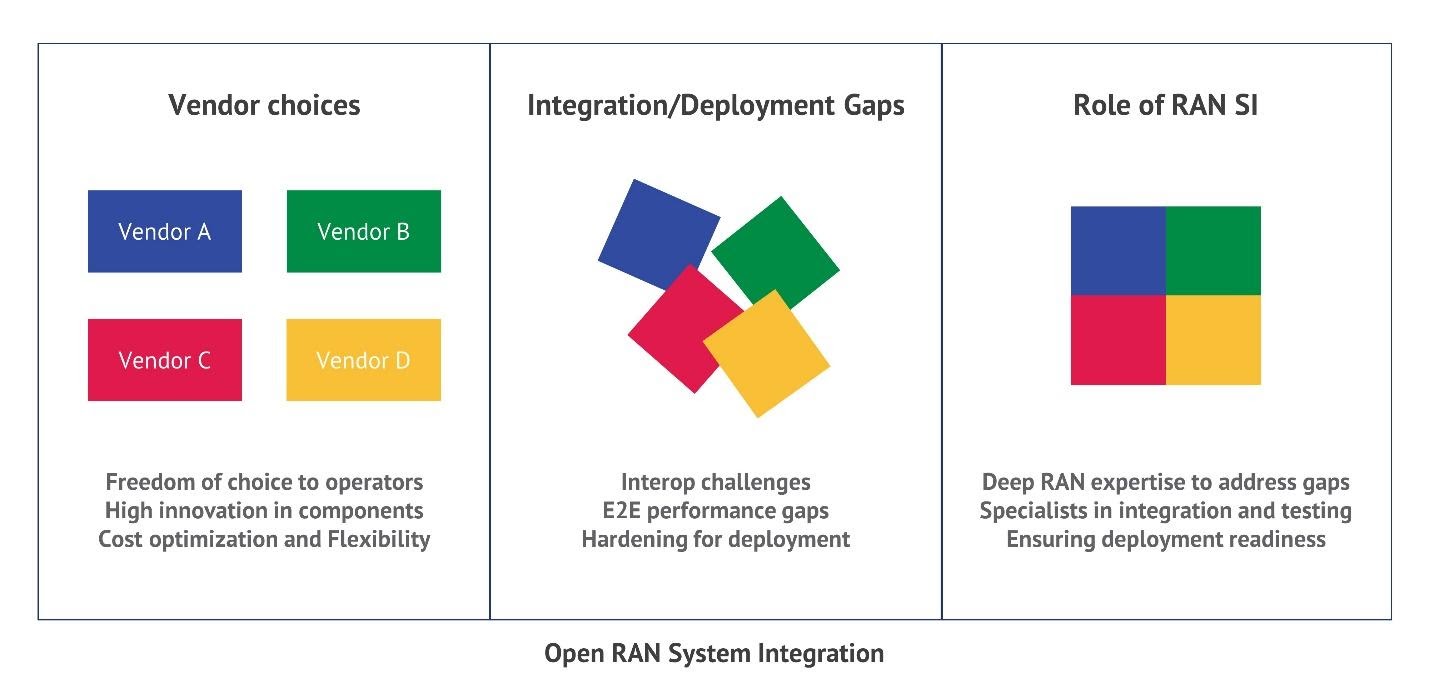
Open RAN system integration is not just another telco system integration
The telco industry has been flush with quite a few system integration players catering to operators’ various network and application level integration needs. They take care of network deployment and network management, and of managing data coming from the network. However, system integration skills alone are not enough when dealing with Open RAN system integration. Integration of radio access network components is indeed very challenging. Here are some of the key areas in which a system integrator must have significant capabilities in order to successfully deploy a multi-vendor RAN solution.
Integration: RAN component integration is very different from system integration. It requires deep knowledge of standards (3GPP, O-RAN, Small Cell Forum and others) as well as system architectures viewpoint, a good understanding of the hardware processors, SoC platforms, and how to integrate the underlying hardware and software environments. Finally, Open RAN integration requires knowledge of specialized processors like FPGAs and ASICs and application acceleration techniques to integrate them with general purpose hardware. Integration of all of these aspects requires a very niche experience to bring in any mix of hardware and software and make it all work together.
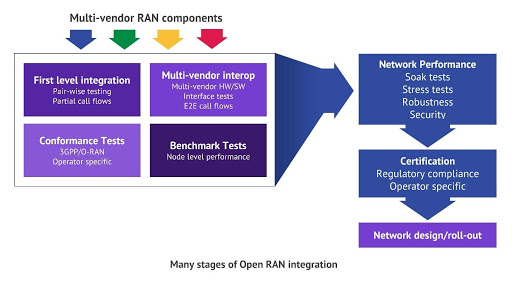
Testing: Knowledge of industry standard tools, the ability to automate and analyze test results, and characterizing the quality of integration are all key to successful testing of RAN solutions. This level of testing is not simple functional testing to make sure all of the network functions are talking together. It takes multiple levels of testing in multi-vendor RAN solutions, starting from the basic functional tests and call flows in an end-to-end fashion, to the various conformance, interoperability and other types of system testing.
Benchmarking: Just having a functional integration of RAN components is not enough. Operators want to know that a solution is performing on par with traditional solutions. RAN solutions, especially for 5G, should live up to the promise of high data rates, low latency and other performance aspects like being CPU efficient, catering to more users with less hardware resources, and network resiliency in case of failures. It takes an innate knowledge from a product design point of view of these nonfunctional aspects. It is imperative that system integrators have the product expertise to be able to identify the underlying issues or bottlenecks and recommend appropriate solutions.
Deployment Readiness: There are a few more steps after successful integration, testing and hardening of the solution. There are industry standard benchmarks and operator specific norms which must also be considered and implemented before a deployment is considered finished. These might include various operator specific conformance tests, regulatory compliance with specific laws and regulations for various countries, and field and operation specific aspects that enable an operator to manage things remotely. The diagram below summarizes the typical journey of successful integration to deployment.
Addressing Open RAN testing and interoperability needs
Today testing for Open RAN solutions needs to be done in a neutral venue where there are common scenarios for all to allow for increased visibility and promotion of broader interoperability. To make the process easier for operators and Open RAN system integrators, the O-RAN Alliance members are working to solve the common issues of integration, testing, benchmarking and deployment readiness both within and through the O-RAN Alliance.
The O-RAN Alliance Test and Integration Focus Group (TIFG) is made up of operators, test equipment vendors and RAN product vendors. This group focuses on the test specifications to achieve end-to-end operability.
In addition to the TIFG, the O-RAN Alliance working groups also publish detailed conformance and interoperability testing specifications. These different testing specifications help ensure interoperability among O-RAN network nodes and open interfaces. For example, the Open Fronthaul working group has recently published a conformance testing specification targeted mainly for O-RAN compliant radios.
The TIFG has also begun conducting “plugfests” in which vendors can bring their various components together and make sure that the solutions are interoperable. This provides opportunity for the ecosystem to also find new partners and expand their interoperability connections. Operators host these events and are able to see how these different products work together, meet their performance standards, and see the range of solutions available for their needs. As a result, operators are more confident in these O-RAN solutions and have begun working with these vendors in their own labs for further details, testing and evaluation. The second edition of O-RAN Plugfest is to be held across multiple geographic locations, during September this year.
New test tools in the market for Open RAN solutions
Just as Open RAN solutions have created more opportunity within other parts of the ecosystem, there is rapid growth taking place in the testing area as current and new vendors begin to develop new testing tools that the market needs. As new interfaces are defined, and new standards come out of the O-RAN Alliance, the leading testing vendors are embracing the O-RAN standards and are building new test products to ensure smooth and seamless integration. The test tools increase operator confidence in compliance and interoperability of multi-vendor Open RAN solutions.
The OTIC Initiative
As new testing tools are available and focus continues on solutions and interoperability, there is a need for a neutral lab and a neutral vendor that will allow operators and vendors to come together with their solutions. Operators and vendors need a neutral system integrator, familiar with all of the nuances inherent in Open RAN integration, testing, benchmarking and deployment readiness, who can serve in the integrator role and will test the interoperability for these solutions.
Last year, a group of leading Tier 1 operators within the O-RAN Alliance announced the Open Test and Integration Center (OTIC) Initiative. Led by China Mobile and Reliance Jio along with participation from China Telecom, China Unicom, Intel, Radisys, Airspan, Baicells, CertusNet, Mavenir, Lenovo, Ruijie Network, Inspur, Samsung Electronics, Sylincom, WindRiver, ArrayComm, and Chengdu NTS,
The O-RAN Alliance is actively encouraging operators to create OTIC labs for themselves and has published guidelines on how an OTIC lab is to function. China Mobile has already established several OTIC labs. As more OTIC labs are hosted by operators around the world, vendors will have a neutral venue to bring their products in and test them on a regular basis, speeding up development and implementation times.
Now operators have the key to Open RAN success
The challenge of a multi-vendor scenario for operators is not as insurmountable as it once was thought due to the efforts of the O-RAN Alliance. The work done by the working groups, the O-RAN plugfests, along with the neutral OTIC labs, is helping address the integration needs of the Open RAN ecosystem. Operators now have a way of evaluating the readiness of Open RAN solutions and are now taking them into their labs and testing them more extensively.
The industry makeup is shifting from a handful of vendors to a more robust ecosystem that is changing the deployment mix on a regional and global scale. By ensuring that solutions are completely ready for deployment and bringing in system integrators with a deep understanding of the nuances required in turning a multi-vendor offering into a hardened, ready to deploy end-to-end solution, the Open RAN ecosystem has met one of its biggest challenges, and is continuing to fundamentally alter the state of the industry.
In the next installment in our blog series, we will look at how these Open RAN solutions are performing compared to traditional solutions. Thanks to the benchmarking work that we have talked about, we have a really good idea.
Table of Contents

