

RCR Wireless
  • News
  • Channels
    • 5G
    • 6G
    • BSS OSS
    • Carriers
    • IoT
    • Network Infrastructure
    • Open RAN
    • Private 5G
    • Telco AI
    • Telco Cloud
    • Test & Measurement
  • Resources
    • Reports
    • Webinars
    • White papers
    • AI Fundamentals
    • Analyst Angle
    • Editorial Calendar
    • Fundamentals
      • 5G NR Release 17
      • AI
        • Telco AI in 2025
    • Podcasts
      • Let’s Get Digital with Carrie Charles
      • Wireless Connectivity to Enable Industry 4.0 for the Middleprise
      • Well Technically…
      • Will 5G Change the World
      • Accelerating Industry 4.0 Digitalization
  • AI Infrastructure
  • Programs
  • Events
  • RCRtv
  • Advertise
  • Subscribe
Thursday, July 23, 2026
RCR Wireless
  • News
  • Channels
    • 5G
    • 6G
    • BSS OSS
    • Carriers
    • IoT
    • Network Infrastructure
    • Open RAN
    • Private 5G
    • Telco AI
    • Telco Cloud
    • Test & Measurement
  • Resources
    • Reports
    • Webinars
    • White papers
    • AI Fundamentals
    • Analyst Angle
    • Editorial Calendar
    • Fundamentals
      • 5G NR Release 17
      • AI
        • Telco AI in 2025
    • Podcasts
      • Let’s Get Digital with Carrie Charles
      • Wireless Connectivity to Enable Industry 4.0 for the Middleprise
      • Well Technically…
      • Will 5G Change the World
      • Accelerating Industry 4.0 Digitalization
  • AI Infrastructure
  • Programs
  • Events
  • RCRtv
  • Advertise
  • Subscribe
Add RCR Wireless as a preferred source on Google
  • Qualcomm 6G Insights
  • Huawei Content Hub
  • Qualcomm – 6G Vision
  • OSS/BSS Channel
  • RCRTech Roundtable: AI Infrastructure
RCR Wireless
RCR Wireless
  • Advanced Mimo
  • Mobile mmWave
  • 5G Positioning
  • Green Networks
  • Metaverse
  • Automotive
  • Industrial and Wide-area IoT
Copyright 2021 - All Right Reserved
Home - Optimizing open RAN: Nokia, AT&T trial cloud-native RIC
5GCarriersOpen RAN

Optimizing open RAN: Nokia, AT&T trial cloud-native RIC

by Sean Kinney, Principal Analyst June 18, 2020
written by Sean Kinney, Principal Analyst June 18, 2020 Share
LinkedinEmail
Share 0LinkedinEmail
open RAN RIC
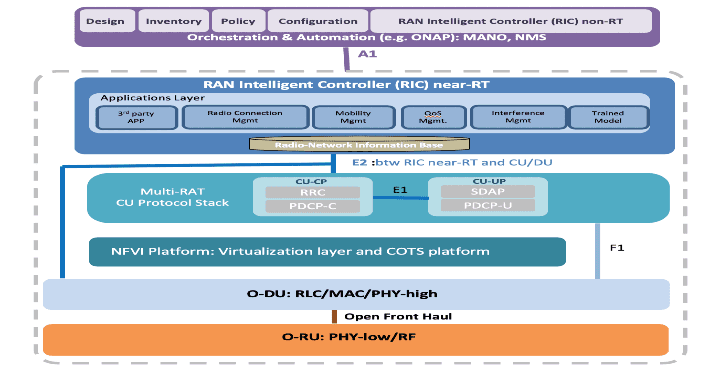
Image courtesy of O-RAN Alliance.
223

Nokia exec says open RAN marked by both merit and hype

Nokia and AT&T today announced a successful trial of a Radio Intelligent Controller (RIC) on the carrier’s millimeter wave 5G network in New York City. Nokia’s Sandro Tavares, global head of mobile networks marketing, told RCR Wireless News the trial met its goals of improving spectral efficiency and proving out functionality of this particular set of technologies derived from O-RAN Alliance technical work.

O-RAN Alliance’s Working Group 3 focuses on the RIC and describes its goal as defining a RIC architecture to enable “near-real-time control and optimization of RAN elements and resources via fine-grained data collection and actions over E2 interface.”

In this trial, the RIC was deployed as a software instance. Measurement and optimization applications were used to collect live network data. Nokia refers to these applications as xApps; in this case the partners used Measurement Campaign, Automated Neighbor Relation and Admission Control.

Describing the trial, Tavares said, “It was focused on one specific part of the city so not many sites. One thing that is important to learn from the architecture is that one RIC instance can support several base station sites. The way the architecture is evolving, and especially on 5G networks, you can have the RIC co-localized with the centralized until that basically handles that part of the baseband processing. Then, from that, you can actually manage up to hundreds of distributed units that are going to be deployed in a city.”

More on the xApp concept. The focus in this trial was on RAN optimization but Tavares said this premise could be extended and open up “new possibilities of third-party applications on top of the network. Basically any service that would benefit from having access to low latency could benefit from having a more direct connection to the RAN. For example, in just an anecdotal way, if you’re looking to a video streaming service or a video communication service, you can have an xApp that can optimize the delivery of the video to the terminals.” 

He said next steps are to develop more xApps “and start to show the value and show the applications working at scale, and then move to an implementation in the future.”

AT&T’s Mazin Gilbert, vice president of technology and innovation, said in a statement, “This successful trial is a testament to what we can achieve through openness and collaboration. Together with the O-RAN Alliance, AT&T and Nokia will continue to develop and contribute to the E2 interface and the RIC platform to help enable an intelligent and flexible 5G network.”

Open but integrated RAN

Open RAN is, well, it’s complicated. It’s complicated from a technology point of view and it’s becoming increasingly complicated from a political point of view as the U.S. gears up to drop some major coin on getting rid of domestically deployed Huawei equipment, pressure allies to do the same, and potentially invest in 5G-related R&D activities.

The thesis statement for open RAN is that it gives operators the ability to pick and choose equipment, which would break vendor lock-in, potentially create more favorable economics and drive scale, while also fostering competition and innovation. The counter is that disaggregating RAN hardware and software forces a trade-off in performance, especially as it relates to advanced RAN functionality like dynamic spectrum sharing, multi-channel carrier aggregation and massive MIMO for instance.

In a recent webinar, Nokia CTO and President of Nokia Bell Labs Marcus Weldon said, “Not all openness is good and not all closed-ness is good. And equally, not always is it necessary to be highly integrated and in many cases it’s good to be more loosely integrated and dynamically interworked. Maybe where we should be aiming…is somewhere in the middle.” As operators strategize in an effort “to find the bullseye in the middle” Weldon’s advice is to “integrate what you have to and open what you can.”

Tavares picked up on this thread in a Wednesday conversation. “It is actually the big point of discussion right now. Of course open RAN is a big topic and is there a lot of merit in it and there is a lot of discussion around it, but there is a lot of hype around it as well. We are looking at a more facts-based approach to open RAN. What are the areas where first of all we can achieve the best results in a shorter period of time and what are the areas that add a lot of complexity and need a bit more work before they become a reality?” 

He said it’s a pragmatic approach meant to “get the benefits of openness with more choices for our customers, the innovation that come with the functionality like RIC, but without losing too much on performance or without delaying the adoption of these advanced features that are actually being required by our customers right now.”

To the cost point, Tavares sketched out a scenario where an operator is using a multi-vendor open RAN approach. To provide a single point of contact in case an issue arises, similar to how operators segment networks by region and vendor, the operator could designate one of its multiple open RAN vendors to serve as the lead, for lack of a better term, or even bring in another third party to aggregate the disaggregation.

Editor’s note: I’m borrowing the phrase “aggregate the disaggregation” from Neeraj Patel, vice president of solutions and general manager of software and services at Radisys. Watch this video for more on open RAN from Patel. 

Talking through the cost/benefit of cheaper equipment versus more vendors and the attendant coordination requirements, Tavares said, “The costs can actually add up and then the whole economic point may not make sense. That’s why it’s important to reduce a little bit of the hype–focus on the facts and do the work.”

For more on open RAN and cloud-native design for 5G networks, listen to this episode of Will 5G Change the World? where Tavares expounds on these topics and others.

And for even more takes on open RAN, listen to even more episodes of Will 5G Change the World?:

  • Episode 5 with Parallel Wireless CEO Steve Papa
  • Episode 9 with Radisys CEO Arun Bhikshesvaran
  • Episode 10 with CommScope SVP Farid Firouzbakht


You Might Also Like
  • Wednesday (telco diary) | What AT&T and Lumen tell us about the AI fiber build-out
  • South Korea launches AI-RAN project to advance industrial AI
  • AT&T’s bets on “best tech” (fiber) pay off with record adds, improving margins 
  • The Agentic Network — Cisco on earning trust in autonomous operations
  • Blue Planet intros AI agents to fight OSS configuration drift – and stand-up telco trust
  • Rakuten Mobile expands O-RAN footprint with 1Finity radios
Share 0 LinkedinEmail
Sean Kinney
Sean Kinney, Principal Analyst

Sean focuses on multiple subject areas including 5G, 6G, Open RAN, hybrid cloud, edge computing, and Industry 4.0. Prior to his work at RCR, Sean studied journalism and literature at the University of Mississippi then spent six years based in Key West, Florida, working as a reporter for the Miami Herald Media Company. He currently lives in Fayetteville, Arkansas.

previous post
Unlocking the promise of IoT with standards (Reader Forum)
next post
eleven-x, Pinchin develop indoor environment monitoring solution

White Papers

  • Norton eBook: The 2026 Telco Playbook

  • Enea White Paper: Why Intelligent AAA is the Swiss Army Knife of Telecom

  • CSG White Paper: Telco AI Enabler: Mediation’s Defining Role

  • Enea White Paper: Scalable Database Design for 5G and Beyond

  • Supermicro and NVIDIA Whitepaper: Powering sovereign AI at scale

Editorial Reports

  • Market Pulse Report: Telco AI in 2026 – Trends, Challenges and Opportunities

  • Nvidia Report: The State of AI in Telecommunications: 2026 Trends

  • Report: Scaling Optical Networks For The Hyperscale And AI Era

Webinars

  • Webinar: Building 6G — aligning technology, policy and purpose

  • SIMCom Webinar: Scaling your next deployment – from plastic to provisioning

  • Webinar: Rethinking the RAN as AI, cloud and openness converge

  • Webinar: Scale-Up, Scale-Out, Scale-Across – Building AI-Era Network Fabrics

  • Webinar: NTN in motion – evolving standards, expanding services

Since 1982, RCR Wireless News has been providing wireless and mobile industry news, insights, and analysis to mobile and wireless industry professionals, decision makers, policy makers, analysts and investors.

Facebook Twitter Youtube Linkedin Envelope Rss

Useful Links

  • Subscribe
  • About RCR Wireless News
  • Contact Us
  • Advertise
  • Editorial Calendar
  • Archive
  • RSS
  • Wireless News Archive
  • Subscribe
  • About RCR Wireless News
  • Contact Us
  • Advertise
  • Editorial Calendar
  • Archive
  • RSS
  • Wireless News Archive

Edtior's Picks

AI drives new demands on optical networks, Ciena says
Market Pulse Report: Telco AI in 2026 – Trends, Challenges and Opportunities
Nokia nips and tucks, and sees supercycle upside – as AI and cloud...

Latest Articles

AI drives new demands on optical networks, Ciena says
Market Pulse Report: Telco AI in 2026 – Trends, Challenges and Opportunities
Nokia nips and tucks, and sees supercycle upside – as AI and cloud orders double
Only 50 of 170 digital infrastructure firms will exist in in five years (Reader Forum)

© 2026 RCR Wireless News All Right Reserved. Developed by Eight Hats.

Cookie Policy | Privacy Policy

RCR Wireless
  • News
  • Channels
    • 5G
    • 6G
    • BSS OSS
    • Carriers
    • IoT
    • Network Infrastructure
    • Open RAN
    • Private 5G
    • Telco AI
    • Telco Cloud
    • Test & Measurement
  • Resources
    • Reports
    • Webinars
    • White papers
    • AI Fundamentals
    • Analyst Angle
    • Editorial Calendar
    • Fundamentals
      • 5G NR Release 17
      • AI
        • Telco AI in 2025
    • Podcasts
      • Let’s Get Digital with Carrie Charles
      • Wireless Connectivity to Enable Industry 4.0 for the Middleprise
      • Well Technically…
      • Will 5G Change the World
      • Accelerating Industry 4.0 Digitalization
  • AI Infrastructure
  • Programs
  • Events
  • RCRtv
  • Advertise
  • Subscribe
RCR Wireless
  • News
  • Channels
    • 5G
    • 6G
    • BSS OSS
    • Carriers
    • IoT
    • Network Infrastructure
    • Open RAN
    • Private 5G
    • Telco AI
    • Telco Cloud
    • Test & Measurement
  • Resources
    • Reports
    • Webinars
    • White papers
    • AI Fundamentals
    • Analyst Angle
    • Editorial Calendar
    • Fundamentals
      • 5G NR Release 17
      • AI
        • Telco AI in 2025
    • Podcasts
      • Let’s Get Digital with Carrie Charles
      • Wireless Connectivity to Enable Industry 4.0 for the Middleprise
      • Well Technically…
      • Will 5G Change the World
      • Accelerating Industry 4.0 Digitalization
  • AI Infrastructure
  • Programs
  • Events
  • RCRtv
  • Advertise
  • Subscribe
@2020 - All Right Reserved. Designed and Developed by PenciDesign
