


RCR Wireless
  • News
  • Channels
    • 5G
    • 6G
    • BSS OSS
    • Carriers
    • IoT
    • Network Infrastructure
    • Open RAN
    • Private 5G
    • Telco AI
    • Telco Cloud
    • Test & Measurement
  • Resources
    • Reports
    • Webinars
    • White papers
    • AI Fundamentals
    • Analyst Angle
    • Editorial Calendar
    • Fundamentals
      • 5G NR Release 17
      • AI
        • Telco AI in 2025
    • Podcasts
      • Let’s Get Digital with Carrie Charles
      • Wireless Connectivity to Enable Industry 4.0 for the Middleprise
      • Well Technically…
      • Will 5G Change the World
      • Accelerating Industry 4.0 Digitalization
  • AI Infrastructure
  • Programs
  • Events
  • RCRtv
  • Advertise
  • Subscribe
Saturday, August 1, 2026
RCR Wireless
  • News
  • Channels
    • 5G
    • 6G
    • BSS OSS
    • Carriers
    • IoT
    • Network Infrastructure
    • Open RAN
    • Private 5G
    • Telco AI
    • Telco Cloud
    • Test & Measurement
  • Resources
    • Reports
    • Webinars
    • White papers
    • AI Fundamentals
    • Analyst Angle
    • Editorial Calendar
    • Fundamentals
      • 5G NR Release 17
      • AI
        • Telco AI in 2025
    • Podcasts
      • Let’s Get Digital with Carrie Charles
      • Wireless Connectivity to Enable Industry 4.0 for the Middleprise
      • Well Technically…
      • Will 5G Change the World
      • Accelerating Industry 4.0 Digitalization
  • AI Infrastructure
  • Programs
  • Events
  • RCRtv
  • Advertise
  • Subscribe
Add RCR Wireless as a preferred source on Google
  • Qualcomm 6G Insights
  • Huawei Content Hub
  • Qualcomm – 6G Vision
  • OSS/BSS Channel
  • RCRTech Roundtable: AI Infrastructure
RCR Wireless
RCR Wireless
  • Advanced Mimo
  • Mobile mmWave
  • 5G Positioning
  • Green Networks
  • Metaverse
  • Automotive
  • Industrial and Wide-area IoT
Copyright 2021 - All Right Reserved
Home - LoRa community hails “unique piece of silicon” as dual-mode IoT comes of age
DevOpsInternet of Things (IoT)NB-IoTNews & Event CoverageSmart CitiesSmart FactoryWi-FiWired Networks, Fiber

LoRa community hails “unique piece of silicon” as dual-mode IoT comes of age

by James Blackman May 26, 2020
written by James Blackman May 26, 2020 Share
LinkedinEmail
Share 0LinkedinEmail
193

The developer community working with LoRa-based IoT solutions took stock of Semtech’s new LR1110 module at a virtual meet-up last month, and declared it a “pretty unique piece of silicon”. The LR1110 is the latest in a flurry of dual-mode silicon that appears to be enabling new use cases for the IoT sector at large.

That is how Wienke Giezeman, co-founder and chief executive at The Things Network (TTN), summed it up, anyway, reflecting on the re-worked delivery and agenda of his group’s LoRaWAN conference, one of the earliest events to go online in the shadow of coronavirus (Covid-19).

Giezeman said: “The LR1110 combines different radio frequency technologies to determine the position of a device, or transmit data. It combines three radios into one unit, and can listen to all kinds of signals, and brings a lot of features – which is super-cool. It is a pretty unique piece of silicon.”

The LR1110 (‘LoRa Edge’) chip, launched in February, features a LoRa transceiver, a passive Wi-Fi scanner, and a multi-constellation GNSS scanner. Nicolas Sornin, creator of the LoRa technology and chief technology officer at Semtech, ran through its features at the TTN event, branded as The Things Conference.

The LR1110 (pictured) is the result of “three years of hard work” by a team of about 50 people at Semtech, apparently. It boasts a number of features, according to the firm, including Wi-Fi geolocation in as little as 80 milliseconds and GNSS geolocation in 1.65 seconds.
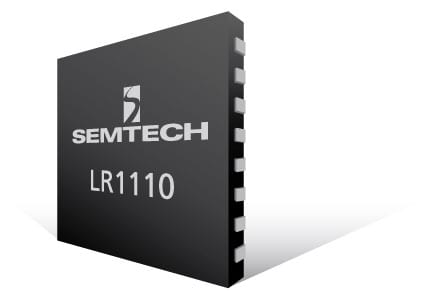
LoRa Edge LR1110These are combined with a LoRa transceiver in a single software defined radio, which limits the module to one activity at a time – “you can’t search for a GPS signal and decode Wi-Fi packets at the same time,” explained TTN – but allows for highly optimised low-power operation, from 100MHz to 1GHz.

Sornin highlighted certain points: the LR1110 operates as a modem and a transceiver; its keys are provisioned at the factory, though distributors can choose to override and load their own; OEMs can install firmware to match intended usage. At the same time, it will only run software from Semtech.

The point is it serves use cases that were previously only enabled by two or three pieces of silicon. “That is for sure. It also replaces multiple power-consuming pieces of silicon. That is the whole idea, because the whole thing [of IoT] starts to fall apart if it’s not power efficient,” said Giezeman, speaking with Enterprise IoT Insights after the event.

For GNSS geolocation, the LR1110 scans for satellites using a preloaded almanac, and then sends a LoRaWAN uplink with the transaction data, which is passed to a cloud solver to produce the latitude, longitude, and altitude. The cloud element is an opt-in service provided by Semtech as an HTTP endpoint.

With Wi-Fi geolocation, the device passively scans for available networks, and sends an uplink with a list of available networks and their signal strength. This data can be posted by the user to Semtech’s solver, which returns a location with an accuracy of around 30 metres.

The IoT market is moving increasingly towards dual-mode hardware that pairs short-range and wide-area IoT connectivity technologies to enable a range of new use cases. The logic to combine IoT technologies runs both ways, horizontally and vertically, explained Giezeman.

“In a horizontal direction, you have different technologies that do different things. Wi-Fi does something completely different to LoRaWAN; the same with Bluetooth. So you can put them side-by-side… [and] make it work all together.

“In the vertical sense, you can sometimes stack these technologies. So you might use 3G for the backhaul – or Wi-Fi or LoRaWAN as the backhaul for Bluetooth beaconing, for instance.”

He added: “But if you see these combinations and permutations, you can then build with these blocks. Because this is not a winner-takes-all market. These technologies amplify each other. Most of the time these technologies are complementary.

Towards the end of last year, the LoRa Alliance and the Wireless Broadband Alliance (WBA) issued a white paper together about combining LoRaWAN and Wi-Fi, specifically. The pair highlighted use cases in smart buildings, homes, and transportation applications.

Tiago Rodrigues, general manager for the WBA, said at the time the paper highlights the ways the two technologies are impacting private-public business models and enabling IoT services, and “complement one another… to further expand the internet of things.”

Donna Moore, chief executive and chairwoman of the LoRa Alliance, remarked: “No one single technology is going to fit the billions of IoT use cases. [Collaboration]… will drive innovation to solve important issues, leverage a broader range of applications and, ensure the success of global mass IoT deployments in the future.”

Meanwhile, Lacuna Space has broken the world record for the distance of a LoRaWAN packet transmission. The attempt, broadcast at The Things Conference in April, saw a high-altitude helium balloon fitted with a LoRaWAN sensor and launched from a field near Utrecht, in the Netherlands.

The gateway that picked up the data packet to break the record was 775 kilometres (476 miles) away in Grenoble, in France. Just before the balloon started its descent, a LoRaWAN packet was also received by a gateway 832 kilometres (517 miles) away, in the Czech Republic, near the border of Slovakia.

The gateway that picked up the message in Grenoble was installed as part of the Wise-IoT European project for smart ski station experimentation. The same gateway, by Kerlink, featured also in the last record breaking attempt, in 2019, which was set at 766 kilometres (476 miles) and held by the University of Zaragoza.

Does the record have any practical implication or application? None at all, reflected Giezeman. But it pushes the technology, and is fun for the LoRaWAN community to witness, he said.

“Why is it important? It’s not important; it has no practical use. But it is cool. It is an experiment, which stretches the technology to its furthest end. Sometimes you just want to see how far you can push something. It gives you an idea of the distribution capabilities.”


You Might Also Like
  • Japan’s private 5G market is finally moving beyond demo experiments (Analyst Angle)
  • Hollow-core fiber won’t hit cost parity for a decade – regarding HKT’s 3.2Tbps DCI ‘superhighway’
  • AI drives new demands on optical networks, Ciena says
  • Monday (telco diary) | Sovereign AI for Industry 4.0
  • When the push becomes the pull – private 5G and physical AI
  • Elisa targets data center growth through fiber connectivity
Share 0 LinkedinEmail
James Blackman
James Blackman

James Blackman has been writing about the technology and telecoms sectors for over a decade. He has edited and contributed to a number of European news outlets and trade titles. He has also worked at telecoms company Huawei, leading media activity for its devices business in Western Europe. He is based in London.

previous post
Trust, test and assure: A multi-party approach to 5G cybersecurity
next post
NTIA asks FCC to reconsider Ligado license changes

White Papers

  • Norton eBook: The 2026 Telco Playbook

  • Enea White Paper: Why Intelligent AAA is the Swiss Army Knife of Telecom

  • CSG White Paper: Telco AI Enabler: Mediation’s Defining Role

  • Enea White Paper: Scalable Database Design for 5G and Beyond

  • Supermicro and NVIDIA Whitepaper: Powering sovereign AI at scale

Editorial Reports

  • Market Pulse Report: Telco AI in 2026 – Trends, Challenges and Opportunities

  • Nvidia Report: The State of AI in Telecommunications: 2026 Trends

  • Report: Scaling Optical Networks For The Hyperscale And AI Era

Webinars

  • Webinar: Building 6G — aligning technology, policy and purpose

  • SIMCom Webinar: Scaling your next deployment – from plastic to provisioning

  • Webinar: Rethinking the RAN as AI, cloud and openness converge

  • Webinar: Scale-Up, Scale-Out, Scale-Across – Building AI-Era Network Fabrics

  • Webinar: NTN in motion – evolving standards, expanding services

Since 1982, RCR Wireless News has been providing wireless and mobile industry news, insights, and analysis to mobile and wireless industry professionals, decision makers, policy makers, analysts and investors.

Facebook Twitter Youtube Linkedin Envelope Rss

Useful Links

  • Subscribe
  • About RCR Wireless News
  • Contact Us
  • Advertise
  • Editorial Calendar
  • Archive
  • RSS
  • Wireless News Archive
  • Subscribe
  • About RCR Wireless News
  • Contact Us
  • Advertise
  • Editorial Calendar
  • Archive
  • RSS
  • Wireless News Archive

Edtior's Picks

Building the AI backbone, waiting on the AI billions
Ensuring colocation success by eliminating network observability blind spots (Reader Forum)
Thursday (telco diary) | Vodafone resets, AT&T reloads

Latest Articles

Building the AI backbone, waiting on the AI billions
Ensuring colocation success by eliminating network observability blind spots (Reader Forum)
Thursday (telco diary) | Vodafone resets, AT&T reloads
SK Telecom’s A.X K2 is South Korea’s biggest bet yet on sovereign AI

© 2026 RCR Wireless News All Right Reserved. Developed by Eight Hats.

Cookie Policy | Privacy Policy

RCR Wireless
  • News
  • Channels
    • 5G
    • 6G
    • BSS OSS
    • Carriers
    • IoT
    • Network Infrastructure
    • Open RAN
    • Private 5G
    • Telco AI
    • Telco Cloud
    • Test & Measurement
  • Resources
    • Reports
    • Webinars
    • White papers
    • AI Fundamentals
    • Analyst Angle
    • Editorial Calendar
    • Fundamentals
      • 5G NR Release 17
      • AI
        • Telco AI in 2025
    • Podcasts
      • Let’s Get Digital with Carrie Charles
      • Wireless Connectivity to Enable Industry 4.0 for the Middleprise
      • Well Technically…
      • Will 5G Change the World
      • Accelerating Industry 4.0 Digitalization
  • AI Infrastructure
  • Programs
  • Events
  • RCRtv
  • Advertise
  • Subscribe
RCR Wireless
  • News
  • Channels
    • 5G
    • 6G
    • BSS OSS
    • Carriers
    • IoT
    • Network Infrastructure
    • Open RAN
    • Private 5G
    • Telco AI
    • Telco Cloud
    • Test & Measurement
  • Resources
    • Reports
    • Webinars
    • White papers
    • AI Fundamentals
    • Analyst Angle
    • Editorial Calendar
    • Fundamentals
      • 5G NR Release 17
      • AI
        • Telco AI in 2025
    • Podcasts
      • Let’s Get Digital with Carrie Charles
      • Wireless Connectivity to Enable Industry 4.0 for the Middleprise
      • Well Technically…
      • Will 5G Change the World
      • Accelerating Industry 4.0 Digitalization
  • AI Infrastructure
  • Programs
  • Events
  • RCRtv
  • Advertise
  • Subscribe
@2020 - All Right Reserved. Designed and Developed by PenciDesign