
RCR Wireless
  • News
  • Channels
    • 5G
    • 6G
    • BSS OSS
    • Carriers
    • IoT
    • Network Infrastructure
    • Open RAN
    • Private 5G
    • Telco AI
    • Telco Cloud
    • Test & Measurement
  • Resources
    • Reports
    • Webinars
    • White papers
    • AI Fundamentals
    • Analyst Angle
    • Editorial Calendar
    • Fundamentals
      • 5G NR Release 17
      • AI
        • Telco AI in 2025
    • Podcasts
      • Let’s Get Digital with Carrie Charles
      • Wireless Connectivity to Enable Industry 4.0 for the Middleprise
      • Well Technically…
      • Will 5G Change the World
      • Accelerating Industry 4.0 Digitalization
  • AI Infrastructure
  • Programs
  • Events
  • RCRtv
  • Advertise
  • Subscribe
Sunday, July 19, 2026
RCR Wireless
  • News
  • Channels
    • 5G
    • 6G
    • BSS OSS
    • Carriers
    • IoT
    • Network Infrastructure
    • Open RAN
    • Private 5G
    • Telco AI
    • Telco Cloud
    • Test & Measurement
  • Resources
    • Reports
    • Webinars
    • White papers
    • AI Fundamentals
    • Analyst Angle
    • Editorial Calendar
    • Fundamentals
      • 5G NR Release 17
      • AI
        • Telco AI in 2025
    • Podcasts
      • Let’s Get Digital with Carrie Charles
      • Wireless Connectivity to Enable Industry 4.0 for the Middleprise
      • Well Technically…
      • Will 5G Change the World
      • Accelerating Industry 4.0 Digitalization
  • AI Infrastructure
  • Programs
  • Events
  • RCRtv
  • Advertise
  • Subscribe
Add RCR Wireless as a preferred source on Google
  • Qualcomm 6G Insights
  • Huawei Content Hub
  • Qualcomm – 6G Vision
  • OSS/BSS Channel
  • RCRTech Roundtable: AI Infrastructure
RCR Wireless
RCR Wireless
  • Advanced Mimo
  • Mobile mmWave
  • 5G Positioning
  • Green Networks
  • Metaverse
  • Automotive
  • Industrial and Wide-area IoT
Copyright 2021 - All Right Reserved
Home - Near, far, where-edge-er you are–The right edge for the right application
5GTelco Cloud

Near, far, where-edge-er you are–The right edge for the right application

by Sean Kinney, Principal Analyst May 15, 2020
written by Sean Kinney, Principal Analyst May 15, 2020 Share
LinkedinEmail
Share 0LinkedinEmail
Image courtesy of Inseego.
200

Edge computing is a broad term that, at a high-level simply means moving computing out of data centers and closer to where applications are running, but has specific qualities that pin what specific edge being referenced to the requirements of an application. 

To understand where the telco edge is, think first of an operator’s existing footprint, including pooled and standalone base stations, macro radio sites, colocation facilities, etc…In the context of a consumer 5G application like mobile gaming, putting compute at existing sites would pass on the latency benefits to the consumer by way of an improved mobile gaming experience with less jitter and lag and more responsive controls. 

For an enterprise, the edge, in many cases, sits at their facility. A manufacturer using 5G to connect robots needs to ingest, analyze and take action on machine-generated data in as close to real time as possible. If an operator is, for lack of a better term, selling edge computing as a service, favorable conditions could lead to placement of infrastructure that meets the specific customer’s needs as well as furthers the operator’s larger goals. Conversely, an enterprise, working with partners, could invest in a private network and the edge computing needed to maximize the value of the network.

So far these various edges have existed on the transmit side of the radio link, as far out as a radio site. However, as devices become more and more powerful, there’s a case to be made for the device as the ultimate edge. Things like on-device artificial intelligence is backed up by the compute power necessary to use apps with voice-based interfaces and for virtual assistants to interface with our calendars and contacts. Then, as explained in the next section, is another edge also on the user side of the radio link but not handsets. 

The point is, how you define edge is a function of the type of service being considered. The more latency dependent an application is, the closer computing should be to the user whether that’s a person or a machine. 

Inseego on extending the edge

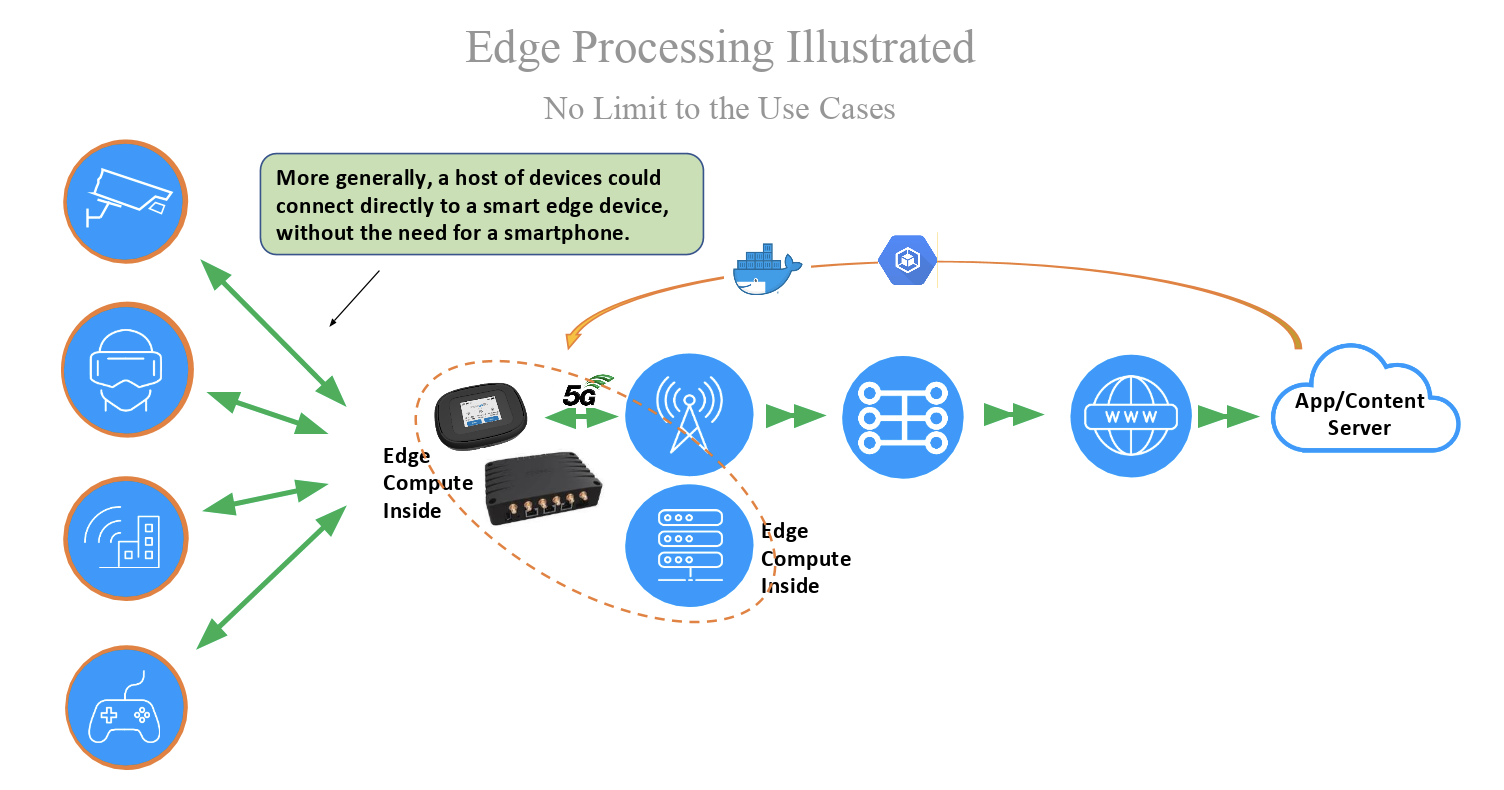
As laid out above, there’s a case to be made for the handset as the ultimate edge given ongoing enhancements to on-device AI based on various hyper-local data inputs. Dan Picker, CTO of Inseego sees another edge, a “bleeding edge,” that resides on the user side of the 5G radio link but not the handset–rather devices like the company’s 5G MiFi mobile hotspot which is compatible with the global New Radio standard and supports both sub-6 GHz and millimeter wave frequencies.

Picker made the case for using a dedicated piece of equipment to make highest and best use of both the 5G connection and the features of the handset. On the user side of the air link, “That’s where Inseego plays,” he said. “We make access devices; we make edge devices” These connect to phones, enterprise networks, gaming devices, AR/VR devices, HD cameras and other connected tech. “What we’re doing with our devices is we’re putting a piece of edge compute power on the other side of the 5G link which is going to offer a ton of advantages.” 

Move to the other side of the 5G link. “That’s where Inseego plays. We make access devices; we make edge devices.” those connect to phones, enterprise networks, gaming devices, headsets, other AR/VR devices or HD cameras. 5G is great for these sorts of applications. “What we’re doing with our devices is we’re putting a piece of edge compute power on the other side of the 5G link which is going to offer a ton of advantages.” 

Picker laid out scenarios highlighting the advantages and disadvantages of 5G and the location of the edge for much-hyped use case–artificial and virtual reality. For VR, consider a standalone headset where an application is running on a device and that application’s content resides on-device. “That’s the best possible case.” 

Now add in 5G. Content is delivered from the cloud in what Picker called a “unidirectional” manner. Relying on the cloud for more functionality means devices can get simpler and less expensive. This one-way flow from the cloud, over a 5G link, to a device works for VR but what about AR? 
Inseego 2

“You might have now some cameras,” Picker said. “Now you’re viewing the real world and you’re mixing into that the content that’s coming from the server. Now we’re dealing with a bi-directional stream. Latency suddenly makes a huge difference. This is where the edge cloud comes in. In this case, pretty much right up at the other side of the 5G link by the base station, processing and storage is brought into there. Now you avoid the bottleneck of having to go all the way through the internet to the cloud.” Given that we’re in relatively early days of building out edge infrastructure, this scenario is perfectly viable but very much a work in progress. 

So, in order to sustain multi-gigabit 5G throughput while taking advantage of edge computing, a dedicated device is the answer, Picker said. “Now your handset can be used for what it’s meant to do. You put all the functionality into this edge device that not only provides the access to the cellular network but also handles a lot of that edge processing for you.” Beyond handsets, this paradigm applies to connected cameras, gaming systems, headsets and other types of consumer and enterprise devices. 


You Might Also Like
  •  VodafoneThree puts P.I. Works’ SMO at the center of network transformation
  • Mimosa Networks and Viaero Wireless demonstrate scalable 5 GHz and 6 GHz fixed wireless broadband with AFC
  • What defines network performance in 5G and beyond? A CTO Perspective
  • Elisa says AI automation has cut network incidents by over 80%
  • Huawei outlines AI-centric network roadmap for telecom monetization
  • Indosat outlines AI Grid vision as 5G modernization targets nationwide AI-ready network
Share 0 LinkedinEmail
Sean Kinney
Sean Kinney, Principal Analyst

Sean focuses on multiple subject areas including 5G, 6G, Open RAN, hybrid cloud, edge computing, and Industry 4.0. Prior to his work at RCR, Sean studied journalism and literature at the University of Mississippi then spent six years based in Key West, Florida, working as a reporter for the Miami Herald Media Company. He currently lives in Fayetteville, Arkansas.

previous post
Monetizing the enterprise–the main obstacles facing operators (Reader Forum)
next post
Las Vegas expands smart city project to manage traffic, control crowds, catch crooks

White Papers

  • Norton eBook: The 2026 Telco Playbook

  • Enea White Paper: Why Intelligent AAA is the Swiss Army Knife of Telecom

  • CSG White Paper: Telco AI Enabler: Mediation’s Defining Role

  • Enea White Paper: Scalable Database Design for 5G and Beyond

  • Supermicro and NVIDIA Whitepaper: Powering sovereign AI at scale

Editorial Reports

  • Nvidia Report: The State of AI in Telecommunications: 2026 Trends

  • Report: Scaling Optical Networks For The Hyperscale And AI Era

  • Test And Measurement Market Pulse Report

Webinars

  • Webinar: Building 6G — aligning technology, policy and purpose

  • SIMCom Webinar: Scaling your next deployment – from plastic to provisioning

  • Webinar: Rethinking the RAN as AI, cloud and openness converge

  • Webinar: Scale-Up, Scale-Out, Scale-Across – Building AI-Era Network Fabrics

  • Webinar: NTN in motion – evolving standards, expanding services

Since 1982, RCR Wireless News has been providing wireless and mobile industry news, insights, and analysis to mobile and wireless industry professionals, decision makers, policy makers, analysts and investors.

Facebook Twitter Youtube Linkedin Envelope Rss

Useful Links

  • Subscribe
  • About RCR Wireless News
  • Contact Us
  • Advertise
  • Editorial Calendar
  • Archive
  • RSS
  • Wireless News Archive
  • Subscribe
  • About RCR Wireless News
  • Contact Us
  • Advertise
  • Editorial Calendar
  • Archive
  • RSS
  • Wireless News Archive

Edtior's Picks

Red Hat outlines AI-RAN roadmap
Ericsson wins role in £8bn UK’s defense upgrade as private 5G moves to...
Thursday (telco diary) | Satellite versus terrestrial

Latest Articles

Red Hat outlines AI-RAN roadmap
Ericsson wins role in £8bn UK’s defense upgrade as private 5G moves to frontline
Thursday (telco diary) | Satellite versus terrestrial
The Agentic Network — Deutsche Telekom on APIs for trusted AI

© 2026 RCR Wireless News All Right Reserved. Developed by Eight Hats.

Cookie Policy | Privacy Policy

RCR Wireless
  • News
  • Channels
    • 5G
    • 6G
    • BSS OSS
    • Carriers
    • IoT
    • Network Infrastructure
    • Open RAN
    • Private 5G
    • Telco AI
    • Telco Cloud
    • Test & Measurement
  • Resources
    • Reports
    • Webinars
    • White papers
    • AI Fundamentals
    • Analyst Angle
    • Editorial Calendar
    • Fundamentals
      • 5G NR Release 17
      • AI
        • Telco AI in 2025
    • Podcasts
      • Let’s Get Digital with Carrie Charles
      • Wireless Connectivity to Enable Industry 4.0 for the Middleprise
      • Well Technically…
      • Will 5G Change the World
      • Accelerating Industry 4.0 Digitalization
  • AI Infrastructure
  • Programs
  • Events
  • RCRtv
  • Advertise
  • Subscribe
RCR Wireless
  • News
  • Channels
    • 5G
    • 6G
    • BSS OSS
    • Carriers
    • IoT
    • Network Infrastructure
    • Open RAN
    • Private 5G
    • Telco AI
    • Telco Cloud
    • Test & Measurement
  • Resources
    • Reports
    • Webinars
    • White papers
    • AI Fundamentals
    • Analyst Angle
    • Editorial Calendar
    • Fundamentals
      • 5G NR Release 17
      • AI
        • Telco AI in 2025
    • Podcasts
      • Let’s Get Digital with Carrie Charles
      • Wireless Connectivity to Enable Industry 4.0 for the Middleprise
      • Well Technically…
      • Will 5G Change the World
      • Accelerating Industry 4.0 Digitalization
  • AI Infrastructure
  • Programs
  • Events
  • RCRtv
  • Advertise
  • Subscribe
@2020 - All Right Reserved. Designed and Developed by PenciDesign

