

RCR Wireless
  • News
  • Channels
    • 5G
    • 6G
    • BSS OSS
    • Carriers
    • IoT
    • Network Infrastructure
    • Open RAN
    • Private 5G
    • Telco AI
    • Telco Cloud
    • Test & Measurement
  • Resources
    • Reports
    • Webinars
    • White papers
    • AI Fundamentals
    • Analyst Angle
    • Editorial Calendar
    • Fundamentals
      • 5G NR Release 17
      • AI
        • Telco AI in 2025
    • Podcasts
      • Let’s Get Digital with Carrie Charles
      • Wireless Connectivity to Enable Industry 4.0 for the Middleprise
      • Well Technically…
      • Will 5G Change the World
      • Accelerating Industry 4.0 Digitalization
  • AI Infrastructure
  • Programs
  • Events
  • RCRtv
  • Advertise
  • Subscribe
Wednesday, July 8, 2026
RCR Wireless
  • News
  • Channels
    • 5G
    • 6G
    • BSS OSS
    • Carriers
    • IoT
    • Network Infrastructure
    • Open RAN
    • Private 5G
    • Telco AI
    • Telco Cloud
    • Test & Measurement
  • Resources
    • Reports
    • Webinars
    • White papers
    • AI Fundamentals
    • Analyst Angle
    • Editorial Calendar
    • Fundamentals
      • 5G NR Release 17
      • AI
        • Telco AI in 2025
    • Podcasts
      • Let’s Get Digital with Carrie Charles
      • Wireless Connectivity to Enable Industry 4.0 for the Middleprise
      • Well Technically…
      • Will 5G Change the World
      • Accelerating Industry 4.0 Digitalization
  • AI Infrastructure
  • Programs
  • Events
  • RCRtv
  • Advertise
  • Subscribe
Add RCR Wireless as a preferred source on Google
  • Qualcomm 6G Insights
  • Huawei Content Hub
  • Qualcomm – 6G Vision
  • OSS/BSS Channel
RCR Wireless
RCR Wireless
  • Advanced Mimo
  • Mobile mmWave
  • 5G Positioning
  • Green Networks
  • Metaverse
  • Automotive
  • Industrial and Wide-area IoT
Copyright 2021 - All Right Reserved
Home - How fast, how near, how private? The role of 5G and AI in industrial AR
5GBuildingsData AnalyticsEnterpriseFundamentalsInfrastructureInternet of Things (IoT)LTENews & Event CoveragePlatformsSensorsSmart FactoryWi-FiWired Networks, Fiber

How fast, how near, how private? The role of 5G and AI in industrial AR

by James Blackman April 28, 2020
written by James Blackman April 28, 2020 Share
LinkedinEmail
Share 0LinkedinEmail
148

Note, this article is taken from an editorial report on industrial AR, called Industrial AR – and the rise of the workers. The report is available to download here. 

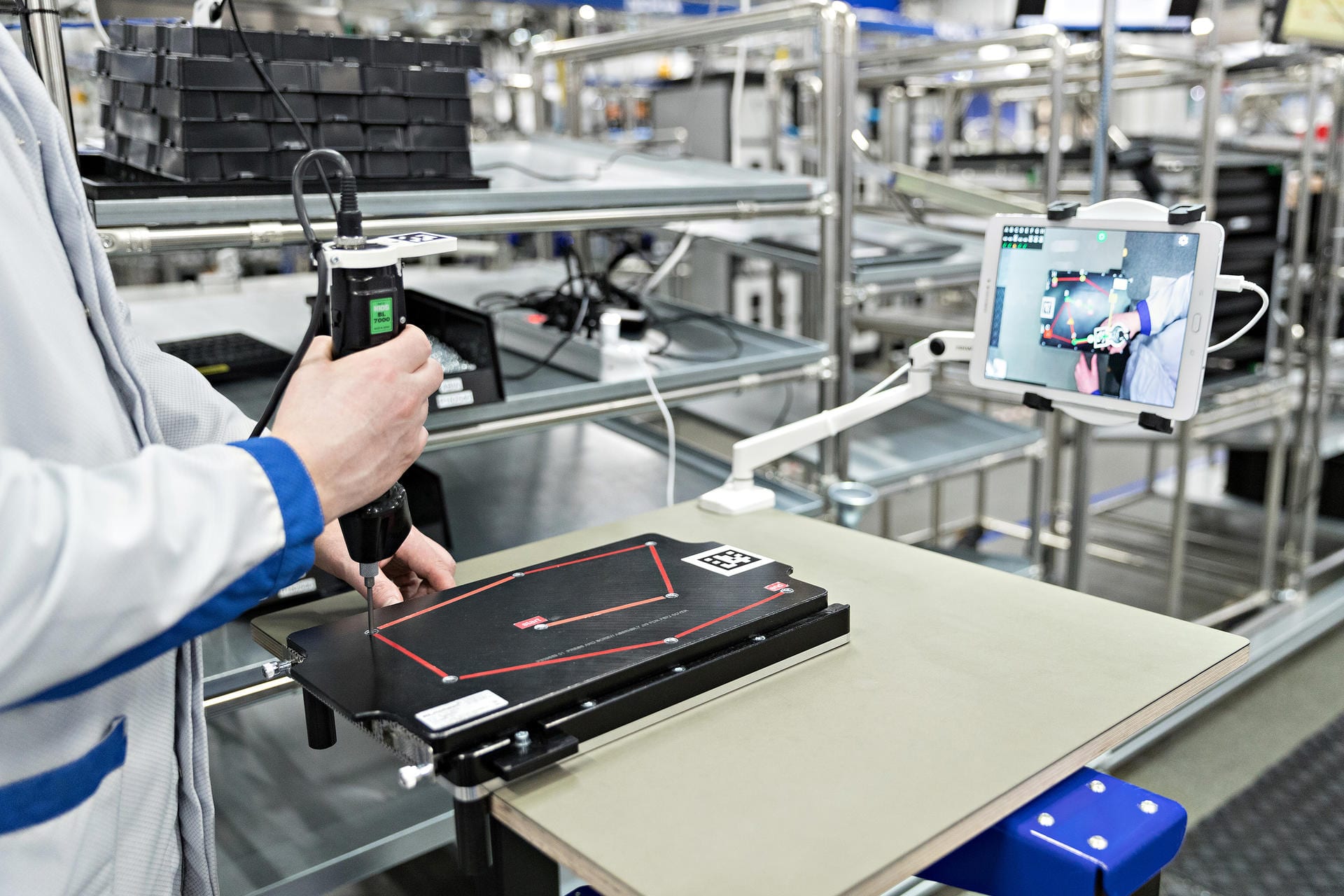
Let us start with the scenario the main article finishes (see report) with: a connected wrench, a connected work station, and a connected worker. It sounds like a lot of data, running between multiple points in real-time, to keep the illusion alive. What about the networking and processing?

What are the requirements in terms of latency, bandwidth, and edge-cloud compute in such a setup? The questions keep coming. Is Wi-Fi good enough? Is a wired setup preferred? Is the AR brigade another voice in the chorus line for industrialised of 5G? The answer is (almost) yes to all of the above, it seems.

But there are no absolutes, as well; circumstances vary with each use case, and the networking requirements shift alongside. PTC has told Enterprise IoT Insights before, as the telecoms set sought to muscle into the industrial space inside the halls of Hannover Messe a year ago, that it is not waiting around for 5G.

“You will get the same answer from me,” says Marc Schuetz, vice president of AR product management at PTC. “We are not dependent on 5G – at all. Some customers have fantastic high-speed Wi-Fi in their factories; others don’t have anything. Our solutions offer total flexibility for customers.”

The AR industry offers ways to stream to AR devices in real-time, but also to cache information on devices, to be available offline. The requirements are different with virtual reality (VR), which creates entire scenes for the viewer, and tends to be tethered to a smartphone or computer with more grunt.

With AR, only the overlay is to be transmitted, however. “The real power is to reduce the amount of data as much as possible, because you only want to render what is not in front of you.”

At the same time, the illusion is sacred; the virtual overlay must lock-in and move with the physical space. The data transfer goes both ways, unlike with video streaming on a smartphone; the AR playback must respond in real-time to positioning inputs to keep in step.

Some jobs are just higher maintenance. “Yes, there are times when faster networking is required,” concedes Schuetz, referencing the “gigantic amounts of data” required for design review; he goes back to the truck example (see page 16), where engineers overlay mock-ups of dashboard alteration while sitting in the cabin.

“You want to get that latency right down. If all the rendering happens in the cloud, the illusion is liable to fail – and the experience will suck. That is where a fast internet connection helps.”

Zeetta Networks is leading the new £3.8 million 5G-ENCODE project in the UK, the biggest government-funded trial of industrial 5G in the country. The project will investigate interactive AR as a key 5G use case to improve productivity and effectiveness of composite design and manufacture.

Network latency for AR should be tuned to less than 5 milliseconds, the company reckons. Any higher, and the chance rises of “disorientation, nausea and vomiting”. Justin Paul, the company’s director of marketing, comments: “We want to show that with 5G people can use AR for long periods without disorientation.”

Standalone 5G will get you there promises sub-millisecond latency, via support for ultra-reliable low latency communication (URLLC) in the forthcoming Release 16 of the standard. But in tests Zeetta Networks has hit the mark with a privately controlled LTE network, which has been highly optimised and geared with localised (within 50 kilometres) edge compute.

Paul remarks: “These applications work well in a controlled network with service prioritisation. They do not work well over networks that haven’t been optimised… Wi-Fi has limitations, but private LTE can support industrial AR and VR. If you know what you’re doing you can support AR and VR latency requirements today.”

Major manufacturing companies including the likes of Bosch, Lufthansa Technik (see images, above), and Siemens are starting to take up options on spectrum for privately-managed industrial 5G, to optimise networking for Industry 4.0 use cases like AR.

Wires are no good for AR, the industry agrees. But there are vested disagreements about how to unleash the technology. Ian Henderson, chief technologist for manufacturing at HPE, comments: “5G may help but many industrial facilities have limited internal mobile signal so Wi-Fi is a better alternative. Developments in WiFi 6 will allow greater bandwidth and lower latency… [and] optimisation [enables]… more freedom in use of both techniques.”

Brian Vogelsang, senior director of product management for XR at Qualcomm, comments: “5G will be transformative for AR and VR. Many facilities will set up private 5G networks [and] 5G modems in AR devices will unlock what we’re calling ‘boundless XR’, [where]… an AR/VR device hosts some processing and distributes heavier [loads to]… edge computers on-premise.

“This will allow for more sophisticated and photorealistic graphics. With private 5G, the edge is the factory’s data centre. With Boundless XR, the headset and network [split the processing but] work together to deliver a high-end experience.”

But industrial transformation with AR is feasible already; the message is not to wait for 5G, even if its arrival will bolster the experience.

Schuetz says: “In the field, with large volumes of data, 5G is going to help; no doubt. But we can break information into blocks, and deliver according to the location. Sure; this would be better with 5G as well. But I would never say we need 5G to be successful. The 5G industry will say that; the AR industry will not. We are successful already with 4G, and Wi-Fi, and whatever else.”


You Might Also Like
  • How the FCC can protect IoT innovation and GPS resilience in the 900 MHz band (Reader Forum)
  • What defines network performance in 5G and beyond? A CTO Perspective
  • Elisa says AI automation has cut network incidents by over 80%
  • “We’re going after the operator channel” – Druid bets on simplicity to scale private 5G
  • Huawei outlines AI-centric network roadmap for telecom monetization
  • Indosat outlines AI Grid vision as 5G modernization targets nationwide AI-ready network
Share 0 LinkedinEmail
James Blackman
James Blackman

James Blackman has been writing about the technology and telecoms sectors for over a decade. He has edited and contributed to a number of European news outlets and trade titles. He has also worked at telecoms company Huawei, leading media activity for its devices business in Western Europe. He is based in London.

previous post
Industrial groups combine to stop IoT fragmentation in the automotive industry
next post
“From acceptable to poor” – the trouble with AR headsets for industry

White Papers

  • Enea White Paper: Why Intelligent AAA is the Swiss Army Knife of Telecom

  • CSG White Paper: Telco AI Enabler: Mediation’s Defining Role

  • Enea White Paper: Scalable Database Design for 5G and Beyond

  • Supermicro and NVIDIA Whitepaper: Powering sovereign AI at scale

  • VIAVI Whitepaper: RAN scenario generators and their critical role for future-proofing AI-native RAN in Advanced 5G and 6G networks

Editorial Reports

  • Report: Scaling Optical Networks For The Hyperscale And AI Era

  • Test And Measurement Market Pulse Report

  • Editorial Report: Securing telecom infrastructure for the quantum era

Webinars

  • Webinar: Rethinking the RAN as AI, cloud and openness converge

  • Webinar: Scale-Up, Scale-Out, Scale-Across – Building AI-Era Network Fabrics

  • Webinar: NTN in motion – evolving standards, expanding services

  • Webinar: Noise-Figure Measurements with RFmx and PXI VSTs

  • Qualcomm Webinar – Building the 6G Standard: Key developments to know

Since 1982, RCR Wireless News has been providing wireless and mobile industry news, insights, and analysis to mobile and wireless industry professionals, decision makers, policy makers, analysts and investors.

Facebook Twitter Youtube Linkedin Envelope Rss

Useful Links

  • Subscribe
  • About RCR Wireless News
  • Contact Us
  • Advertise
  • Editorial Calendar
  • Archive
  • RSS
  • Wireless News Archive
  • Subscribe
  • About RCR Wireless News
  • Contact Us
  • Advertise
  • Editorial Calendar
  • Archive
  • RSS
  • Wireless News Archive

Edtior's Picks

How the FCC can protect IoT innovation and GPS resilience in the 900...
What defines network performance in 5G and beyond? A CTO Perspective
Elisa says AI automation has cut network incidents by over 80%

Latest Articles

How the FCC can protect IoT innovation and GPS resilience in the 900 MHz band (Reader Forum)
What defines network performance in 5G and beyond? A CTO Perspective
Elisa says AI automation has cut network incidents by over 80%
“We’re going after the operator channel” – Druid bets on simplicity to scale private 5G

© 2026 RCR Wireless News All Right Reserved. Developed by Eight Hats.

Cookie Policy | Privacy Policy

RCR Wireless
  • News
  • Channels
    • 5G
    • 6G
    • BSS OSS
    • Carriers
    • IoT
    • Network Infrastructure
    • Open RAN
    • Private 5G
    • Telco AI
    • Telco Cloud
    • Test & Measurement
  • Resources
    • Reports
    • Webinars
    • White papers
    • AI Fundamentals
    • Analyst Angle
    • Editorial Calendar
    • Fundamentals
      • 5G NR Release 17
      • AI
        • Telco AI in 2025
    • Podcasts
      • Let’s Get Digital with Carrie Charles
      • Wireless Connectivity to Enable Industry 4.0 for the Middleprise
      • Well Technically…
      • Will 5G Change the World
      • Accelerating Industry 4.0 Digitalization
  • AI Infrastructure
  • Programs
  • Events
  • RCRtv
  • Advertise
  • Subscribe
RCR Wireless
  • News
  • Channels
    • 5G
    • 6G
    • BSS OSS
    • Carriers
    • IoT
    • Network Infrastructure
    • Open RAN
    • Private 5G
    • Telco AI
    • Telco Cloud
    • Test & Measurement
  • Resources
    • Reports
    • Webinars
    • White papers
    • AI Fundamentals
    • Analyst Angle
    • Editorial Calendar
    • Fundamentals
      • 5G NR Release 17
      • AI
        • Telco AI in 2025
    • Podcasts
      • Let’s Get Digital with Carrie Charles
      • Wireless Connectivity to Enable Industry 4.0 for the Middleprise
      • Well Technically…
      • Will 5G Change the World
      • Accelerating Industry 4.0 Digitalization
  • AI Infrastructure
  • Programs
  • Events
  • RCRtv
  • Advertise
  • Subscribe
@2020 - All Right Reserved. Designed and Developed by PenciDesign