

Can 5G truly scale without a shift in network economics and collaborative development?
5G is billed as a revolutionary technology that will change consumer behavior and disrupt enterprises of all stripes. We’re currently in the very early days of commercial 5G so these paradigm-altering impacts have yet to be made real. And, based on accelerating work on developing interoperability for radio access network and edge computing infrastructure, many key stakeholders see the long view for 5G through a collaborative lens.
For 5G, the RAN is the largest focus of carrier capex and, in markets where millimeter wave spectrum is in play, that spend is compounded due to the density requirements needed to offset limited propagation. While the network edge is still taking shape in terms of ownership and high-value use cases, it’s clear that operators view 5G monetization as a function of the latency-sensitive services the combination of distributed computing and 5G can enable.
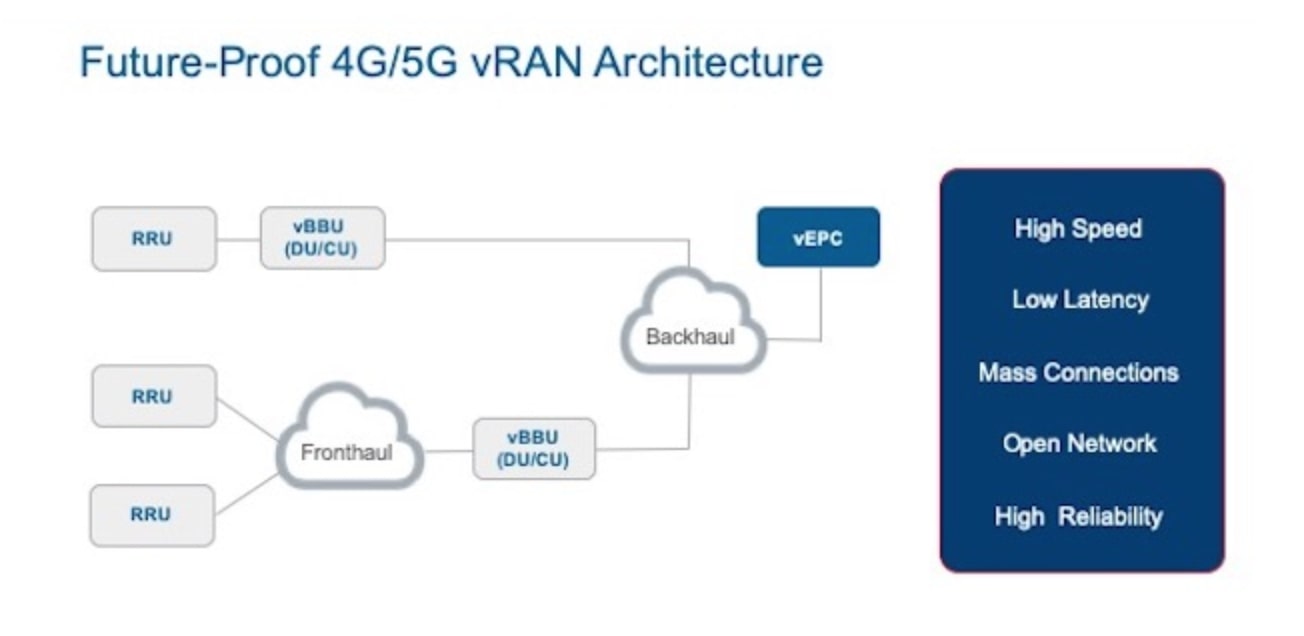
The broad premise of openness involves letting the buyer, in this case an operator or large enterprise, pick best of breed hardware solutions and use software frameworks to glue everything together as it were. If you project this forward, the idea would be to ultimately move from proprietary, single-purpose boxes to commercial off the shelf hardware running virtualized network functions.
While the technical underpinnings are typically worked though during the 3GPP standards-setting process, industry stakeholders are gone off-book so to speak in working to develop interoperability and other standards through consortia. We’ve seen this play out before with the MulteFire Alliance leading the charge on operating cellular solely in unlicensed spectrum; similarly, Verizon stood up the Verizon Technical Forum to develop what would become the non-standard, 5G Home fixed wireless service.
Opening up the edge
This trend is continuing now with the groups focused on working out what exactly open RAN and edge is. To the latter point, six of the largest telecom operators in January put together the 5G Future Forum, which is focused on interoperability and adoption of 5G and mobile edge computing. The founding members are América Móvil, KT, Rogers, Telstra, Verizon and Vodafone.
According to a statement from the carriers, the 5G Future Forum “will focus on the creation of uniform interoperability specifications to improve speed to market for developers and multinational enterprises working on 5G-enabled solutions.” Additionally, they said, they will “develop public and private marketplaces to enhance developer and customer access to 5G, and will share global best practices in technology deployment.”
“This partnership will deliver the most competitive and continuous services based on 5G infrastructure to our customers, and provide developers with edge platform to deploy solutions around the world,” said Dr. Hongbeom Jeon, CTO of KT.
“This forum of global leaders in 5G marks an important step in ensuring edge computing works seamlessly for our customers,” said Vinod Kumar, CEO of Vodafone Business. “These new specifications will allow us to offer services that work consistently across the globe and support devices moving between countries. 5G opens up a wealth of opportunities for new solutions and business models and we’re excited to play a role in bringing them to life.”
Click here for more on the 5G Future Forum.
Ahead of MWC Los Angeles in October, Verizon announced it had internally developed a “GPU-based orchestration system” that could “enable the development of scalable GPU cloud-based services.” In a statement, the operator said its team “developed a prototype using GPU slicing and management of virtualization that supports any GPU-based service and will increase the ability for multiple user-loads and tenants.” Tests focused on computer vision and a gaming service; in both cases, the new tech significantly increased the number of the concurrent users.
Facial recognition and cloud gaming are both use cases that have drawn global interest and are both use cases that require the combination of a low-latency 5G connection and an edge computing infrastructure capable of enabling the real-time aspects of data processing associated with identifying a person from a streaming video feed or delivering a consistent gaming experience to a mobile device.
Open RAN and OpenRAN
The general criticism around open RAN initiatives is that the tech isn’t ready for prime time and is still limited to parts of networks, generally rural communities or geographies otherwise hard to connect. However, that tide seems to be turning given some of the large-scale interest from major telcos.
Vodafone has tested open RAN technologies in parts of Turkey and South Africa and, in October, began testing the radio access network equipment in the United Kingdom. And, in a presentation in November at the Telecom Infra Project Summit in Amsterdam, Vodafone’s Head of Network Strategy and Architecture Yago Tenorio said the operator would initiate a tender covering its entire European footprint–more than 100,000 sites in 14 countries.
Vodafone Group CEO Nick Read who said the operator is “ready to fast track” open RAN in Europe “as we actively expand our vendor ecosystem. OpenRAN improves the network economics enabling us to reach more people in rural communities and that supports our goal to build digital societies in which no one is left behind.”
There’s a distinction between open RAN and OpenRAN that’s worth noting. The former refers broadly to the idea of developing open interfaces and inoperability to build multi-vendor RAN sites using commodity hardware. OpenRAN is a specific TIP project that contemplates the same goal covering 2G, 3G, 4G and 5G. TIP describes OpenRAN as focused “on developing a vendor-neutral hardware and software-defined technology based on open interfaces and community-developed standards. Unlike traditional RAN, OpenRAN decouples hardware and software. This gives operators more flexibility as they deploy and upgrade their network architecture in various deployment scenarios and geographies.”
On the spec side, the O-RAN Alliance, a combination of the former XRAN Forum and C-RAN Alliance, is an operator-led group that develops actual specifications for things like open fronthaul, RAN controllers and so forth.
Open RAN is also moving from more isolated deployments to more dense network and user environments. U.K. operator O2 last month announced it will work with Mavenir, DenseAir and WaveMobile to deploy 4G and 5G networks in dense environments and as well as more isolated rural communities.
“O-RAN represents a really exciting opportunity to deliver better coverage, in more places, more of the time. By opening up our radio access network to smaller vendors, and as we look towards wider adoption of 5G, O-RAN will be part of the solution to bring the latest connectivity to more people around the country,” said O2 CTO Brendan O’Reilly.
For its part in the project, Mavenir, which launched its fully virtualized 4G/5G OpenRAN solution in October, will focus its O-RAN attention on London’s high-density areas—such as stadiums and shopping centers—with the objective to deliver enhanced mobile connectivity. Stefano Cantarelli, CMO of Mavenir, commented, “Densification of coverage in cities is a challenge, but OpenRAN is ready to take it forward.”
In the U.S., open RAN could get a shot in the arm by way of federal funding meant to further 5G-related R&D from U.S. companies like Mavenir. This comes amid the ongoing disputes between the U.S. and China and infrastructure vendor Huawei, which some U.S. officials contend could act as an agent of the Chinese state.
On the U.S. carrier side, Verizon SVP Nicki Palmer, in an interview during Mobile World Congress Los Angeles, said there are benefits and challenges associated with opening up the RAN. “Our ideal, like our North Star, is that we’re able to pick best-of-breed componentry and stitch it together. Best-of-breed gives us the performance characteristic we want [and] the cost we want.”
On the other hand, open RAN “does require a level of interop, a level of integration. But I think, you know, we’re a while away from fully realizing the vision that I just laid out but we’ve been chipping away at it and working towards it.”
Table of Contents

