

LoRaWAN will work in the 2.4 GHz spectrum band, also occupied by Wi-Fi and Bluetooth systems, to enable LoRaWAN-based IoT devices to work globally at the same frequency for the first time, without needing to switch between sub-GHz bands in roaming.
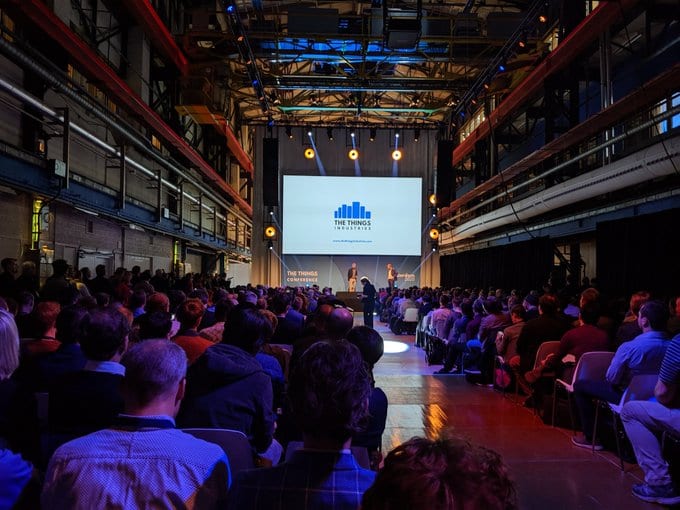
That is the proposal, at least, which caught the imagination of the LoRaWAN community at The Things Conference in Amsterdam this week. The LoRa Alliance confirmed it has prioritized 2.4 GHz compatibility for LoRaWAN in its working groups, but said also the move may be too soon for the LoRaWAN community, comprising both DIY IoT makers and major corporations, and that a final decision is still to be made.
“It is on the table,” remarked Alper Yegin, who heads the LoRa Alliance technical committee, said in a keynote about the future path of the technology.
He said: “We have this prioritization activity, because a lot of features are coming into the LoRa Alliance, and even though we look like a big crowd, we are in fact at the infancy of the ecosystem, and we need to respect its capacity to absorb new features. For that reason, we are going through this activity, but that is all I can say.”
At the same time, 2.4 GHz LoRa gateways and devices will start to hit the market through 2020, the event was told in an earlier presentation, with the first 2.4 GHz LoRa gateway from MultiTech Systems already available, and the first 2.4 GHz LoRa deployment live with maritime group Wilhelmsen’s shipping fleet, as announced at the end of 2019.
LoRaWAN has so far operated at various sub-GHz frequencies, in different global markets. LoRaWAN compatibility at 2.4 GHz is geared towards global roaming, and also for indoor use cases in the smart buildings and smart industry sectors, said The Things Network, the Netherlands-based LoRaWAN community support group, and the show host.
The Wilhelmsen deployment is with The Things Industries, its LoRaWAN operator spinoff. The Amsterdam meetup, billed as a “no-nonsense IoT conference” at the start of a season of bluster and hype on the conference circuit, sought to address challenges around how to simplify and scale LoRaWAN based IoT deployments.
The Things People (?!) told a packed room in an old warehouse on the waterfront in Amsterdam that the LoRaWAN industry had evolved out of an “open standards and hard work” – as well as an “accumulation of screw-ups” – to reach some maturity, with network deployments going from only hundreds of gateways a couple of years back, to thousands in 2019, and hundreds of thousands at the start of 2020.
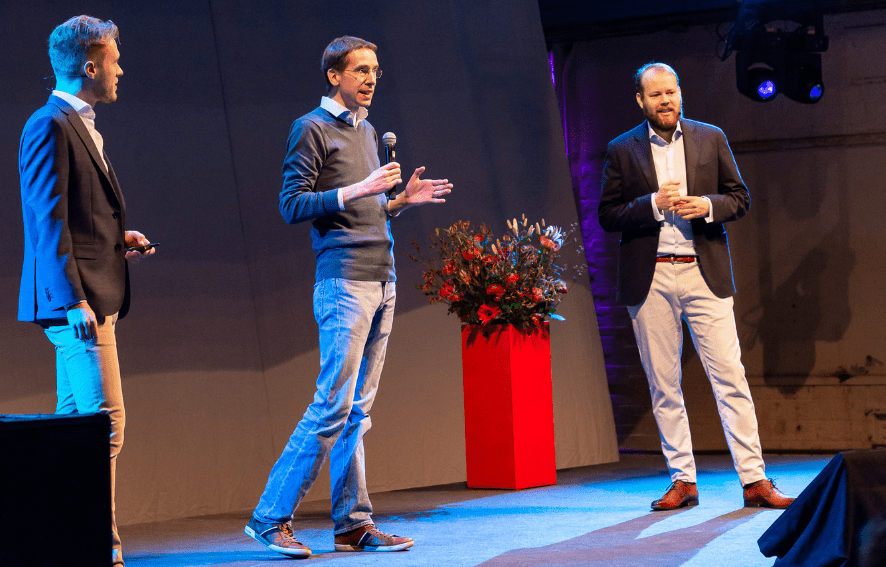
Giezman (far right), with Lacuna Space – LoRaWAN has grown through ‘open standards and [the luxury of] screw-ups’; the real work starts now
The Things Industries claims 18,000 gateways in 2020, up from 6,000 a year ago, at the start of 2019. Of these, about 10,500 are on public LoRaWAN networks, and 7,500 are on private networks – across 150 countries. They connect 500,000 IoT devices, carrying nine billion messages per year, or 25,000 per day.
But the message, here, was that, in early 2020, simplification and scale, with the first helping to engender the second, are harder to grasp.
“LoRa is almost five years old. Business cases are looking very positive. The customer base is cracking lots of different nuts – there are lots of verticals where LoRaWAN can play. So we have awesome tech, and fantastic business cases everywhere. So what more do you need? It is working, yes, but we have to multiply it,” said Wienke Giezman, co-founder and chief executive of the various ‘Things’ ventures.
To this end, the opening session ran through bold developments, both in the industry and in its own business, to bring order to the chaos of the IoT space. As well as the heavy hint of extended LoRaWAN activity at 2.4 GHz, the event saw key announcements around a new peering service to unite and bolster disparate LoRaWAN networks, and a tie-up with Lacuna Space to route LoRaWAN traffic via its new satellite installation into ground-based LoRaWAN systems.
The peering of public and private LoRaWAN networks, called Packet Broker, creates an internet exchange for IoT, including an optional data marketplace for high-value networks. Unlike with licensed cellular, but like with unlicensed Wi-Fi, LoRaWAN gateways forward all packets, and LoRaWAN networks receive them from all devices covered by their gateways, even if the data is intended for other networks.
The cost to forward the packet to the device’s home network is near zero. The new system seeks to take advantage of this. It supports individual packet selection, so home networks only pay for packets they want. “There are clear transactions instead of requiring blind trust between parties about which packet has been used by the home network,” said The Things Industries.
The Packet Broker system separates packet routing from clearing; packets are encrypted and can be decrypted using any trusted key exchange. It also separates payload from metadata, so home networks can buy payload and metadata separately. The system is open, too. Providers can build their own specifications on top, and make their own terms.
“Packet Broker brings together gateway owners and network service providers; there is no requirement for all parties to operate a LoRaWAN network server. This allows tower companies, real estate companies and satellite service providers to monetize gateway infrastructure directly.”
Meanwhile, Lacuna Space is launching a constellation of low-orbit satellites equipped with LoRaWAN gateways into space, capable of receiving LoRaWAN messages from the ground. The plan is to fill the blackspots between terrestrial gateways out of cellular reach, and gateways at sea. The Things Industries is the first to sign as ground-based LoRaWAN forwarder, for maritime, agriculture, and other remote use cases.
License fees will be linked to existing cloud accounts, or else charged per use, it said. Wilhelmsen’s 2.4 GHz LoRaWAN network uses Lacuna Space satellites to carry IoT traffic from vessels at sea; it routes directly via cheaper ground-based LoRaWAN networks, managed by The Things Industries, when ships are in port.
As well, hardware-level advances, to embed functionality – and security, importantly – into LoRaWAN modules were a major talking point in Amsterdam, with the introduction of secure hardware elements onto devices and a new Join Server component in LoRaWAN networks from The Things Industries. Combined, these offer secure storage of root keys on open LoRaWAN devices, which can change the network server provider, and simpler key management.
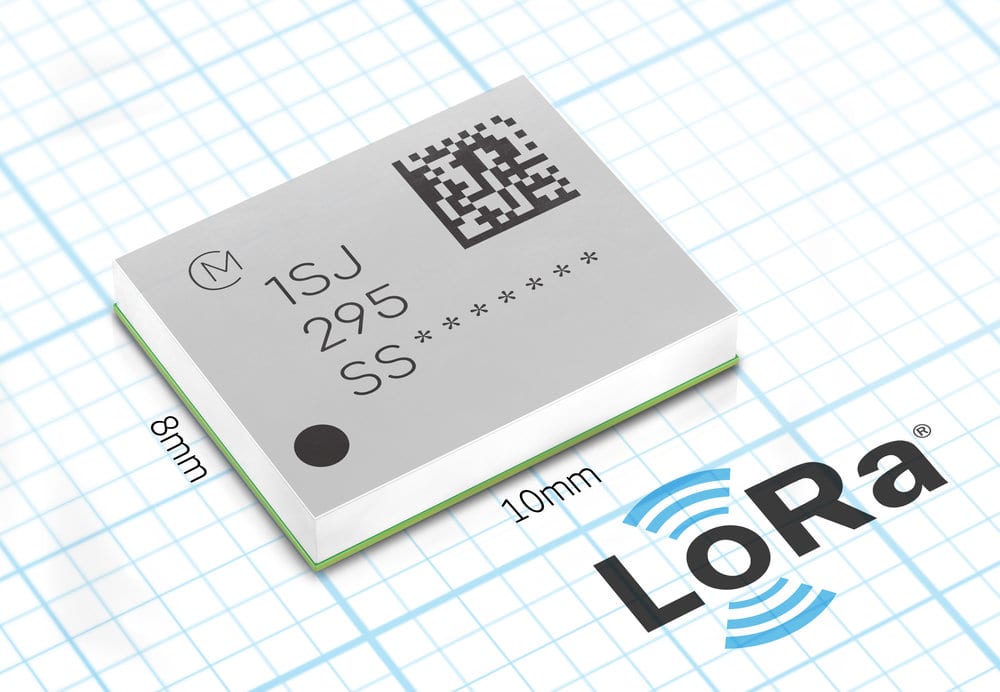
Murata’s SoC – embedded security in a miniature package
Japanese manufacturer Murata showed a “smaller and cheaper” LoRa module (Type 1SJ), based on a radio circuit (SX1262) from Semtech and an Arm (Cortex-M0) based microcontroller (STM32L0) from STMicroelectronics, which builds a secure software library from French IoT firm Trusted Object into it, as a system-on-chip (SoC).
The Type 1SJ module, for miniature long-life industrial IoT devices, supports operation at 860-930 MHz, and at -40°C to +85°C, and includes multiple interfaces and an on-board temperature-controlled crystal oscillator. It measures 10.0 mm x 8.0 mm x 1.60 mm.
STMicro, meanwhile, showed the first (proper) LoRa SoC, the STM32WLE5, which integrates an STM32 microcontroller and LoRaWAN radio into a single silicon die. It is geared for simpler development of IoT sensors, meters, trackers, and process controllers, with cheaper material costs, better energy efficiency, and longer life. The STM32WLE5 is available in a 5mm x 5mm UFBGA73 package.

