In the 5G era, mobile communication experiences man-to-man communication, man-to-thing communication, and machine-to-machine. AR/VR, IoT, industry automation, unmanned driving etc services are introduced widely. Thus come lots of network requirements, i.e. high bandwidth, low delay and massive connections, which are three 5G scenarios defined by 3GPP.
In order to meet above-mentioned requirements, more and more NEs start to separate control planes from forwarding planes, perform hierarchical deployment and centralized dispatch of control planes, user planes are distributed near the users, so as to realize the balancing between management costs and user experience. Meanwhile, in order to effectively realize service anchor offloading, shortens service response time and exposes communication capability of traditional mobile network, MEC concept is fully introduced. Also, it is necessary to perform edge distributed reconstruction of centralized telecom cloud to adapt to distributed deployment of NEs and edge deployment of MEC in infrastructure layer.
Distributed cloud is composed of central cloud and edge cloud, edge cloud includes cities, counties, and base stations. Central cloud is defined as the brain and center, mainly controls/manages centralized media plane NEs; Edge cloud mainly bears distributed deployment of user plane/media plane NEs to realize fast unloading of traffic, as well as NEs with high real-time requirements to optimize user experience, such as HD video, Internet of Vehicles, VR/AR etc services.

Edge cloud has the following feature as a result of its location, scale and environment particularity.
Limited by environment ( air conditioner, load-bearing, power etc), the edge cloud deployed in cities, counties and base stations usually adopt customized multi-node sever or hardware integrated with computing, storage and network, the hardware adopts universal X86 architecture, which realizes high environment adaption, the minimum design of cabinet height and depth. It usually adopts front maintenance mode, high integration and low power consumption, which matches existing equipment room conditions and reduces transformation of the room.
With the incoming of 5G services, edge cloud resource pool must evolve from single VM/bare machine resource pool to coexistence of VM/bare machine, container etc resource pool. OpenStack/Kubernetes dual-core technology unifies network, storage and security etc bottom technologies, realizes uniform orchestration management of VM/bare machine, which greatly enhances flexibility and utilization ratio of resources.
Edge cloud usually configures FPGA, GPU etc acceleration card in X86 processor to meet high-speed forwarding network, therefore, the latest ETSI NFV architecture introduces hardware acceleration into NFV architecture, enhancing its virtualization capability, abstracts the accelerator, presents in logic resources acceleration, and provides comprehensive acceleration services.
Due to the small storage scale, edge cloud adopts independent resources pool, with high costs and low utilization ratio of resources, therefore, the computing and storage convergence solution is widely used, and deploy distributed storage in the computing node. The unification of computing and storage nodes greatly enhance utilization ratio. Meanwhile, it enables VM/container of local node to visit local storage by policy configuration, deploys the copy in other nodes, which greatly enhances storage performance while guaranteeing the reliability.
Management modules needs to reduce the occupied resources, which adopts the light-weighted management module for deployment, or deploys the management modules in upper-layer cloud. Edge cloud only deploys computing nodes. Both two kinds of deployment can be chosen flexibly.
Distributed cloud adopts multi-layer deployment, data center is distributed in different places with multiple resource types, which requires the uniform management platform to shield heterogeneity of the resource pool, perform global O&M, thus to enhance the efficiency.
Above the edge cloud, MEC(Mobile/Multi-Access Edge Computing, MEC)technology refers to provide IT and cloud computing capability by deploying universal server near the wireless access side, helping applications, services and contents to make localization, near distance and distributed deployment become possible, thus to enable wireless network with low delay and high bandwidth transmission capability, bandwidth postback reduction greatly reduces operation costs. Meanwhile, MEC defines the dual-way API communication mechanism of the complete network and the 3rd party application, such as wireless network exposes context information (location, network load, wireless resources utilization ratio etc) to the 3rd party service applications via API, which effectively enhances intelligence of mobile network, and promotes deep convergence of network and services.
MEC application scenarios are divided into two types according to different service features: local service, including local services cache and convergence, the typical scenarios include enterprise park network, or AR/VR service expansion; the other is expansion of vertical industries, typical scenarios include IOV and industry Internet etc. in order to better support new services and explore existing network capability, MEC scenarios need to add more precise indoor navigation, platform development and application integration etc.
Considering about ETSI and 3GPP’s definition about MEC system architecture features and 5G MEC scenarios requirements, the thoughts about MEC architecture are designed as follows:
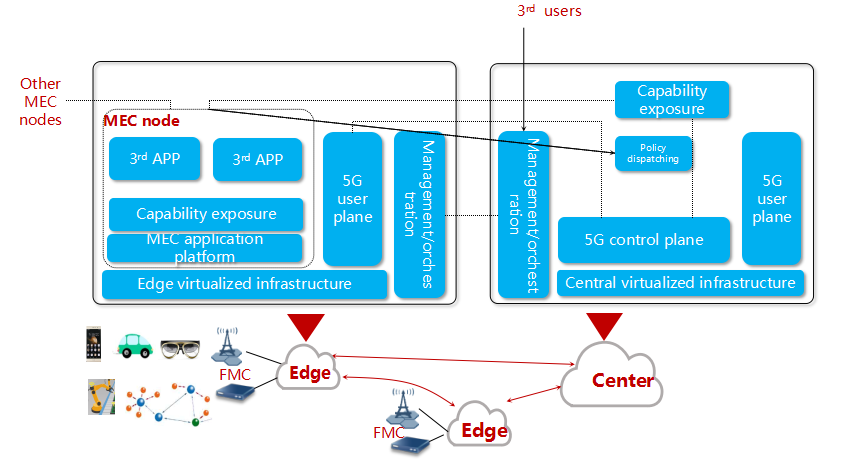
5G-based distributed cloud infrastructure builds 5G user plane and 5G MEC odes in the edge cloud, 5G MEC nodes provide MEC application platform for enabling 3rd party application, and public services to the 3rd party applications. MEC nodes cooperation with each other to support context switching during movement to guarantee service continuity.
The central side provides capability exposure to the 3rd party users and applications. The policy dispatching function integrates application health situation, load and network situation and dynamically creates /deletes the 3rd party instances, and gives selection policies for edge user plane, thus to realize the best coordination.
It adopts hierarchical management/orchestration architecture, the management/orchestration function in the central side is the uniform entrance to the 3rd party application, and it selects the location to deploy applications. The management/orchestration in the edge side management actual resources allocation and application deployment.
We shall embrace the future with evolution in the incoming 5G era and ICT convergence. Different from the pipe provider in 4G era, operators have more chances to explore value-added services and turn into the E2E service provider. As the new technology of ICT convergence, edge computing offloads high bandwidth, low delay and local services into the network edge, it provides uniform telecom infrastructure support for mobile and fixed convergence, which plays an important role in digital transformation and industry structure upgrading. A new technology and ecology rising needs strong supports from the business mode. The industry has lots of expectation and visions on different application scenarios of edge service platform. However, it needs the efforts of the whole industry chain. ZTE wishes to cooperate with more partners to discuss about the cooperation of MEC and build edge ecosystem of 5G network, promote the prosperous development of the edge service.