

RCR Wireless
  • News
  • Channels
    • 5G
    • 6G
    • BSS OSS
    • Carriers
    • IoT
    • Network Infrastructure
    • Open RAN
    • Private 5G
    • Telco AI
    • Telco Cloud
    • Test & Measurement
  • Resources
    • Reports
    • Webinars
    • White papers
    • AI Fundamentals
    • Analyst Angle
    • Editorial Calendar
    • Fundamentals
      • 5G NR Release 17
      • AI
        • Telco AI in 2025
    • Podcasts
      • Let’s Get Digital with Carrie Charles
      • Wireless Connectivity to Enable Industry 4.0 for the Middleprise
      • Well Technically…
      • Will 5G Change the World
      • Accelerating Industry 4.0 Digitalization
  • AI Infrastructure
  • Programs
  • Events
  • RCRtv
  • Advertise
  • Subscribe
Thursday, July 23, 2026
RCR Wireless
  • News
  • Channels
    • 5G
    • 6G
    • BSS OSS
    • Carriers
    • IoT
    • Network Infrastructure
    • Open RAN
    • Private 5G
    • Telco AI
    • Telco Cloud
    • Test & Measurement
  • Resources
    • Reports
    • Webinars
    • White papers
    • AI Fundamentals
    • Analyst Angle
    • Editorial Calendar
    • Fundamentals
      • 5G NR Release 17
      • AI
        • Telco AI in 2025
    • Podcasts
      • Let’s Get Digital with Carrie Charles
      • Wireless Connectivity to Enable Industry 4.0 for the Middleprise
      • Well Technically…
      • Will 5G Change the World
      • Accelerating Industry 4.0 Digitalization
  • AI Infrastructure
  • Programs
  • Events
  • RCRtv
  • Advertise
  • Subscribe
Add RCR Wireless as a preferred source on Google
  • Qualcomm 6G Insights
  • Huawei Content Hub
  • Qualcomm – 6G Vision
  • OSS/BSS Channel
  • RCRTech Roundtable: AI Infrastructure
RCR Wireless
RCR Wireless
  • Advanced Mimo
  • Mobile mmWave
  • 5G Positioning
  • Green Networks
  • Metaverse
  • Automotive
  • Industrial and Wide-area IoT
Copyright 2021 - All Right Reserved
Home - Why ultra-low 5G latencies are not assured, and Europe is worst placed
5GCarriersFundamentalsInternet of Things (IoT)Smart FactoryWired Networks, Fiber

Why ultra-low 5G latencies are not assured, and Europe is worst placed

by James Blackman September 11, 2018
written by James Blackman September 11, 2018 Share
LinkedinEmail
Share 0LinkedinEmail
Italian
284

The physics of time-division duplexing in radio communications means 5G could, in certain frequency bands, struggle to achieve the ultra low latencies it promises. Worse, in some markets, regulatory forces have compounded the challenge with backwards rules about 5G radio operations.

As a consequence, radio engineers face an uphill battle to liberate the transformative power of 5G, and enable operators to address lucrative vertical sectors for the first time with their ultra-reliable, low-latency (URLLC) new tech.

This was the thrust of a useful 3GPP presentation at URLLC 2018 in London last week, which skipped through the latest achievements and newest challenges with the 5G New Radio (NR) standard.

Channelling Blue Peter, BT’s director of technology standards, Kevin Holley, brandished a couple of toilet-roll tubes in order to describe the difference between full duplexing techniques, and get to the bottom of the 5G latency dilemma.

After all, 5G latencies will not just depend on antenna types and antenna tilts, and whether or not communications run in millimetre-wave spectrum. The difference between time-division (TDD) and frequency division (FDD) duplexing matters, too, he said.

“These terms get thrown around, but one of the things people in the industry haven’t really understood is the difference between them,” said Holley.

The toilet rolls came out, and he positioned one at his mouth and one at his ear. This is FDD, he explained, with an uplink channel for talking and a downlink channel for listening. “You can do both at the same time; you can talk and listen at the same time.”

Holley removed one tube. With TDD, you have but a single channel, he explained – and you talk, and then you listen. “There’s a gap – a physics between the talking and listening,” he explained. The uplink and downlink packets have pre-allocated time slots in the frame structure, too.

Two-way TDD communications follow a pre-set pattern, which introduces latency.

Operators employ a mechanism called hybrid automatic repeat request (HARQ) to verify packet radio communications have arrived. This imposes a transmit-and-receive pattern. The frame structure for TDD in LTE networks defines a four millisecond delay between certain downlink and uplink communications (between slot three and slot seven in the below graphic).
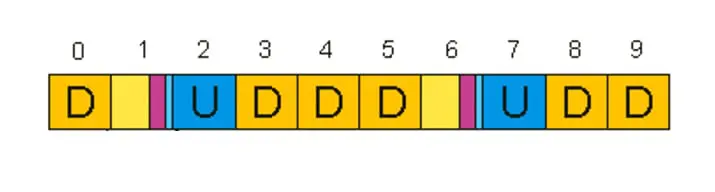
LTE TDD 1

As a result, latency is capped in LTE networks. “You can’t do latency lower than four milliseconds, even if your processing is zero,” said Holley.

The challenge for “ultra-reliable, low-latency” (URLLC) 5G is how it plays in TDD bands, notably the 3.5 GHz band, defined by the ITU as part of its IMT-2020 vision as spectrum between 3.3 GHz and 3.8 GHz. In Europe, the 3.5 GHz band is the principle allocation for delivering 5G communications.

3GPP has sought to overcome these limitations in 5G NR by breaking up the LTE frame structure. Release 15 divides the old millisecond TDD time-slots into “mini slots”, explained Holley. “Rather than insisting you talk and then listen, you can listen, and then do a quick-talk while you’re still listening.”

5G Frame Structure 1

There remains an issue with interference for 3GPP to sort out in Release 16, but the assumption is 5G operators will be able to apply this “mini-slot” technique in TDD spectrum to get latency down, “very, very low”. There is cliffhanger, however, in the UK at least.

Ofcom, regulating operators like Holley’s employer in the UK, has already defined frame structures for certain spectrum in the 3.5 GHz band, during the auction of 150MHz of frequency north of the 3.4 GHz-mark in June. These bear more than a passing resemblance to the old LTE TDD patterning.

Ofcom Frame Structures 1

Which means, ultimately, 5G could also be limited to four-millisecond latencies in most cases in Europe. Disaster, as Holley suggested. “You’ve got to ask yourself, how are we going to deliver low latency if we have to follow what Ofcom’s asked us to do?”

UK operators have some thinking to do. They must hope, as well, that Ofcom does better next time around, when it sets the operating conditions for radio spectrum at 3.6 GHz to 3.8 GHz – “so we can deliver something more in the URLLC vein”.


You Might Also Like
  • South Korea launches AI-RAN project to advance industrial AI
  • AT&T’s bets on “best tech” (fiber) pay off with record adds, improving margins 
  • The Agentic Network — Cisco on earning trust in autonomous operations
  • Blue Planet intros AI agents to fight OSS configuration drift – and stand-up telco trust
  • Rakuten Mobile expands O-RAN footprint with 1Finity radios
  • Monday (telco diary) | Sovereign AI for Industry 4.0
Share 0 LinkedinEmail
James Blackman
James Blackman

James Blackman has been writing about the technology and telecoms sectors for over a decade. He has edited and contributed to a number of European news outlets and trade titles. He has also worked at telecoms company Huawei, leading media activity for its devices business in Western Europe. He is based in London.

previous post
10 smart building tech companies every building owner should know
next post
AT&T expands mobile 5G plans

White Papers

  • Norton eBook: The 2026 Telco Playbook

  • Enea White Paper: Why Intelligent AAA is the Swiss Army Knife of Telecom

  • CSG White Paper: Telco AI Enabler: Mediation’s Defining Role

  • Enea White Paper: Scalable Database Design for 5G and Beyond

  • Supermicro and NVIDIA Whitepaper: Powering sovereign AI at scale

Editorial Reports

  • Nvidia Report: The State of AI in Telecommunications: 2026 Trends

  • Report: Scaling Optical Networks For The Hyperscale And AI Era

  • Test And Measurement Market Pulse Report

Webinars

  • Webinar: Building 6G — aligning technology, policy and purpose

  • SIMCom Webinar: Scaling your next deployment – from plastic to provisioning

  • Webinar: Rethinking the RAN as AI, cloud and openness converge

  • Webinar: Scale-Up, Scale-Out, Scale-Across – Building AI-Era Network Fabrics

  • Webinar: NTN in motion – evolving standards, expanding services

Since 1982, RCR Wireless News has been providing wireless and mobile industry news, insights, and analysis to mobile and wireless industry professionals, decision makers, policy makers, analysts and investors.

Facebook Twitter Youtube Linkedin Envelope Rss

Useful Links

  • Subscribe
  • About RCR Wireless News
  • Contact Us
  • Advertise
  • Editorial Calendar
  • Archive
  • RSS
  • Wireless News Archive
  • Subscribe
  • About RCR Wireless News
  • Contact Us
  • Advertise
  • Editorial Calendar
  • Archive
  • RSS
  • Wireless News Archive

Edtior's Picks

South Korea launches AI-RAN project to advance industrial AI
Tuesday (telco diary) | Telco agents and outcomes
AT&T’s bets on “best tech” (fiber) pay off with record adds, improving margins 

Latest Articles

South Korea launches AI-RAN project to advance industrial AI
Tuesday (telco diary) | Telco agents and outcomes
AT&T’s bets on “best tech” (fiber) pay off with record adds, improving margins 
The most expensive wireless system is the one you install twice (Reader Forum)

© 2026 RCR Wireless News All Right Reserved. Developed by Eight Hats.

Cookie Policy | Privacy Policy

RCR Wireless
  • News
  • Channels
    • 5G
    • 6G
    • BSS OSS
    • Carriers
    • IoT
    • Network Infrastructure
    • Open RAN
    • Private 5G
    • Telco AI
    • Telco Cloud
    • Test & Measurement
  • Resources
    • Reports
    • Webinars
    • White papers
    • AI Fundamentals
    • Analyst Angle
    • Editorial Calendar
    • Fundamentals
      • 5G NR Release 17
      • AI
        • Telco AI in 2025
    • Podcasts
      • Let’s Get Digital with Carrie Charles
      • Wireless Connectivity to Enable Industry 4.0 for the Middleprise
      • Well Technically…
      • Will 5G Change the World
      • Accelerating Industry 4.0 Digitalization
  • AI Infrastructure
  • Programs
  • Events
  • RCRtv
  • Advertise
  • Subscribe
RCR Wireless
  • News
  • Channels
    • 5G
    • 6G
    • BSS OSS
    • Carriers
    • IoT
    • Network Infrastructure
    • Open RAN
    • Private 5G
    • Telco AI
    • Telco Cloud
    • Test & Measurement
  • Resources
    • Reports
    • Webinars
    • White papers
    • AI Fundamentals
    • Analyst Angle
    • Editorial Calendar
    • Fundamentals
      • 5G NR Release 17
      • AI
        • Telco AI in 2025
    • Podcasts
      • Let’s Get Digital with Carrie Charles
      • Wireless Connectivity to Enable Industry 4.0 for the Middleprise
      • Well Technically…
      • Will 5G Change the World
      • Accelerating Industry 4.0 Digitalization
  • AI Infrastructure
  • Programs
  • Events
  • RCRtv
  • Advertise
  • Subscribe
@2020 - All Right Reserved. Designed and Developed by PenciDesign
