

Five wireless inventions that define 5G NR — the global 5G standard
 I have seen many changes and amazing innovations in wireless technology, but nothing quite compares to the fundamental shift happening right now with 5G. Over the last several years, I’ve been leading a Qualcomm Research project to design a unified 5G wireless air interface that will vastly expand the capability, efficiency, and utility of mobile networks and devices.
3GPP standardization efforts to develop a global specification for this unified, more capable wireless air interface called 5G New Radio (5G NR) have been ongoing since March 2016. And this week, at a 3GPP RAN Plenary meeting in Lisbon, Portugal, it is expected that 3GPP will successfully complete the first 5G NR specification — a significant industry milestone toward making 5G NR a commercial reality in 2019. This first 5G NR specification not only supports 2019 enhanced mobile broadband deployments, it also establishes the foundation for expanding 5G networks to virtually every industry, every object, and every connection.
So, what wireless technologies define this first 5G NR specification?
5G NR must meet an expanding and radically diverse set of connectivity requirements and deployment types. 5G NR also needs to get the most out of every bit of spectrum across a wide array of available spectrum regulatory paradigms and bands — from low bands below 1 GHz, to mid bands from 1 GHz to 10 GHz, to high bands above 24 GHz loosely known as millimeter-wave (mmWave). Therefore, there is no one single technology component that defines 5G NR. Instead, 5G NR will be built out of multiple technology inventions.
At Qualcomm, we have been developing these 5G building blocks for years — inventing new 5G technologies that are pushing, and often redefining, the boundaries of wireless. One of the most rewarding aspects of my work in Qualcomm Research is seeing our advanced system designs and wireless techniques progress from theory through design, standardization, implementation, and ultimately commercialization. And now, with the first 5G NR specification about to be completed, we are seeing our wireless technology inventions (summarized in Figure 1 below), make 5G NR — and our 5G vision — a reality.
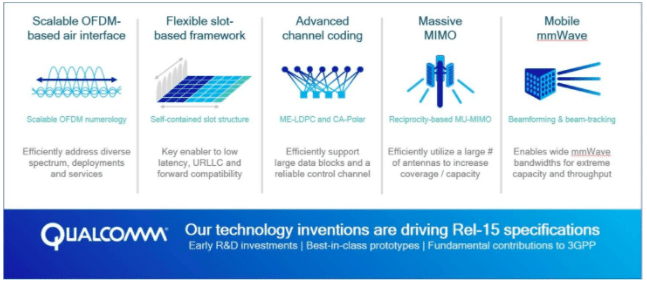
Figure 1: Five wireless inventions that define 5G NR
Invention #1: Scalable OFDM numerology with 2n scaling of subcarrier spacing
One of the foremost decisions for 5G NR design is the choice of radio waveforms and multiple access techniques. While many approaches have been evaluated and will continue to be, we have found through extensive studies (published in a Qualcomm Research paper in November 2015) that the OFDM family — specifically CP-OFDM1 and DFT-Spread (DFT-S) OFDM2, are the right choices for 5G enhanced mobile broadband (eMBB) and beyond.
Since OFDM is used today, you might ask where’s the further innovation? One key 5G NR innovation is scalable OFDM multi-tone numerology (Figure 2). Today, LTE supports carrier bandwidths up to 20 MHz with a mostly fixed OFDM numerology of 15 kHz spacing between OFDM tones (often called subcarriers). With 5G NR, we have introduced scalable OFDM numerology to support diverse spectrum bands/types and deployment models. For example, 5G NR must be able to operate in mmWave bands that have wider channel widths (e.g., 100s of MHz). 3GPP 5G NR Rel-15 specification will utilize scalable OFDM numerology with 2N scaling of subcarrier spacing that can scale with the channel width, so the FFT size scales such that processing complexity does not increase unnecessarily for wider bandwidths.
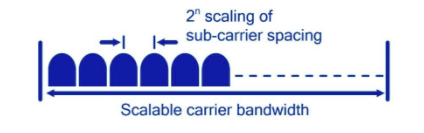
Figure 2: Scalable OFDM multi-tone numerology
Invention #2: Flexible self-contained slot structure
Another key component of the 5G NR design is a flexible slot-based framework that will allow network operators to efficiently multiplex the envisioned (and unforeseen) 5G services on the same frequency. A key technology invention to deliver this flexible framework is the 5G NR self-contained slot structure. With the new self-contained slot structure (see TDD example in Figure 3 below), each 5G NR transmission is a modular transaction with the ability to independently decode slots and avoid static timing relationships across slots. By confining transmissions in time and frequency, the flexible design simplifies adding new 5G NR features/services in future — delivering a more forward-compatible design than previous generations.
The 5G NR self-contained slot structure also delivers significantly lower latency than LTE thanks to support for fast UL/DL turn-around and scalable slot durations of e.g. 500 µs at 30 kHz tone spacing to 125 µs at 120 kHz tone spacing. This slot structure framework includes the opportunity for UL/DL scheduling, data, and acknowledgement to occur in the same slot. Beyond lower latency, this modular slot structure design enables more adaptive TDD UL/DL configuration, advanced reciprocity-based antenna techniques (e.g., downlink Massive MIMO steering based on fast uplink sounding) as well as additional use cases enabled by adding subframe headers (e.g., contention resolution headers for shared/unlicensed spectrum) — making this invention, which is part of the 3GPP 5G NR specification, a key enabler to meeting many of the 5G NR requirements.
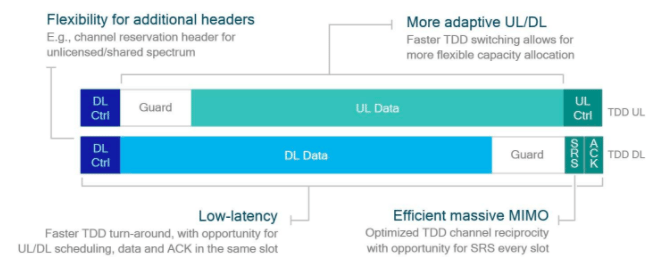
Figure 3: Benefits of the 5G NR TDD self-contained slot structure
Invention #3: Advanced ME-LDPC and CA-Polar channel coding
Along with the scalable numerology and flexible framework for 5G NR services, the physical layer design should include an efficient channel coding scheme that can provide robust performance and flexibility. Although Turbo codes have been well suited for 3G and 4G, Qualcomm Research has demonstrated that low-density parity check (LDPC) codes, and specifically advanced Multi-Edge LDPC (ME-LDPC) codes pioneered by Qualcomm Technologies, have advantages from both complexity and implementation standpoints when scaling to very high throughputs and larger block lengths as demonstrated in Figure 4. As a result, the 3GPP 5G NR Rel-15 specification will utilize ME-LDPC as the coding scheme for the eMBB data channel.
In addition, 3GPP selected Polar channel coding as the coding scheme for the eMBB control channel. Performance gains of CRC-Aided Polar (CA-Polar) channel coding, with significant design contributions from Qualcomm Technologies, led to its adoption across many 5G NR control use cases.
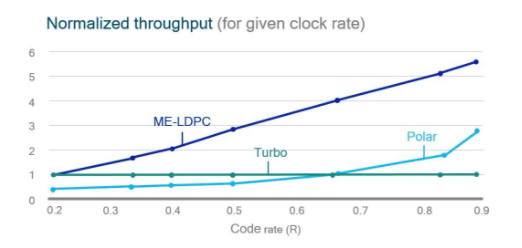
Figure 4: Throughput scaling with advanced ME-LDPC codes
Invention #4: Massive MIMO
Our 5G design is also advancing MIMO antenna technologies. By using more antennas intelligently, one can improve both network capacity and coverage. That is, more spatial data streams can significantly increase spectral efficiency (e.g., with multiuser massive MIMO), allowing more bits to be transmitted per Hertz, and smart beamforming techniques can extend the reach of base stations by focusing RF energy in specific directions on the downlink and similarly enabling the base station receiver to capture energy from a specific direction with less noise and interference on the uplink.
5G NR massive MIMO technology will make use of 2D antenna arrays at the base station capable of 3D beamforming, to make use of the higher frequency bands of mid-band spectrum. Accurate and timely channel knowledge is essential to realizing the full benefits of this 3D beamforming. Our optimized design for fast reciprocity-based TDD Massive MIMO, which is part of the 5G NR specification, will make use of the self-contained slot structure and enhanced Reference Signals to support much faster and more accurate channel feedback. Our test results have shown that it is possible to reuse existing macro cell sites (e.g., at 2 GHz) for new 5G NR deployments that operate in mid-bands between 3 GHz and 5 GHz. Our test results with new multiuser user 5G NR massive MIMO designs have shown significant gains in both capacity and cell-edge user throughput as shown in Figure 5, which is key to delivering a more uniform 5G mobile broadband user experience.
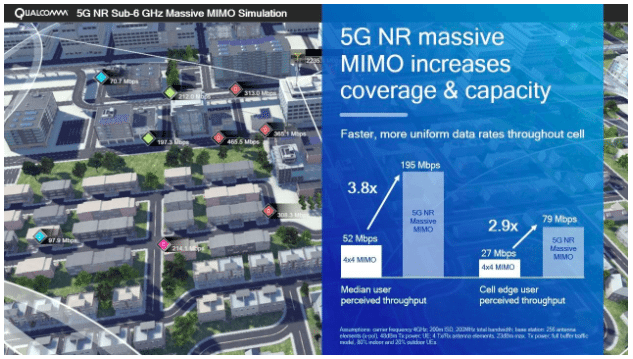
Figure 5: 5G NR massive MIMO simulations
Invention #5: Mobile mmWave
Our 5G NR design does not only enable the use of higher frequencies in mid-band spectrum for macro/small cell deployments, but it will also bring new mmWave opportunities at spectrum bands above 24 GHz for mobile broadband. The abundant spectrum available at these high frequencies supports extreme data speeds and capacity that will reshape the mobile experience. However, increased propagation loss, susceptibility to blockage (e.g., hand, head, body, foliage, building penetration), and RFIC complexity and power-efficiency, has historically made these high-bands not feasible for mobile communications. That is, until now. 5G NR mmWave is changing this, and Qualcomm is leading the way.
We have been working many years on the key design elements necessary to harness mmWave bands for usage in mobile broadband communication systems — proving to both ourselves and the industry what is feasible. As we demonstrated at Mobile World Congress earlier this year, our Qualcomm Research 5G mmWave prototype system (Figure 6 below) is utilizing a large number of antenna elements in both the base station and the device, along with intelligent/fast beamforming and beam-tracking algorithms, to showcase sustained broadband communications even for non-line-of-sight communications and device mobility. Although there is still work to do, we are confident that we can achieve this next big moment in the mobile industry, making 5G NR mmWave a commercial reality in 2019 mobile networks and mobile devices, including smartphones.
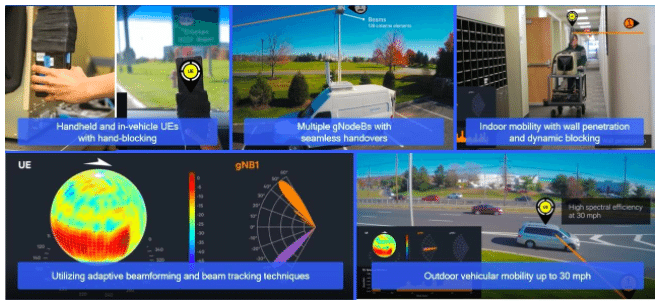
Figure 6: Qualcomm Research 5G mmWave prototype system operating at 28 GHz
And that’s only the beginning…
The 3GPP Release-15 5G NR specification will establish the foundation for enhanced mobile broadband and beyond, but the 5G technology roadmap has just begun. We have already begun work on many new technology inventions that will drive future evolution and expansion of 5G NR networks and devices. Pioneering new technologies like 5G NR Spectrum Sharing to unlock more spectrum and support new deployment types, 5G NR Ultra-Reliable Low-Latency Communications (URLLC) to support new mission-critical services, 5G NR Cellular-V2X (C-V2X) to bring new capabilities for automated driving, 5G NR Integrated Access and Backhaul (IAB) to reduce backhaul costs more efficient network densification, and 5G NR massive IoT (mIoT) to address the low-power, wide-area Internet of Things.
Want to learn more about these five 5G NR inventions and what’s coming next? Download our new presentation — Making 5G NR a Commercial Reality.
1 OFDM waveform with Cyclic-Prefix insertion to help maintain orthogonality despite multi-path fading – utilized in LTE DL today
2 Use of DFT spreading to produce single-carrier OFDM waveform to reduce power variations in uplink – utilized in LTE UL today
Qualcomm Research is a division of Qualcomm Technologies, Inc.


