
RCR Wireless
  • News
  • Channels
    • 5G
    • 6G
    • BSS OSS
    • Carriers
    • IoT
    • Network Infrastructure
    • Open RAN
    • Private 5G
    • Telco AI
    • Telco Cloud
    • Test & Measurement
  • Resources
    • Reports
    • Webinars
    • White papers
    • AI Fundamentals
    • Analyst Angle
    • Editorial Calendar
    • Fundamentals
      • 5G NR Release 17
      • AI
        • Telco AI in 2025
    • Podcasts
      • Let’s Get Digital with Carrie Charles
      • Wireless Connectivity to Enable Industry 4.0 for the Middleprise
      • Well Technically…
      • Will 5G Change the World
      • Accelerating Industry 4.0 Digitalization
  • AI Infrastructure
  • Programs
  • Events
  • RCRtv
  • Advertise
  • Subscribe
Monday, July 6, 2026
RCR Wireless
  • News
  • Channels
    • 5G
    • 6G
    • BSS OSS
    • Carriers
    • IoT
    • Network Infrastructure
    • Open RAN
    • Private 5G
    • Telco AI
    • Telco Cloud
    • Test & Measurement
  • Resources
    • Reports
    • Webinars
    • White papers
    • AI Fundamentals
    • Analyst Angle
    • Editorial Calendar
    • Fundamentals
      • 5G NR Release 17
      • AI
        • Telco AI in 2025
    • Podcasts
      • Let’s Get Digital with Carrie Charles
      • Wireless Connectivity to Enable Industry 4.0 for the Middleprise
      • Well Technically…
      • Will 5G Change the World
      • Accelerating Industry 4.0 Digitalization
  • AI Infrastructure
  • Programs
  • Events
  • RCRtv
  • Advertise
  • Subscribe
Add RCR Wireless as a preferred source on Google
  • Qualcomm 6G Insights
  • Huawei Content Hub
  • Qualcomm – 6G Vision
  • OSS/BSS Channel
RCR Wireless
RCR Wireless
  • Advanced Mimo
  • Mobile mmWave
  • 5G Positioning
  • Green Networks
  • Metaverse
  • Automotive
  • Industrial and Wide-area IoT
Copyright 2021 - All Right Reserved
Home - As public safety networks evolve, test and measurement is key
Network Infrastructurepublic safetySponsoredTest and Measurement

As public safety networks evolve, test and measurement is key

by RCR Wireless News January 12, 2017
written by RCR Wireless News January 12, 2017 Share
LinkedinEmail
Share 0LinkedinEmail
167

Learn how to ensure service quality, reliability, availability and resilience in 911, E-911 and NG-911 networks

Access to emergency services like police, fire and ambulance are the backbone of a civilized society. In the U.S., first responders are reached through a single number–911. In other countries, there may be a different unique number or several numbers. In the European Union, the number is 112, in other countries 999, for example. Once a call is placed, a governmental agency or other service representative at a Public Service Access Point, or PSAP, close to the location of the emergency answers the call and dispatches the required first responders. PSTN, VoIP and wireless carriers have developed methods for voice connection to the right PSAP to provide accurate location data that enables first responders to reach emergencies quickly and efficiently.

Such mission-critical public safety networks are undergoing a tremendous evolution from simply delivering traditional voice services to supporting high-volumes of voice, data and video, as well as inter-connectivity between different public organizations for a reliable communication during emergency situations. These trends are resulting in the adoption of newer technologies such as LTE, all-IP networking, and standards being developed to define the ways the network and devices can be tailored for mission-critical communications.

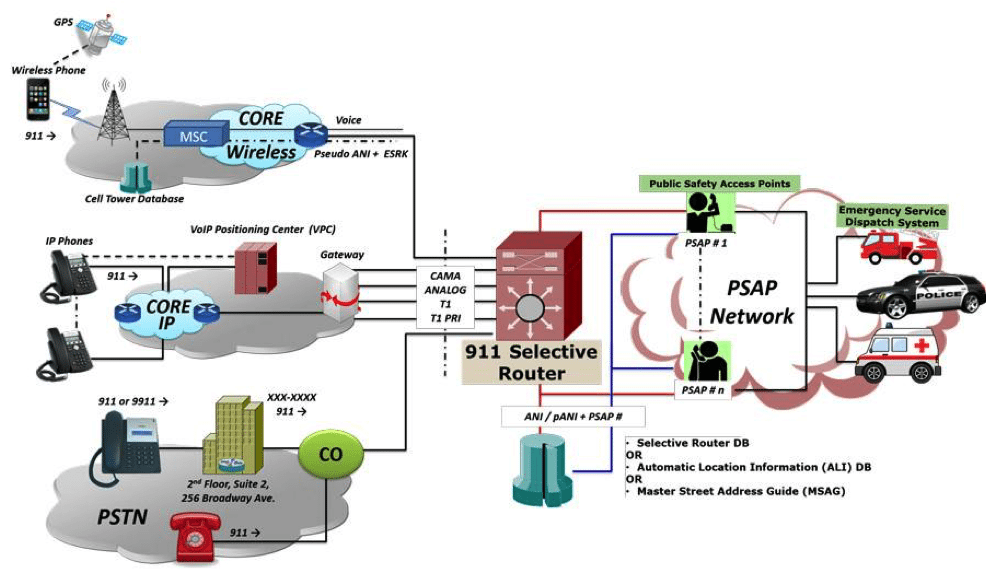
The diagram below shows a simplified architecture of the current 911 and E-911 networks. Typically, a call flow starts with the carrier network routing the voice call to a 911 Selective Router, which in turn routes the call to the responsible PSAP. Routing is based on an eight, 10 or 20-digit number, or an equivalent key provided by the carrier network to the 911 Selective Router. The PSAP attendant, in addition to answering the emergency call, also uses the number routing number or key to access many location databases – Selective Router (SR), Master Street Address Guide (MSAG), or the Automatic Location Identifier (ALI)–that provide the specific location of the caller including street address, building floor, suite, latitude/longitude, and the like.
GL image 2911 and E-911 network architecture

In all networks, the SR determines the correct PSAP to connect to by interrogating databases, and completes the voice connection to the PSAP attendant. The caller’s numerical code or identification key are termed the Automatic Number Identification (ANI), Pseudo Automatic Number Identification (PANI), or Enhanced Services Routing Key (ESRK/ESQK), depending on if the call is from a PSTN, VoIP, or wireless carrier, respectively.

These numbers are transmitted in-band to the PSAP via multi frequency (MF) digits, or Enhanced MF if more than 10 digits are required. In the T1/PRI or SS7 connectivity case, these numbers or keys are transmitted via ISDN or ISUP messaging fields. In a wireless LTE/UMTS network, this information is carried through similar messaging fields with MSISDN (the Mobile Subscriber Integrated Services Digital Network), cell site number, and location based services.

Other essential features served by traditional land mobile radio networks include push-to-talk, and direct communication mode between devices, called “Device-to-Device” (D2D) communications, which provides the ability to communicate even in the absence of network coverage. This feature is also being adopted in newer wireless devices, although D2D it is not yet ubiquitous.

To ensure quality, reliability, availability and resiliency, testing and monitoring systems for public safety networks must be multi-functional, device-independent, compatible with hybrid-networks, and capable of end-to-end testing on devices both indoors/outdoors.

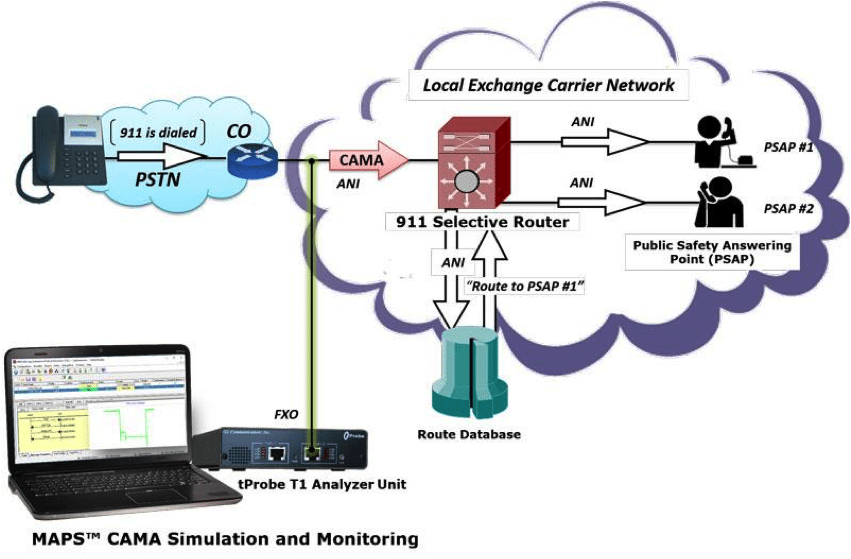
Consider: a normal analog call that is routed based on the destination (called party) phone number; however, 911 calls are routed based on the calling party number. This type of signaling, called centralized automated message accounting, or CAMA, is used for sending the calling party’s Automatic Number Identification (ANI) to the 911 selective router. GL Communication’s tProbe™ FXO can be tapped into CAMA-type circuits for non-intrusive monitoring of 911 service, including measures of seizure and wink start detection, onhook and off-hook detection and MF digit (calling party ANI) detection.
GL image 1

Monitoring Services over Traditional 911 network

Similarly, GL’s simulation test tools such as the MAPS™ CAS Emulator, MAPS™ ISDN Emulator,   MAPS™ SS7 Emulator and MAPS SIP Emulator can be configured to simulate real world 911 services and users in lab environment. The networks can be put under load and stress testing by simulating high volumes of callers, which is often the case during a disaster or emergency. All these tools can be accompanied by protocol analyzers and call capture applications, to record network behavior and replay the captured traffic for later analysis and troubleshooting.

For 911 services deployed over next-generation networks, application developers need to test their applications with realistic network conditions prior to live deployment. Conducting tests on real WAN links is expensive and, in some cases, simply not feasible. IP WAN Link Emulators help test the performance of such WAN network-dependent applications by easily and cost effectively emulating wide area network conditions in a local setup. Congestion in the network can be simulated by generating background traffic in addition to traffic of interest. Latency can be used to recreate the constant or varying delay caused by various factors in the network.

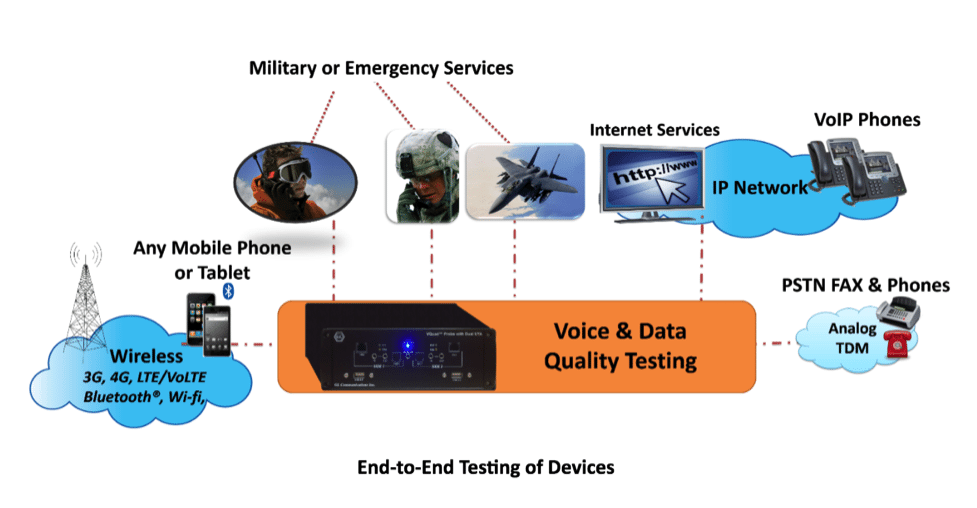
To perform complete end-to-end testing with real devices, GL Communication’s VQuad™ Probe offers voice, video and data quality testing in a portable single-box system, and works with wireless PTT, Bluetooth, Wi-Fi, VoLTE, LTE and 3G networks, and VoIP, analog and TDM networks, for testing at practically any endpoint interface. Drive testing can be accomplished with any wireless device using real-time GPS mapping and automation for unattended, 24/7 testing. This end-to-end approach to testing public safety networks means a wireless device in a pocket, in a car, on a train, or virtually anywhere else is constantly executing the functions that ensure when a call is placed to 911, first responders can locate emergencies and respond appropriately.

Contact experts at GL Communications Inc for further details.
GL image 3

You Might Also Like
  • Wednesday | Telco agents and smash hits (Editorial Diary)
  • Tuesday | Vertical build-outs, horizontal break-ups (Editorial Diary)
  • From autonomous networks to intelligent telcos – the next evolution of telecom
  • BT and Verizon merge international arms in $4bn global enterprise JV
  • Friday | Starlink raises the stakes (Editorial Diary)
  • Thursday | Tokenomics is not new telco economics (Editorial Diary)
Share 0 LinkedinEmail
RCR Wireless News

previous post
Kagan: Can PayPal stay ahead of the competition?
next post
5G spectrum at center of Straight Path settlement with FCC

White Papers

  • Enea White Paper: Why Intelligent AAA is the Swiss Army Knife of Telecom

  • CSG White Paper: Telco AI Enabler: Mediation’s Defining Role

  • Enea White Paper: Scalable Database Design for 5G and Beyond

  • Supermicro and NVIDIA Whitepaper: Powering sovereign AI at scale

  • VIAVI Whitepaper: RAN scenario generators and their critical role for future-proofing AI-native RAN in Advanced 5G and 6G networks

Editorial Reports

  • Report: Scaling Optical Networks For The Hyperscale And AI Era

  • Test And Measurement Market Pulse Report

  • Editorial Report: Securing telecom infrastructure for the quantum era

Webinars

  • Webinar: Rethinking the RAN as AI, cloud and openness converge

  • Webinar: Scale-Up, Scale-Out, Scale-Across – Building AI-Era Network Fabrics

  • Webinar: NTN in motion – evolving standards, expanding services

  • Webinar: Noise-Figure Measurements with RFmx and PXI VSTs

  • Qualcomm Webinar – Building the 6G Standard: Key developments to know

Since 1982, RCR Wireless News has been providing wireless and mobile industry news, insights, and analysis to mobile and wireless industry professionals, decision makers, policy makers, analysts and investors.

Facebook Twitter Youtube Linkedin Envelope Rss

Useful Links

  • Subscribe
  • About RCR Wireless News
  • Contact Us
  • Advertise
  • Editorial Calendar
  • Archive
  • RSS
  • Wireless News Archive
  • Subscribe
  • About RCR Wireless News
  • Contact Us
  • Advertise
  • Editorial Calendar
  • Archive
  • RSS
  • Wireless News Archive

Edtior's Picks

Enea White Paper: Why Intelligent AAA is the Swiss Army Knife of Telecom
Huawei outlines AI-centric network roadmap for telecom monetization
Why consolidation will reshape MDU connectivity (part 3/3) – Analyst Angle

Latest Articles

Enea White Paper: Why Intelligent AAA is the Swiss Army Knife of Telecom
Huawei outlines AI-centric network roadmap for telecom monetization
Why consolidation will reshape MDU connectivity (part 3/3) – Analyst Angle
Quantum Safe Networks Forum 2026

© 2026 RCR Wireless News All Right Reserved. Developed by Eight Hats.

Cookie Policy | Privacy Policy

RCR Wireless
  • News
  • Channels
    • 5G
    • 6G
    • BSS OSS
    • Carriers
    • IoT
    • Network Infrastructure
    • Open RAN
    • Private 5G
    • Telco AI
    • Telco Cloud
    • Test & Measurement
  • Resources
    • Reports
    • Webinars
    • White papers
    • AI Fundamentals
    • Analyst Angle
    • Editorial Calendar
    • Fundamentals
      • 5G NR Release 17
      • AI
        • Telco AI in 2025
    • Podcasts
      • Let’s Get Digital with Carrie Charles
      • Wireless Connectivity to Enable Industry 4.0 for the Middleprise
      • Well Technically…
      • Will 5G Change the World
      • Accelerating Industry 4.0 Digitalization
  • AI Infrastructure
  • Programs
  • Events
  • RCRtv
  • Advertise
  • Subscribe
RCR Wireless
  • News
  • Channels
    • 5G
    • 6G
    • BSS OSS
    • Carriers
    • IoT
    • Network Infrastructure
    • Open RAN
    • Private 5G
    • Telco AI
    • Telco Cloud
    • Test & Measurement
  • Resources
    • Reports
    • Webinars
    • White papers
    • AI Fundamentals
    • Analyst Angle
    • Editorial Calendar
    • Fundamentals
      • 5G NR Release 17
      • AI
        • Telco AI in 2025
    • Podcasts
      • Let’s Get Digital with Carrie Charles
      • Wireless Connectivity to Enable Industry 4.0 for the Middleprise
      • Well Technically…
      • Will 5G Change the World
      • Accelerating Industry 4.0 Digitalization
  • AI Infrastructure
  • Programs
  • Events
  • RCRtv
  • Advertise
  • Subscribe
@2020 - All Right Reserved. Designed and Developed by PenciDesign