
RCR Wireless
  • News
  • Channels
    • 5G
    • 6G
    • BSS OSS
    • Carriers
    • IoT
    • Network Infrastructure
    • Open RAN
    • Private 5G
    • Telco AI
    • Telco Cloud
    • Test & Measurement
  • Resources
    • Reports
    • Webinars
    • White papers
    • AI Fundamentals
    • Analyst Angle
    • Editorial Calendar
    • Fundamentals
      • 5G NR Release 17
      • AI
        • Telco AI in 2025
    • Podcasts
      • Let’s Get Digital with Carrie Charles
      • Wireless Connectivity to Enable Industry 4.0 for the Middleprise
      • Well Technically…
      • Will 5G Change the World
      • Accelerating Industry 4.0 Digitalization
  • AI Infrastructure
  • Programs
  • Events
  • RCRtv
  • Advertise
  • Subscribe
Tuesday, July 21, 2026
RCR Wireless
  • News
  • Channels
    • 5G
    • 6G
    • BSS OSS
    • Carriers
    • IoT
    • Network Infrastructure
    • Open RAN
    • Private 5G
    • Telco AI
    • Telco Cloud
    • Test & Measurement
  • Resources
    • Reports
    • Webinars
    • White papers
    • AI Fundamentals
    • Analyst Angle
    • Editorial Calendar
    • Fundamentals
      • 5G NR Release 17
      • AI
        • Telco AI in 2025
    • Podcasts
      • Let’s Get Digital with Carrie Charles
      • Wireless Connectivity to Enable Industry 4.0 for the Middleprise
      • Well Technically…
      • Will 5G Change the World
      • Accelerating Industry 4.0 Digitalization
  • AI Infrastructure
  • Programs
  • Events
  • RCRtv
  • Advertise
  • Subscribe
Add RCR Wireless as a preferred source on Google
  • Qualcomm 6G Insights
  • Huawei Content Hub
  • Qualcomm – 6G Vision
  • OSS/BSS Channel
  • RCRTech Roundtable: AI Infrastructure
RCR Wireless
RCR Wireless
  • Advanced Mimo
  • Mobile mmWave
  • 5G Positioning
  • Green Networks
  • Metaverse
  • Automotive
  • Industrial and Wide-area IoT
Copyright 2021 - All Right Reserved
Home - IoT connectivity challenge: 3 reasons why 2.4 GHz should be in the mix
Internet of Things (IoT)

IoT connectivity challenge: 3 reasons why 2.4 GHz should be in the mix

by Ted Myers August 19, 2016
written by Ted Myers August 19, 2016 Share
LinkedinEmail
Share 0LinkedinEmail
122

As the internet of things (IoT) continues to evolve, a wealth of connectivity options—utilizing a variety of different spectrum options—are emerging. The 2.4 GHz band—also called unlicensed spectrum—has thrown its hat into the ring as a legitimate option. There are three key reasons 2.4 GHz has a rightful place as an IoT connectivity contender:

Reason 1: Cost-free IoT coverage

Many are under the impression that the 2.4 GHz band provides inferior range and coverage to the sub-GHz bands (915 MHz band in United States and 868 MHz in Europe). It is true that, all things being equal, sub-GHz signals propagate further than 2.4 GHz signals according to the textbook Friis equation.  However, in the real world, all things are not equal.  Propagation loss is only one input of many that feed into the range/coverage of a wireless technology.  The coverage figure of merit for how well a wireless technology works is called link budget and consists of other factors including antenna diversity, receiver sensitivity, and amount of interference.

As a matter of fact, the use of antenna diversity in the 2.4 GHz band can largely compensate for the Friis equation disadvantage. Devices with two antennas are uniquely feasible in the 2.4 GHz band because the quarter-wavelength separation is supportable in most IoT form factors, which is often not the case for the sub-GHz bands with larger wavelengths.  And thus, the relative coverage of 2.4 GHz vs. sub-GHz bands is often dominated by the receive sensitivity of the modules and the amount of interference in the bands.

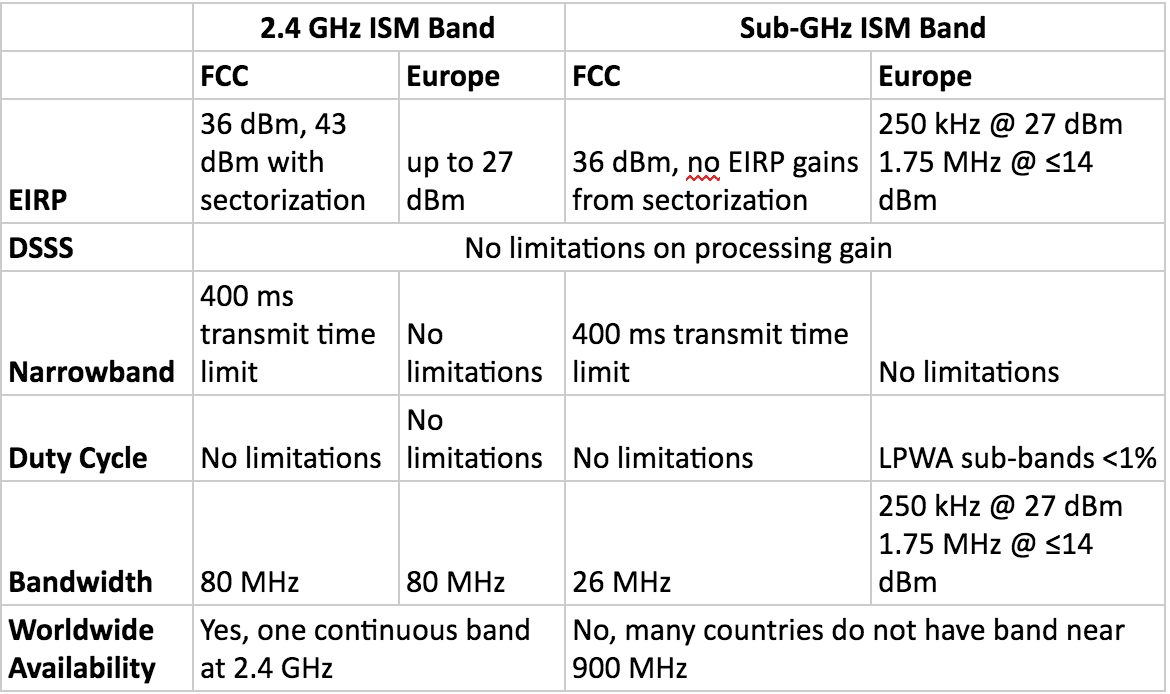
Additionally, if the technology uses direct sequence spread spectrum (DSSS) modulation, it has an extremely favorable global regulatory environment. This is summarized in the table below. Two main points to take away are that the 2.4 GHz band has from 7x to 67x the bandwidth of the sub-GHz band, depending on the regulatory environment, which provides an enormous capacity advantage. And, the 868 MHz band is constrained to one percent duty cycle limitations as well as extremely fractured availability around the world.

Reason 2: Simplest global deployments

The 2.4 GHz band is freely available worldwide, in every country on earth, at one single frequency. A device maker can build a single device, assign a single SKU, and it will work anywhere in the world. Essentially, that means a wireless module can be installed in a washing machine in a factory anywhere in the world, without concern for which country it is getting shipped to. This offers device makers access to the global market with just a single device using the 2.4 GHz band.

Reason 3: Instant global reach

Perhaps one of the greatest benefits of the 2.4 GHz band is the fact that it offers instant access to the global market. Wireless technologies using licensed bands or the unlicensed sub-GHz band suffer from a very fractured market. Device makers in those markets have to be careful about their market strategy and must choose the customers they want to serve or bear the expense of supporting numerous bands or versions of hardware.

The best of all worlds

The 2.4 GHz band can easily have comparable range with the sub-GHz bands when all inputs to link budget are accounted for. When combined with the more favorable regulatory environment for DSSS in the 2.4 GHz band, suddenly wireless technologies in that band can produce much better range than sub-GHz peers. The 2.4 GHz band also has worldwide availability at a single frequency. This means that device makers only have to make one device to reach any market in the world, removing the need for complex device management, and gives them access to more customers than any other band. With 7x to 67x the bandwidth of other bands, the 2.4GHz band offers the capacity to support IoT applications today and plenty of room to grow for the IoT applications of tomorrow.
Screen Shot 2016-08-19 at 7.37.58 AM

Ted Meyers, co-Founder and chief technology officer, Ingenu

Myers is a recognized expert in wireless communication systems and digital signal processing theory. Prior to co-founding Ingenu, Myers was a founder of CommASIC, where he developed the WBSP processor and its first application to the 802.11 a/b/g physical layer. Based on this architecture, the resulting chipset was a first-pass success and industry best in cost and power consumption, which led to the acquisition of CommASIC by Freescale Semiconductor in 2005. While at Freescale Semiconductor, he applied the WBSP processor architecture to various other wireless applications. Earlier in his career he led and/or contributed to numerous other physical layer designs for cellular applications and government satellite systems. Myers has a Ph.D. and B.S. in Electrical Engineering from Virginia Tech and an M.S. in Electrical Engineering from the University of Maryland at College Park.

You Might Also Like
  • Monday (telco diary) | Sovereign AI for Industry 4.0
  • When the push becomes the pull – private 5G and physical AI
  • Fast-growing private 5G offers blueprint for AI-era telecoms
  • Monday (telco diary) | Consolidation, orchestration, automation
  • Wireless Logic’s 21st acquisition exposes IoT consolidation paradox
  • Thursday (telco diary) | The plumbing is the product

Table of Contents

  • Reason 1: Cost-free IoT coverage
  • Reason 2: Simplest global deployments
  • Reason 3: Instant global reach
  • The best of all worlds
Share 0 LinkedinEmail
Ted Myers

previous post
Uber and Volvo partner on self-driving cars
next post
Huawei targets small cell revenue of $2B in 2020

White Papers

  • Norton eBook: The 2026 Telco Playbook

  • Enea White Paper: Why Intelligent AAA is the Swiss Army Knife of Telecom

  • CSG White Paper: Telco AI Enabler: Mediation’s Defining Role

  • Enea White Paper: Scalable Database Design for 5G and Beyond

  • Supermicro and NVIDIA Whitepaper: Powering sovereign AI at scale

Editorial Reports

  • Nvidia Report: The State of AI in Telecommunications: 2026 Trends

  • Report: Scaling Optical Networks For The Hyperscale And AI Era

  • Test And Measurement Market Pulse Report

Webinars

  • Webinar: Building 6G — aligning technology, policy and purpose

  • SIMCom Webinar: Scaling your next deployment – from plastic to provisioning

  • Webinar: Rethinking the RAN as AI, cloud and openness converge

  • Webinar: Scale-Up, Scale-Out, Scale-Across – Building AI-Era Network Fabrics

  • Webinar: NTN in motion – evolving standards, expanding services

Since 1982, RCR Wireless News has been providing wireless and mobile industry news, insights, and analysis to mobile and wireless industry professionals, decision makers, policy makers, analysts and investors.

Facebook Twitter Youtube Linkedin Envelope Rss

Useful Links

  • Subscribe
  • About RCR Wireless News
  • Contact Us
  • Advertise
  • Editorial Calendar
  • Archive
  • RSS
  • Wireless News Archive
  • Subscribe
  • About RCR Wireless News
  • Contact Us
  • Advertise
  • Editorial Calendar
  • Archive
  • RSS
  • Wireless News Archive

Edtior's Picks

The Agentic Network — Cisco on earning trust in autonomous operations
Blue Planet intros AI agents to fight OSS configuration drift – and stand-up...
Rakuten Mobile expands O-RAN footprint with 1Finity radios

Latest Articles

The Agentic Network — Cisco on earning trust in autonomous operations
Blue Planet intros AI agents to fight OSS configuration drift – and stand-up telco trust
Rakuten Mobile expands O-RAN footprint with 1Finity radios
Monday (telco diary) | Sovereign AI for Industry 4.0

© 2026 RCR Wireless News All Right Reserved. Developed by Eight Hats.

Cookie Policy | Privacy Policy

RCR Wireless
  • News
  • Channels
    • 5G
    • 6G
    • BSS OSS
    • Carriers
    • IoT
    • Network Infrastructure
    • Open RAN
    • Private 5G
    • Telco AI
    • Telco Cloud
    • Test & Measurement
  • Resources
    • Reports
    • Webinars
    • White papers
    • AI Fundamentals
    • Analyst Angle
    • Editorial Calendar
    • Fundamentals
      • 5G NR Release 17
      • AI
        • Telco AI in 2025
    • Podcasts
      • Let’s Get Digital with Carrie Charles
      • Wireless Connectivity to Enable Industry 4.0 for the Middleprise
      • Well Technically…
      • Will 5G Change the World
      • Accelerating Industry 4.0 Digitalization
  • AI Infrastructure
  • Programs
  • Events
  • RCRtv
  • Advertise
  • Subscribe
RCR Wireless
  • News
  • Channels
    • 5G
    • 6G
    • BSS OSS
    • Carriers
    • IoT
    • Network Infrastructure
    • Open RAN
    • Private 5G
    • Telco AI
    • Telco Cloud
    • Test & Measurement
  • Resources
    • Reports
    • Webinars
    • White papers
    • AI Fundamentals
    • Analyst Angle
    • Editorial Calendar
    • Fundamentals
      • 5G NR Release 17
      • AI
        • Telco AI in 2025
    • Podcasts
      • Let’s Get Digital with Carrie Charles
      • Wireless Connectivity to Enable Industry 4.0 for the Middleprise
      • Well Technically…
      • Will 5G Change the World
      • Accelerating Industry 4.0 Digitalization
  • AI Infrastructure
  • Programs
  • Events
  • RCRtv
  • Advertise
  • Subscribe
@2020 - All Right Reserved. Designed and Developed by PenciDesign

