

What is a time-sensitive network?
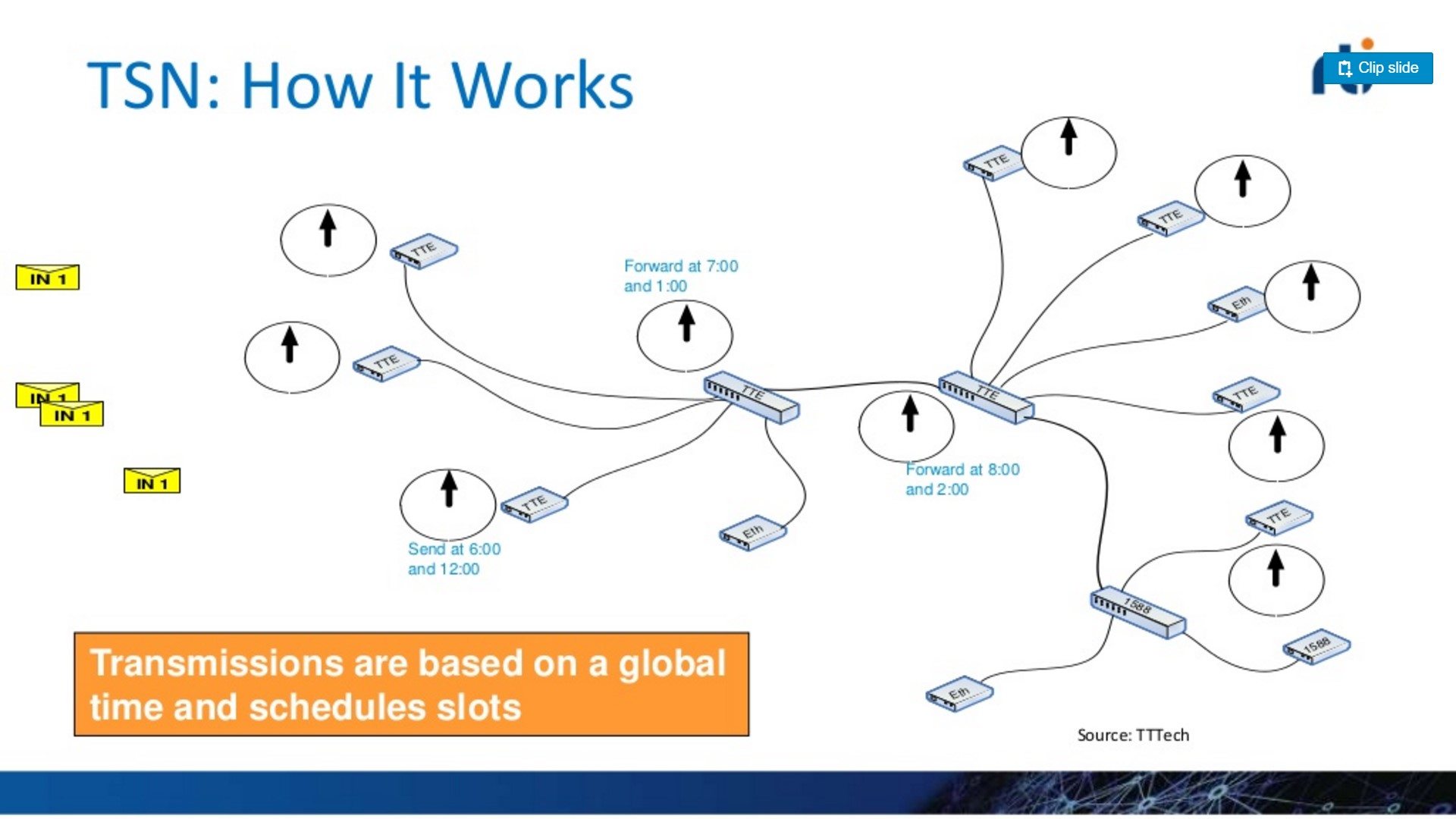
A time-sensitive network is a set of Ethernet standards that will allow time-synchronized low latency streaming services through 802 networks. TSN delivers mechanisms to create distributed, synchronized, hard real-time systems over standard Ethernet. These systems use the same infrastructure to provide real-time control and communicate all standard IT data, powering convergence of control, measurement, configuration, UI and file exchange infrastructure. By defining queues based on time, time-sensitive networking ensures a bounded maximum latency for traffic through switched networks. According to TTTech Computertechnik AG, this means that standard Ethernet will now allow:
- Message latency guaranteed through switched networks;
- Critical and noncritical traffic can be converged in one network;
- Higher-layer protocols can share the network infrastructure;
- Real-time control can be extended away from the operations area;
- Subsystems can be integrated more easily;
- Components can be added without network or equipment alterations; and
- Network faults can be diagnosed and repaired faster.
It is under development by the Time-Sensitive Network Task Group, an initiative created by the Institute of Electrical and Electronics Engineers. The task group’s charter outlines the following specific goals it would like to accomplish:
- A Layer 2 time-synchronizing service that is appropriate for the most stringent requirements of consumer electronics applications. This was done in cooperation with the IEEE 1588. It is currently under revision as IEEE P802.1AS-REV: IEEE Standard for Local and Metropolitan Area Networks – Timing and Synchronization for Time-Sensitive Applications in Bridged Local Area Networks:
- This standard enables stations attached to bridged LANs to meet the respective jitter, wander and time synchronization requirements for time-sensitive applications. This includes applications that involve multiple streams delivered to multiple endpoints.
- Definition of an admission control system that allows bridges to guarantee the resources needed for AV streams. A new project to update the protocol and provide better interfaces for centralized management and some of the other enhanced TSN features is IEEE P802.1Qcc: Standard for Local and metropolitan area networks – Media Access Control (MAC) Bridges and Virtual Bridged Local Area Networks Amendment: Stream Reservation Protocol (SRP) Enhancements and Performance Improvements:
- This amendment provides protocols, procedures and managed objects for bridges and end stations that are compatible with existing mechanisms and provide:
- Support for more streams;
- Configurable SR (stream reservation) classes and streams;
- Better description of stream characteristics;
- Support for Layer 3 streaming;
- Deterministic stream reservation convergence; and
- UNI (User Network Interface) for routing and reservations.
- This amendment provides protocols, procedures and managed objects for bridges and end stations that are compatible with existing mechanisms and provide:
- Enhancement of standard 802.1 bridge frame forwarding rules to support AV streams. The original version of this work has been published as IEEE Std 802.1Qav-2010: IEEE Standard for Local and Metropolitan Area Networks – Virtual Bridged Local Area Networks – Amendment 12: Forwarding and Queuing Enhancements for Time-Sensitive Streams. Two new projects are underway to provide even lower network delays:
- Support for packet preemption, which allows very time-sensitive packets to interrupt a normal best-effort packet being transmitted on an egress port and then resume it once the time-sensitive packet has been transmitted. This work is being done as “project IEEE P802.1Qbu: Standard for Local and metropolitan area networks – Media Access Control (MAC) Bridges and Virtual Bridged Local Area Networks Amendment: Frame Preemption.” The current PAR and 5 criteria are available in the public archives.
- Scheduled traffic enhancements, which defines ways for bridges and end stations to schedule the transmission of frames based on timing derived from IEEE Std 802.1AS. This work is being done as “project IEEE P802.1Qbv: Standard for Local and metropolitan area networks – Media Access Control (MAC) Bridges and Virtual Bridged Local Area Networks Amendment: Enhancements for Scheduled Traffic” and the current PAR and 5 criteria are available in the public archives.
- Establishment of a set of usage-specific profiles that will help ensure interoperability between networked devices using the AV bridging specifications. The original version of this work has been published as IEEE Std 802.1BA-2011: Standard for Local and Metropolitan Area Networks: Audio Video Bridging (AVB) Systems. A project to amend this standard will be started once the other new AVB projects are complete:
- This standard defines profiles that select features, options, configurations, defaults, protocols and procedures of bridges, stations and LANs that are necessary to build networks that are capable of transporting time-sensitive audio and/or video data streams. The purpose of this standard is to specify defaults and profiles that manufacturers of LAN equipment can use to develop AVB-compatible LAN components, and to enable a person not skilled in networking to build a network – using those components – that does not require configuration to provide working audio and/or video services.
How it is being used
At NI Week 2016, National Instruments announced an early access technology platform for time-sensitive networking in coordination with Cisco and Intel. That platform will help customers build distributed systems that perform synchronized I/O, code execution and deterministic communication for distributed control and measurement loops, all using standard Ethernet. Engineers are using this platform to help vet the technology in ecosystem activities including the Industrial Internet Consortium TSN Testbed for smart manufacturing, according to NI.
The Laboratory for Machine Tools and Production Engineering of RWTH Aachen University is using the platform to make advancements in next-generation computer numeric control machining, EUV Tech is using it for novel semiconductor processing machines and Oak Ridge National Laboratory for future electrical grid research.
“Oak Ridge National Laboratory is working to address challenges to the stability and control of the world’s power grids caused by the accelerating deployment of distributed renewable energy sources,” said Mark Buckner, power and energy systems group leader at ORNL. “In partnership with NI and Cisco, we are demonstrating how Time Sensitive Networking can enable an unprecedented level of microgrid coordination and control, significantly increasing the resiliency of power delivery systems.”

