RCR Wireless
  • News
  • Channels
    • 5G
    • 6G
    • BSS OSS
    • Carriers
    • IoT
    • Network Infrastructure
    • Open RAN
    • Private 5G
    • Telco AI
    • Telco Cloud
    • Test & Measurement
  • Resources
    • Reports
    • Webinars
    • White papers
    • AI Fundamentals
    • Analyst Angle
    • Editorial Calendar
    • Fundamentals
      • 5G NR Release 17
      • AI
        • Telco AI in 2025
    • Podcasts
      • Let’s Get Digital with Carrie Charles
      • Wireless Connectivity to Enable Industry 4.0 for the Middleprise
      • Well Technically…
      • Will 5G Change the World
      • Accelerating Industry 4.0 Digitalization
  • AI Infrastructure
  • Programs
  • Events
  • RCRtv
  • Advertise
  • Subscribe
Sunday, August 9, 2026
RCR Wireless
  • News
  • Channels
    • 5G
    • 6G
    • BSS OSS
    • Carriers
    • IoT
    • Network Infrastructure
    • Open RAN
    • Private 5G
    • Telco AI
    • Telco Cloud
    • Test & Measurement
  • Resources
    • Reports
    • Webinars
    • White papers
    • AI Fundamentals
    • Analyst Angle
    • Editorial Calendar
    • Fundamentals
      • 5G NR Release 17
      • AI
        • Telco AI in 2025
    • Podcasts
      • Let’s Get Digital with Carrie Charles
      • Wireless Connectivity to Enable Industry 4.0 for the Middleprise
      • Well Technically…
      • Will 5G Change the World
      • Accelerating Industry 4.0 Digitalization
  • AI Infrastructure
  • Programs
  • Events
  • RCRtv
  • Advertise
  • Subscribe
Add RCR Wireless as a preferred source on Google
  • Qualcomm 6G Insights
  • Huawei Content Hub
  • Qualcomm – 6G Vision
  • OSS/BSS Channel
  • RCRTech Roundtable: AI Infrastructure
RCR Wireless
RCR Wireless
  • Advanced Mimo
  • Mobile mmWave
  • 5G Positioning
  • Green Networks
  • Metaverse
  • Automotive
  • Industrial and Wide-area IoT
Copyright 2021 - All Right Reserved
Home - Smart Alternatives to Small Cell Deployment (content provided by Westell Technologies)
Network InfrastructureSponsored

Smart Alternatives to Small Cell Deployment (content provided by Westell Technologies)

by RCR Wireless News June 1, 2016
written by RCR Wireless News June 1, 2016 Share
LinkedinEmail
Share 0LinkedinEmail
112

Despite all the hype about small cells, digital repeaters are still the easiest, lowest cost, and most reliable solution for improving in-building wireless coverage for all carriers. I am not talking about the broadband signal boosters that are not carrier-authorized, which can potentially interfere with just about everything, including public safety systems, and result in fines. I am talking about digitally-filtered, carrier-approved, frequency-dependent industrial repeaters that keep pace with carrier network enhancements. These digital repeaters have been feeding DAS systems for over 15 years and remain a core option for carriers today.
Digital Repeaters vs. Small Cells
Small cell deployment costs may appear to be less on the surface, but as you add multiple carriers and more frequency bands, the cost increases exponentially. Until there is a proven and reliable multi-carrier small cell solution in the market, small cell will not be the answer to most enterprise customers’ coverage challenge. Besides being more expensive, many small cell solutions available today have other inherent drawbacks. Their performance can be diminished by interference with nearby macro sites operating in the same frequency ranges, as well as other small cells or fiber DAS systems fed by carrier radios. Co-channel interference results from spurious signals from these nearby sites, which can lower the Signal-to-Interference-plus-Noise Ratio (SINR) and overall performance. A lower SINR can affect both the users on the small cell and those connected to the macro sites or other small cells.
Digital repeaters get their source directly from the macro sites themselves, and are filtered to reduce the effects of co-channel interference with low delay, simplifying installation. Another potential drawback of small cells is the recurring operational expense for the land-line backhaul, which is typically a fiber lease. Digital repeaters are a one-time purchase with no recurring charges.
How Digital Repeaters Work
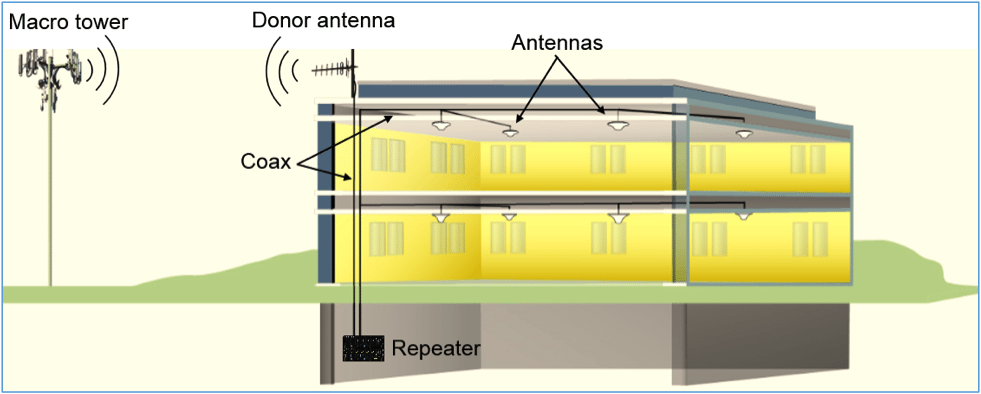
Digital repeaters receive the signals from the macro sites, filter them, and amplify only the appropriate frequencies to the signal strength required to have good service in the building. These systems will include one or more donor antennas, which point to the respective macro sites, providing the carrier signals. Behind the repeaters are one or more antennas to act like mini cell towers throughout the building. An optimized model is typically created in advance using an in-building wireless coverage design tool to simulate performance. This optimization will determine the number and types of antennas needed, and how they will all interconnect.
westell image 1
The Bottom Line
The total cost of a typical digital repeater installation by a qualified local contractor, or DAS integrator, can be less than $10,000 for a single carrier and a few antennas, with remarkable performance. Furthermore, any enterprise can easily purchase and install it themselves with the assistance of a local DAS integrator. The costs go up as more carriers are added and as more antennas are needed, but it will almost certainly be less expensive than a small cell deployment. Each situation will be different, and digital repeaters might not be the right solution for you. But, you owe it to yourself to at least consider whether a digital repeater DAS might be a good fit; as either a temporary or permanent solution, for your mobile wireless coverage needs.
Learn more about Westell at www.westell.com.

You Might Also Like
  • Thursday (telco diary) | APAC telcos pile into AI infrastructure
  • Starlink Mobile – what is Musk actually building, beyond the chatter?
  • SpaceX targets US carriers with small-cell terrestrial rollout and mega demand from physical AI
  • Tuesday (telco diary) | More about ISAC – on battlefields and sportsfields
  • Intelligent RAN Forum 2026
  • NTN Integration Forum 2026
Share 0 LinkedinEmail
RCR Wireless News

previous post
Vodafone deploys mini base stations to boost 4G in London
next post
T-Mobile passes Verizon as leading smartphone sales channel

White Papers

  • Norton eBook: The 2026 Telco Playbook

  • Enea White Paper: Why Intelligent AAA is the Swiss Army Knife of Telecom

  • CSG White Paper: Telco AI Enabler: Mediation’s Defining Role

  • Enea White Paper: Scalable Database Design for 5G and Beyond

  • Supermicro and NVIDIA Whitepaper: Powering sovereign AI at scale

Editorial Reports

  • Report: NTN in motion — evolving standards, expanding services

  • Market Pulse Report: Telco AI in 2026 – Trends, Challenges and Opportunities

  • Nvidia Report: The State of AI in Telecommunications: 2026 Trends

Webinars

  • Webinar: Building 6G — aligning technology, policy and purpose

  • SIMCom Webinar: Scaling your next deployment – from plastic to provisioning

  • Webinar: Rethinking the RAN as AI, cloud and openness converge

  • Webinar: Scale-Up, Scale-Out, Scale-Across – Building AI-Era Network Fabrics

  • Webinar: NTN in motion – evolving standards, expanding services

Since 1982, RCR Wireless News has been providing wireless and mobile industry news, insights, and analysis to mobile and wireless industry professionals, decision makers, policy makers, analysts and investors.

Facebook Twitter Youtube Linkedin Envelope Rss

Useful Links

  • Subscribe
  • About RCR Wireless News
  • Contact Us
  • Advertise
  • Editorial Calendar
  • Archive
  • RSS
  • Wireless News Archive
  • Subscribe
  • About RCR Wireless News
  • Contact Us
  • Advertise
  • Editorial Calendar
  • Archive
  • RSS
  • Wireless News Archive

Edtior's Picks

The Agentic Network — NVIDIA on the full-stack path to telecom autonomy
Ericsson named sole global tech partner in SK Telecom-led AI-RAN pilot
Bell advances AIDC strategy as fiber and enterprise AI drive Q2

Latest Articles

The Agentic Network — NVIDIA on the full-stack path to telecom autonomy
Ericsson named sole global tech partner in SK Telecom-led AI-RAN pilot
Bell advances AIDC strategy as fiber and enterprise AI drive Q2
Context before control – Blue Planet maps AI architecture for autonomous networks

© 2026 RCR Wireless News All Right Reserved. Developed by Eight Hats.

Cookie Policy | Privacy Policy

RCR Wireless
  • News
  • Channels
    • 5G
    • 6G
    • BSS OSS
    • Carriers
    • IoT
    • Network Infrastructure
    • Open RAN
    • Private 5G
    • Telco AI
    • Telco Cloud
    • Test & Measurement
  • Resources
    • Reports
    • Webinars
    • White papers
    • AI Fundamentals
    • Analyst Angle
    • Editorial Calendar
    • Fundamentals
      • 5G NR Release 17
      • AI
        • Telco AI in 2025
    • Podcasts
      • Let’s Get Digital with Carrie Charles
      • Wireless Connectivity to Enable Industry 4.0 for the Middleprise
      • Well Technically…
      • Will 5G Change the World
      • Accelerating Industry 4.0 Digitalization
  • AI Infrastructure
  • Programs
  • Events
  • RCRtv
  • Advertise
  • Subscribe
RCR Wireless
  • News
  • Channels
    • 5G
    • 6G
    • BSS OSS
    • Carriers
    • IoT
    • Network Infrastructure
    • Open RAN
    • Private 5G
    • Telco AI
    • Telco Cloud
    • Test & Measurement
  • Resources
    • Reports
    • Webinars
    • White papers
    • AI Fundamentals
    • Analyst Angle
    • Editorial Calendar
    • Fundamentals
      • 5G NR Release 17
      • AI
        • Telco AI in 2025
    • Podcasts
      • Let’s Get Digital with Carrie Charles
      • Wireless Connectivity to Enable Industry 4.0 for the Middleprise
      • Well Technically…
      • Will 5G Change the World
      • Accelerating Industry 4.0 Digitalization
  • AI Infrastructure
  • Programs
  • Events
  • RCRtv
  • Advertise
  • Subscribe
@2020 - All Right Reserved. Designed and Developed by PenciDesign