

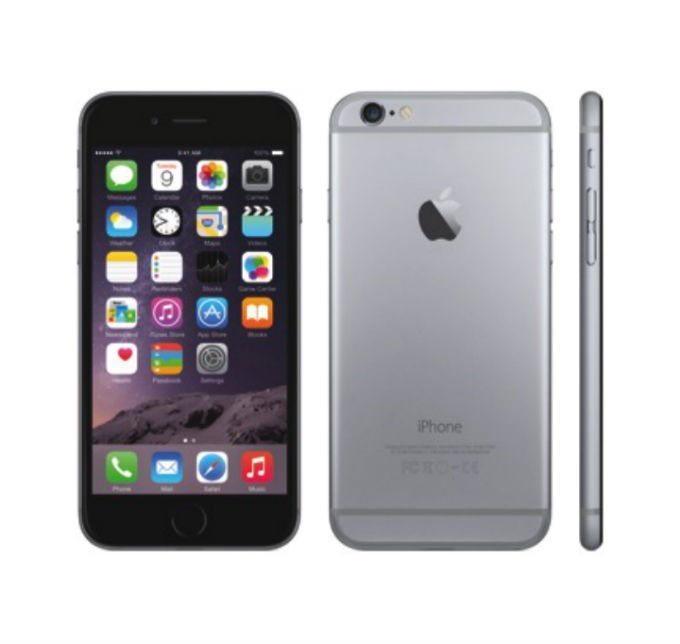
In announcing its latest iPhone iterations, Apple has yet again shown its unique influence over the competitive landscape for wireless carriers.
Apple said the iPhone 6 (4.7-inch screen) and 6 Plus (5.5-inch screen) would be available beginning Sept. 19, and supported by all carriers that currently offer the iPhone line up. Apple’s iPhone site specifically notes Verizon Wireless, AT&T Mobility and Sprint with corresponding two-year contract pricing beginning at $199 for the iPhone 6 and $299 for the 6 Plus, and T-Mobile US pricing shown as “contract-free” priced at $649 for the iPhone 6 and $749 for the iPhone 6 Plus. U.S. Cellular also said it plans to offer both models on their launch date.
While Apple announced two new iPhone models, the company is actually releasing six different technology models with three variations of each model to support a wide breadth of wireless operators. (This does not include the fact that each model will be available with three different storage capacities: 16 gigabytes, 64 GB and 128 GB.)
One is geared for GSM-based carriers that includes support for 2G GSM/GPRS/EDGE technology across the 850 MHz, 900 MHz, 1800 MHz and 1900 MHz bands; UMTS/HSPA 3G services across the 850 MHz, 900 MHz, 1700/2100 MHz, 1900 MHz and 2100 MHz bands; and 16 FDD-LTE bands. These models target a broad range of worldwide operators, including domestic operators AT&T Mobility and T-Mobile US.
The second model targets CDMA-based legacy operators like Verizon Wireless, by adding support for CDMA2000 1x EV-DO Revision A and B across the 800 MHz, 1700/2100 MHz, 1900 MHz and 2100 MHz band. These models also include the GSM-based 2G and 3G support from the GSM-based model for international roaming. The LTE support for the CDMA model also includes the same 16 bands as the GSM-based model.
The third model is the most diverse, as it adds to the CDMA model support for the TD-SCDMA technology standard in the 1900 MHz and 2000 MHz bands and TD-LTE technology across four bands, including the 2.5 GHz spectrum used by Sprint in Band Class 41. While not the first device to support Sprint’s nascent Spark offering, the inclusion is the first in an Apple device and seen as a big win for the carrier. Analysts have noted that Sprint’s vast 2.5 GHz spectrum holdings could be its secret weapon in gaining network superiority at least in terms of performance as it can throw multiple wide-channel blocks of support behind the service to support higher data speeds.
The third model also supports Chinese carriers like China Mobile, China Unicom and China Telecom that are beginning to roll out TD-LTE services.
Band Class 12 left out
While the latest iPhones appear to have very broad LTE support, they do still lack inclusion of Band Class 12, which includes all of the lower 700 MHz spectrum bands used in the United States. The FCC earlier this year moved forward with plans on ensuring interoperability across the lower 700 MHz spectrum band, announcing a modification to AT&T’s lower B- and C-Block licenses that were part of Band Class 17 to require interoperability with the adjacent A-Block under Band Class 12.
That omission could limit LTE support for some rural carriers that are looking to roll out LTE services across the 700 MHz A-Block licenses they acquired in 2008. U.S. Cellular, which has aggressively gobbled up A-Block licenses and rolled out LTE services across that band, also taps into its 850 MHz spectrum to support its LTE services and thus can use the CDMA version of the newest iPhones to run LTE.
Another carrier that could be limited by the Band Class 12 omission is T-Mobile US, which has picked up significant chunks of 700 MHz A-Block licenses. T-Mobile US has said it plans to begin tapping into those spectrum licenses later this year to help expand coverage of its network based on the greater propagation characteristics of the low-band spectrum. However, that network, at least for now, will not allow an iPhone device to run LTE services.
VoLTE support
Beyond carriers offering the latest iPhone models, Apple’s inclusion of voice over LTE support could boost consumer adoption and thus carrier rollout plans for the voice technology. A number of operators have just recently begun to roll out VoLTE or have announced plans, which allows operators to transmit voice traffic over their more efficient LTE networks. While there are a handful of devices that already support VoLTE services, few have the cache of Apple’s iPhone lineup.
Carriers are looking to quickly move consumers over to VoLTE services so that they can begin decommissioning legacy 2G and 3G networks that currently transport circuit-switched voice services and use those spectrum resources to further bolster their LTE networks. That support could become more critical as the larger screen sizes of the iPhone 6 line could tempt consumers to partake in data-heavy video offerings, which could impact network operations as well as inflate the bottom line.
“Apple’s new devices offer operators a great opportunity to increase data usage and data revenues,” explained Paul Lambert, senior analyst for operator strategy at Ovum. “Each of the new devices will lead to more cellular data use, which is also great news for operators — especially if they can price data services in ways that capture consumers’ imaginations. The iPhones support more 4G frequencies and also VoLTE, both of which are welcome additions for 4G operators and will boost global 4G uptake.
Pricing moves
Apple’s decision to price the iPhone 6 Plus at a premium also alters the market’s dynamic landscape. Apple has traditionally offered up the base model of its high-end device at $199 with a two-year contract through domestic operators. (Or, in some cases for $150 when the iPhone 5 and iPhone 4S models launched with rural and regional operators months after the device’s initial launch with nationwide operators.) With the iPhone 6 Plus, Apple is pricing the base model at $299, with the premium going toward a larger and more pixel-dense screen.
Apple’s move to the $199 price point set a standard for rivals, with most top-end devices not priced at that price when launched. OEMs have on occasion attempted to move above that price level with models that included either bigger batteries in the case of Motorola and its Maxx line up or with a “phablet” form factor in the case of models from Samsung and LG. However, such moves did appear to temper consumer demand.
Apple also cut pricing on the larger storage capacity models of the devices, with the new models now quadrupling storage from 16 GB to 64 GB for a $100 premium compared with the previous doubling of storage for that same $100. The 128 GB version is a new capacity all together, priced at a similar level as the 5S’ 64 GB model.
Beyond the mention of T-Mobile US’ “contract-free” pricing, there has been no mention of the latest iPhone models being offered by no-contract operators, which typically offer little or no subsidy on pricing.
With Apple now playing at a higher price point for one of its models, consumers could become more accepting of higher-priced devices.
The launch of the iPhone 6 and 6 Plus also came with Apple announcing price cuts for its current 5S and 5C models. The 5S has seen its base price cut to $100 with a two-year contract, a price point that the device has been selling at in some locations leading up to the iPhone 6 launch, while the 5C in its eight gigabyte version set for free with a two-year contract.
Bored? Why not follow me on Twitter
Table of Contents

