

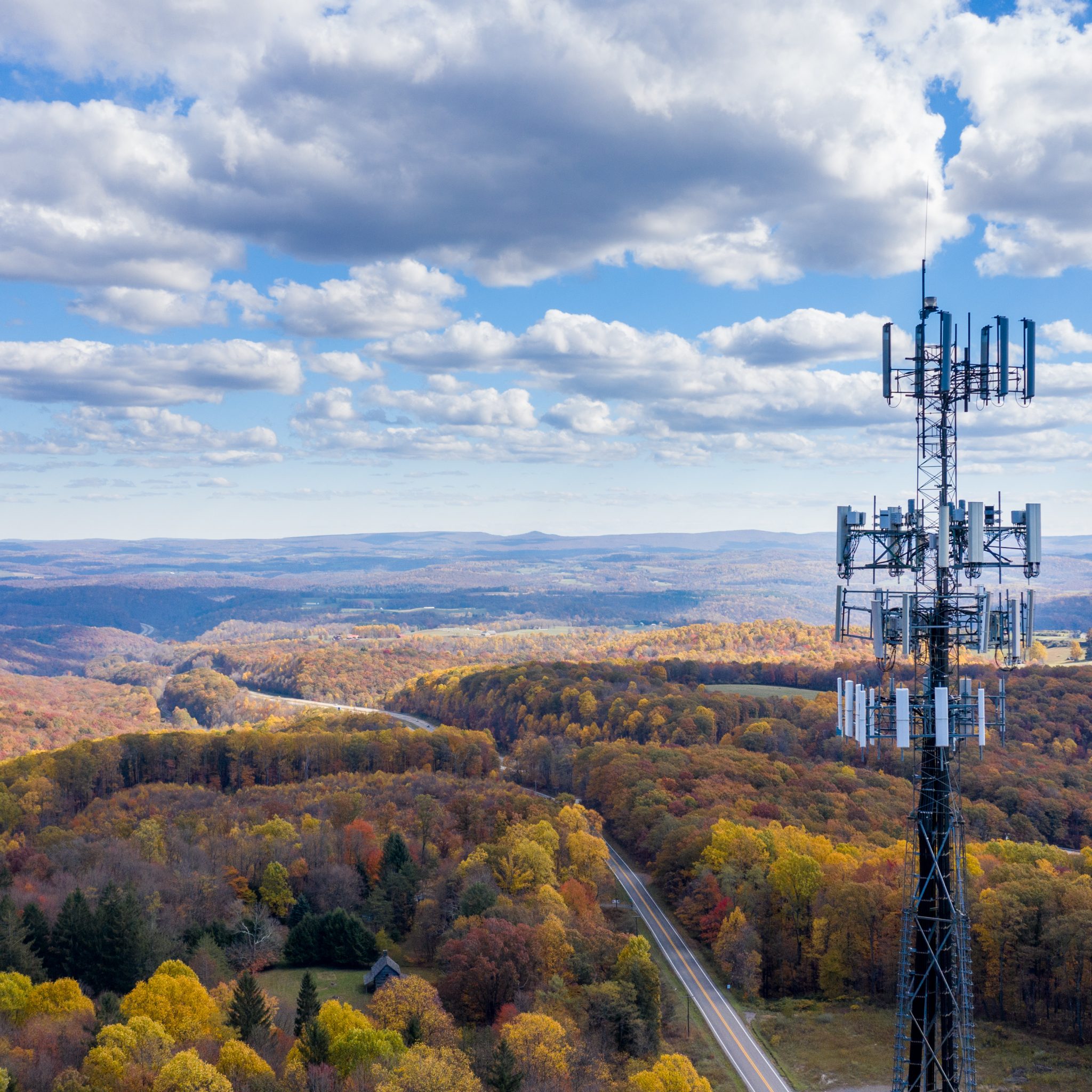
The coronavirus pandemic has led to an intensified focus on broadband availability, as people around the world turned to online services to stay connected, work and learn. Terry Young, who is director of service provider and 5G product marketing for A10 Networks, sees the intense focus on expanding broadband networks as one of the few good things to emerge from the pandemic. As governments around the world seek to mitigate the economic and social fallout from the pandemic, many of them are thinking about broadband and 5G as part of their economic recovery strategy.
“This is a global phenomenon – it’s not just the U.S.,” says Young. “Everywhere in the world, the pandemic has put the spotlight on where the digital divide is, and who’s on which side of it, and how many unconnected people there are.”
While holes in broadband service areas exist in urban and suburban markets as well, there has been more attention paid recently not just to whether people in rural America have access to minimum broadband speeds (currently defined by the FCC as 25/3 Mbps), but to high-speed services that are actually on-par with high-quality services in more populated areas. In the U.S., Young points out, the most recent rural broadband expansion funding efforts such as the Rural Digital Opportunity Fund aimed to support providers who promised gigabit-level speeds. “They’re not just giving them some kind of access, it’s designed to provide good quality access. I think that’s a real shift from how people might have thought connecting rural broadband was about, in terms of just velocity,” she says.
As regional service providers seek to deploy faster networks using new techniques or technologies — CBRS spectrum, 5G or DOCSIS 3.1, for example — they face many of the same challenges as the national carriers, in addition to some that are unique to their own specific situations and geographies. “Some are augmenting their existing capabilities to extend to more homes passed, and others it may be totally a new build altogether,” Young says. “The circumstances for each are different, but all those homes passed, they have some common, critical functions” that are necessary in order for the access technology to actually be used to provide service. She highlights two things that “no matter where you are, you have to address in some way,” as a network operator: Protection against the evolving network threat landscape, including specific protection against Dedicated Denial of Service attacks, and making sure that you have an IP address strategy to support new customers and devices.
Expanding service territory means an opportunity to assess cybersecurity needs and capabilities. Recent cyber attacks on large U.S. companies, including the largest U.S. pipeline system and a major meat producer, have raised additional concerns about the shifting threat landscape – one that both rural operators and newly connected customers will have more exposure to as they expand. The Covid-19 pandemic has also driven a massive and rapid shift in Dedicated Denial of Service (DDos) attacks around the world: As digital services became more vital, they also became targets. Network monitoring company Netscout reported that it observed a record 10 million DDos attacks in the second half of 2020, and the lessons it distilled from the resulting data are pretty bleak: Even as the world grappled with the impacts of a global pandemic, cybercriminals were taking advantage of end users without enterprise-grade security and targeting online services that people were depending on, such as e-commerce, online learning, streaming services and healthcare. Netscout reported a “huge upsurge in distributed denial-of-service (DDoS) attacks, brute-forcing of access credentials, and malware targeting of internet-connected
devices. … We observed multiple record-breaking events: the most DDoS attacks launched in a single month (929K), the most DDoS attacks in a single year (more than 10 million), and monthly DDoS attack numbers that regularly exceed the 2019 averages by 100,000 to 150,000 attacks.” Netscout’s report concludes that high levels of DDoS attacks are becoming the “new normal” of the threat landscape.
While most of the attack strategies are not necessarily new, operators should re-think whether they are fully leveraging the tools available to them, particularly as they expand the number of connections and devices on their networks. “Operators have not necessarily taken advantage of all the tools that are out there, and they need
to double down more on some of the basic security,” says Young. “I think the same is true of some of these operators who are introducing new subscribers to a whole new environment. … They’re expanding the wide, wide
world of broadband access – and threats – to communities that maybe haven’t had to deal with it before. There may be a whole learning curve on trying to get more up to speed on all the ways you can be attacked,” she adds – for operators, consumer and rural enterprises as well. Young notes that small hospital locations have been among specific targets of cyberattacks during the course of the pandemic, and Covid-19 related scams (robocalls,
phishing and other tactics) have proliferated rapidly as well.
More customers and more devices means a need for more IP addresses. The transition to IPv6 has been inevitable since it was put into motion more than 20 years ago, when it became clear that the rising numbers of personal computers and connected devices would deplete the existing pool of IPv4 Internet Protocol addresses – the IP addresses that every single connected thing must have in order to access the internet. Now, the proliferation of IoT devices is a major driver of IPv6 adoption — and many locations for IoT use cases, such as precision agriculture and smart manufacturing, are often in rural areas that will be targeted for expanded broadband.
IPv6 is not backwards-compatible to IPv4, and the extent to which any network providers’ traffic is IPv6 and IPv4 depends on a number of variables: Customer CPE mix, technology within the data center and what web sites customers are trying to access. “The basic dilemma for most operators is that it continues to be a very mixed environment – you may have customers who have very old legacy CPE, you have service providers who may have older technology that is still very functional within their data center, and then you have the websites that subscribers are trying to get to,” Young explains. In order for customers or devices to access the internet at all, smooth translation back and forth between IPv4 and IPv6 is fundamental. “IPv6 adoption keeps increasing. Everyone is moving in that direction,” Young says. “But in the meantime, you’ve got this mixed environment that has to be addressed.”
The translation between IPv4 and IPv6 isn’t the only complicating factor. While operators often have an existing base of IPv4 addresses that they have been assigned, expanding services to tens of thousands of new customers and devices can deplete them.
“They are probably going to run out, if they’re trying to extend service to that ten thousand, fifteen thousand, twenty thousand, forty thousand – however many subscribers it might be as they build out to these new areas,” Young says. “So they have to either acquire more IPv4 addresses or find a way to use what they have more effectively.” One of A10’s solutions allows them to share existing IPv4 addresses among all their subscribers in order to avoid the cost of buying new addresses. There are much bigger line-items in a broadband build-out, Young acknowledges — but the rise in cost of IPv4 addresses can be an unwelcome surprise, and saving money on IP addresses is one place for network operators to reduce their total cost of ownership in a way that is still meaningful. Young offers up some rough math: IPv4 addresses, which are now scarce and in-demand, can cost up to $32 apiece, she says. For 10,000 new subscribers, that’s a cost of $320,000. She gives another data point: The FCC’s RDOF program of $9.2 billion aims to cover an additional 5.2 million premises, or nearly $1,800 per home. “$32 might not sound like much, but it’s 1-2% of the total spend for that subscriber. That’s 1-2% that they could use for something else — it could mean [reaching] more homes, or a hospital that you couldn’t otherwise get to. It’s a small amount relative to the entire budget, but every little bit helps.”
Looking for more information on the trends and challenges in rural broadband deployment? Read RCR Wireless News’ editorial report, Building a Future-Ready Rural Broadband Infrastructure, and watch the accompanying webinar featuring A10, the Competitive Carriers Association and regional operator Nsight.

