


Carriers and vendors are solidly behind advances in 5G technology, but the advanced business and use case to support the technology remains elusive
Perhaps the most challenging issue surrounding “5G” today is in terms of use cases.
Speaking with a number of carriers leading up to and at the recent CTIA Super Mobility event, it became apparent one of the first use cases for commercial 5G deployments is likely to be some form of fixed wireless broadband connectivity, though others, such as the “internet of things,” also are on the agenda.
In terms of “basic” services like fixed wireless broadband, Verizon Communications and AT&T have hinted that their initial trials will include such services, which is expected to allow the market to ease into new technology advances.
“There is a lot of talk about massive densification of networks and millimeter wave technologies, but the first to hit the market will be fixed broadband access because that can be done cost effectively and there is a use case behind it,” explained Larry Davis, national sales manager at Anritsu.
These initial plans will likely see operators supplant plans for fiber-to-the-home broadband services and instead use 5G technology to power connectivity from a central location to a building or neighborhood. But, those plans could also vary by carrier.
“Use cases are really operator-centric in terms of how important those use cases are,” said Thomas Keathley, SVP of wireless network architecture and design at AT&T. “Enhanced mobile broadband is indeed one use case, but we also see opportunities with IoT with increased connection density. There are also other use cases like low-latency, high-reliability applications and mission-critical services.”
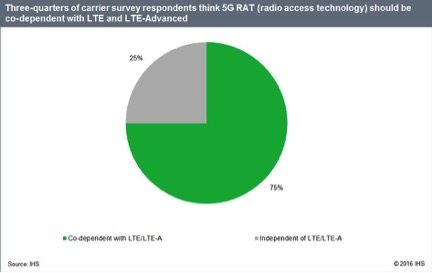
A recent report from IHS found three-fourths of the operators questioned cited IoT as the top use case for 5G.
For 5G, Verizon Communications is initially focusing on using the technology as a last-mile deployment of high-speed data services to the home, with support from installed fiber assets. Verizon Communications President and CEO Lowell McAdam, speaking with investment analysts following release of the company’s second-quarter results, said the move is expected to provide a compelling broadband experience for customers at an attractive price point for the telecom operator.
“I think of 5G initially as, in effect, wireless fiber, which is wireless technology that can provide an enhanced broadband experience that could only previously be delivered with physical fiber to the customer,” McAdam said. “With wireless fiber the so-called last mile can be a virtual connection, dramatically changing our cost structure.”
Verizon Communications noted lab tests have shown transmission speeds in excess of 1 gigabit per second, with ongoing field trials being used to investigate propagation characteristics of millimeter wave spectrum in real-world conditions. The company also sees its pending acquisition of XO Communications as part of its overall 5G strategy based on the 28 GHz spectrum currently controlled by XO.
Digging into those trials, McAdam cited deployments in Dallas with Ericsson and Nokia, as well as work in New Jersey near Verizon Communications’ headquarters and in parts of Virginia. Those trials are said to be producing the 1 Gbps speeds at a range of 500 yards or less “because of the confined space that we’ve got available to us,” McAdam explained.
Verizon is now moving those trials into a “field environment,” where it’s looking to cover a typical 200-home development. That work is looking to test performance from sites at a distance of up to 1,000 meters.
In terms of cost, McAdam said the carrier is looking at models showing deployments at roughly half the cost of current fiber-based Fios deployments to the home. Further cost savings tied to 5G plans also are expected to come from taking advantage of current small cell deployments tapping the carrier’s midband spectrum in order to increase capacity of its LTE network.
“But we’ll know a lot more as we finish these trials,” McAdam said. “And I fully expect that as we wrap these trials up, we’ll actually be bringing some analysts and some of the media to the field to take a look at these deployments, so that you can judge for yourself.”
Scott Mair, SVP for technology and engineering at AT&T, recently said the carrier was on track to begin testing fixed broadband services using spectrum in the 15 GHz band and pre-5G technology, on its way to adding 28 GHz band spectrum to its tests later this year. Those tests are then expected to add a mobility component by early 2017.
Mair said AT&T is set to have “thousands” of cell sites hosting the carrier’s 2.3 GHz spectrum resources by the end of this year, moving on work the carrier began last year. The spectrum will initially be used in dense urban and suburban environments where the carrier sees the greatest need for additional capacity, he said. Moving forward, in late 2017 AT&T is looking to add support from the 1.7/2.1 GHz spectrum band the carrier purchased in last year’s AWS-3 auction, with volume deployments set for 2018.
T-Mobile US earlier this year announced plans with Nokia and Ericsson to trial technology using the 28 GHz band, with Ericsson recently filing a request with the Federal Communications Commission to tap the 14.7-15.5 GHz bands to conduct trials near T-Mobile US’ headquarters in Bellevue, Washington.
More recently, T-Mobile US announced plans to work with Samsung later this year to demonstrate technology advances using spectrum in the 28 GHz band. The collaboration is set to include both lab work and field trials encapsulating “real-world mobile use cases and applications.”
Initial testing set for later this year is to include mobility in an outdoor environment using T-Mobile US’ 28 GHz spectrum and Samsung’s proof-of-concept system, which is enabled with beamforming technology. The work is then set to include trials using a pre-commercial 28 GHz system early next year.
AT&T’s Mair also provided some insight into how AT&T views network needs connected to new use cases around IoT and connected cars, noting massive IoT deployments will require networks capable of supporting 1 million devices in a one-square-kilometer environment; while vehicle-to-vehicle, smart city and mobile health care services will rely on extremely low latency networks of less than one millisecond in the air interface. Mair said both would require the “need to rearchitect LTE” in order to meet those performance requirements.
One of the more significant performance requirements for IoT is expected to be latency, which is the time it takes for an action to be initiated and the time it’s completed. Latency has been one of the more challenging issues for mobile broadband networks compared with wired connections as the inherent limitations of transmitting data over the air falls short of what can be accomplished over a fiber optic cable.
The move to LTE technology allowed mobile carriers to slash latency from hundreds of milliseconds to tens of milliseconds. A significant improvement, but still not quite fast enough for some of the more demanding IoT use cases being bandied about. Those are likely to require latency of less than 10 milliseconds, with an ideal push toward 1 millisecond if possible.
“Latency is hard to explain to people, but is very important,” said Ron Marquardt, VP of technology innovation and architecture at Sprint, on the carrier’s recent 5G trials. “We tried to show that issue, but it didn’t really gel with people.”
Bored? Why not follow me on Twitter
Photo copyright: nerthuz / 123RF Stock Photo


