

RCR Wireless
  • News
  • Channels
    • 5G
    • 6G
    • BSS OSS
    • Carriers
    • IoT
    • Network Infrastructure
    • Open RAN
    • Private 5G
    • Telco AI
    • Telco Cloud
    • Test & Measurement
  • Resources
    • Reports
    • Webinars
    • White papers
    • AI Fundamentals
    • Analyst Angle
    • Editorial Calendar
    • Fundamentals
      • 5G NR Release 17
      • AI
        • Telco AI in 2025
    • Podcasts
      • Let’s Get Digital with Carrie Charles
      • Wireless Connectivity to Enable Industry 4.0 for the Middleprise
      • Well Technically…
      • Will 5G Change the World
      • Accelerating Industry 4.0 Digitalization
  • AI Infrastructure
  • Programs
  • Events
  • RCRtv
  • Advertise
  • Subscribe
Wednesday, July 8, 2026
RCR Wireless
  • News
  • Channels
    • 5G
    • 6G
    • BSS OSS
    • Carriers
    • IoT
    • Network Infrastructure
    • Open RAN
    • Private 5G
    • Telco AI
    • Telco Cloud
    • Test & Measurement
  • Resources
    • Reports
    • Webinars
    • White papers
    • AI Fundamentals
    • Analyst Angle
    • Editorial Calendar
    • Fundamentals
      • 5G NR Release 17
      • AI
        • Telco AI in 2025
    • Podcasts
      • Let’s Get Digital with Carrie Charles
      • Wireless Connectivity to Enable Industry 4.0 for the Middleprise
      • Well Technically…
      • Will 5G Change the World
      • Accelerating Industry 4.0 Digitalization
  • AI Infrastructure
  • Programs
  • Events
  • RCRtv
  • Advertise
  • Subscribe
Add RCR Wireless as a preferred source on Google
  • Qualcomm 6G Insights
  • Huawei Content Hub
  • Qualcomm – 6G Vision
  • OSS/BSS Channel
RCR Wireless
RCR Wireless
  • Advanced Mimo
  • Mobile mmWave
  • 5G Positioning
  • Green Networks
  • Metaverse
  • Automotive
  • Industrial and Wide-area IoT
Copyright 2021 - All Right Reserved
Home - Analyst Angle: Smartphone innovation will increase in the run-up to 5G introduction
5GAnalyst AngleOpinion

Analyst Angle: Smartphone innovation will increase in the run-up to 5G introduction

by Keith Mallinson September 14, 2016
written by Keith Mallinson September 14, 2016 Share
LinkedinEmail
Share 0LinkedinEmail
5G
158

Innovation in cellular and other supporting technologies as well as in applications will sustain the rate of smartphone improvements

Press and industry analyst response to the recent announcement of the iPhone 7 has been lukewarm. For example, The Economist notes the “main novelty” is it no longer has a conventional jack for headphones. That newspaper reckons “after almost 10 heady years, dating from the release of the first iPhone in mid-2007, both growth and pace of innovation have slowed markedly in recent months.” I doubt the pace of innovation is really slowing or that this could ever be reliably determined over months rather than years. However, in conclusion, The Economist also wisely rejects “talk of an end to the smartphone era.”

Improvements under the hood

Whereas some smartphone innovations are very overt and revolutionary; others are not so apparent to consumers and are more evolutionary, but are at least as significant. The multitouch capabilities included in the first iPhone were literally very tangible and enabled access to regular web pages, as opposed to the repurposed content hitherto required for small displays with WAP browsers. The iPhone transformed browsing on a small device connected to the internet via Wi-Fi, but remained hobbled as a truly mobile device – six years after the introduction of the first 3G networks – with only 2G cellular connectivity and a maximum downlink speed of only around 150 kilobits per second achievable. Uplink speeds were much slower still.

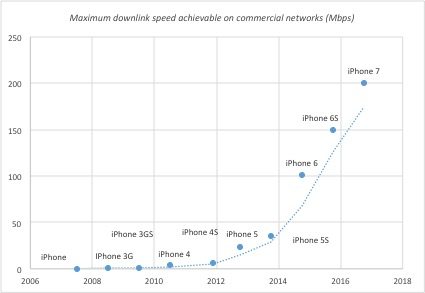
Performance has improved enormously over the last nine years. LTE data rates are 1,000-times faster – at hundreds of megabits per second in the downlink, tens of megabits per second in the uplink, and latencies have reduced from several hundred milliseconds to tens of milliseconds. Ever-higher maximum cellular data rates achievable in the uplink and the downlink on the succession of iPhone models illustrates the gradual yet relentless improvements in cellular technology. For consistency over many years, the following chart includes fastest downlink data rates in device testing on commercial networks or considered likely following announcement of each new iPhone model, as indicated in contemporaneous analyst and press reports. Maximum speeds depend on latest technologies in devices and in network upgrades, which can take a year or so to roll out. Actual speeds are also affected by a user’s location and radio interference with other users nearby. For example, AT&T Mobility’s customers in New York and San Francisco suffered with slow speeds and poor availability following the introduction of the iPhone 3GS in 2009. Such problems are rarely so severe these days.
 
Exponential growth in downlink speeds
mallinson-chart

Other fundamental device improvements include the number of cellular standards and frequency bands supported. The first iPhone was a single-mode GSM/GPRS/EDGE device. Over the years, CDMA, TD-SCDMA, LTE-FDD and LTE-TDD have been added to make iPhones multimode devices. Multiple frequency bands are also employed with each standard. In particular, large and increasing numbers of bands are required for LTE. Since the introduction of the iPhone 5 in 2012, with support for LTE in up to five bands, the number of LTE bands supported has increased to 23 bands in the iPhone 7. Squeezing more and more modes, bands and other cellular functions into smartphones and getting higher and higher levels of radio performance out of them is no mean feat. It requires major innovative efforts and accomplishments in various ways.

A lot of inspiration and perspiration

Cellular technology developments have included some relatively large step-changes, for example, with new air interfaces; but developments mainly arise in a series of many incremental improvements. Even generational upgrades can take years to deploy across networks before benefits can be fully enjoyed. Until at least the turn of the millennium, cellular technology improvements were overwhelmingly in supporting voice and the most basic data capability imaginable with a maximum of 140 characters per text message. Since then, innovations have been focused on exponentially increasing speeds and network capacity for data. Numerous new technologies have been developed and introduced in the last decade. Terminology for these includes dual carrier, carrier aggregation, inter cell interference coordination, coordinated multipoint and heterogeneous networks among many others which have collectively boosted spectral efficiency, increased end-user data rates, increased network capacity and lowered latency.

The development of these standard-essential technologies is a massive coordinated endeavor involving numerous companies. According to analysis by Signals Research Group on 262,773 submissions to five 3GPP working groups from 1999 through December 2014, 43,917 documents were approved for inclusion in standards. The approved documents include 3G only, LTE only, and 3G and LTE documents as well as submissions that fall outside all of these three categories – documents pertaining to GSM/GERAN or IP multimedia subsystems are examples. More than an estimated 1 million man-hours is spent actually in 3GPP working group meetings each year. However, working group activity is merely the tip of the iceberg. Mobile communications sector research and development investment is estimated at up to $100 billion per year. Much of that is in development of standard-essential technologies including 4G recently, and now also in 5G.

‘You ain’t seen nothing yet!’

Each successive new generation of cellular technology has been driven by increasing technology developments, innovation and adoption by wireless carriers and consumers. Following the rather disappointing data rates and lackluster adoption of 3G W-CDMA between 2001 and 2005, the pace of all the above increased with the introduction of HSDPA from around 2006, and then increased again with the introduction of LTE from around 2010. Industry enthusiasm for 5G is also great and so we should expect the rate of innovation to be maintained, not diminish, with the expected introduction of 5G toward the end of the decade.

Whereas demand for 5G will be dependent on new applications such as those in artificial intelligence and augmented reality, some of those applications will only be possible by the improved performance such as ultra-low latency and ultra-high availability, as well as higher data rates that 5G communications promises. Many innovations and improvements will be required for new types of devices and services such as with the “internet of things,” but smartphones will also be in the frontline.

keith-mallinson

Keith Mallinson is a leading industry analyst, commercial consultant and testifying expert witness. Solving business problems in wireless and mobile communications, he founded consulting firm WiseHarbor in 2007.

Editor’s Note: Welcome to Analyst Angle. We’ve collected a group of the industry’s leading analysts to give their outlook on the hot topics in the wireless industry.

Photo copyright: charnsitr / 123RF Stock Photo

You Might Also Like
  • What defines network performance in 5G and beyond? A CTO Perspective
  • Elisa says AI automation has cut network incidents by over 80%
  • Huawei outlines AI-centric network roadmap for telecom monetization
  • Why consolidation will reshape MDU connectivity (part 3/3) – Analyst Angle
  • Indosat outlines AI Grid vision as 5G modernization targets nationwide AI-ready network
  • Wednesday | Telco agents and smash hits (Editorial Diary)

Table of Contents

  • Innovation in cellular and other supporting technologies as well as in applications will sustain the rate of smartphone improvements
  • Improvements under the hood
  • A lot of inspiration and perspiration
  • ‘You ain’t seen nothing yet!’
Share 0 LinkedinEmail
Avatar of Keith Mallinson
Keith Mallinson

Keith Mallinson is a leading industry analyst, commercial consultant and testifying expert witness. Solving business problems in wireless and mobile communications, he founded consulting firm WiseHarbor in 2007.

previous post
Dan Pitt leaves ONF; Rick Bauer to lead SDN organization
next post
Analyst Angle: Why video streaming to mobile devices is changing the way we watch the Olympics

White Papers

  • Enea White Paper: Why Intelligent AAA is the Swiss Army Knife of Telecom

  • CSG White Paper: Telco AI Enabler: Mediation’s Defining Role

  • Enea White Paper: Scalable Database Design for 5G and Beyond

  • Supermicro and NVIDIA Whitepaper: Powering sovereign AI at scale

  • VIAVI Whitepaper: RAN scenario generators and their critical role for future-proofing AI-native RAN in Advanced 5G and 6G networks

Editorial Reports

  • Report: Scaling Optical Networks For The Hyperscale And AI Era

  • Test And Measurement Market Pulse Report

  • Editorial Report: Securing telecom infrastructure for the quantum era

Webinars

  • Webinar: Rethinking the RAN as AI, cloud and openness converge

  • Webinar: Scale-Up, Scale-Out, Scale-Across – Building AI-Era Network Fabrics

  • Webinar: NTN in motion – evolving standards, expanding services

  • Webinar: Noise-Figure Measurements with RFmx and PXI VSTs

  • Qualcomm Webinar – Building the 6G Standard: Key developments to know

Since 1982, RCR Wireless News has been providing wireless and mobile industry news, insights, and analysis to mobile and wireless industry professionals, decision makers, policy makers, analysts and investors.

Facebook Twitter Youtube Linkedin Envelope Rss

Useful Links

  • Subscribe
  • About RCR Wireless News
  • Contact Us
  • Advertise
  • Editorial Calendar
  • Archive
  • RSS
  • Wireless News Archive
  • Subscribe
  • About RCR Wireless News
  • Contact Us
  • Advertise
  • Editorial Calendar
  • Archive
  • RSS
  • Wireless News Archive

Edtior's Picks

What defines network performance in 5G and beyond? A CTO Perspective
Elisa says AI automation has cut network incidents by over 80%
“We’re going after the operator channel” – Druid bets on simplicity to scale...

Latest Articles

What defines network performance in 5G and beyond? A CTO Perspective
Elisa says AI automation has cut network incidents by over 80%
“We’re going after the operator channel” – Druid bets on simplicity to scale private 5G
Enea White Paper: Why Intelligent AAA is the Swiss Army Knife of Telecom

© 2026 RCR Wireless News All Right Reserved. Developed by Eight Hats.

Cookie Policy | Privacy Policy

RCR Wireless
  • News
  • Channels
    • 5G
    • 6G
    • BSS OSS
    • Carriers
    • IoT
    • Network Infrastructure
    • Open RAN
    • Private 5G
    • Telco AI
    • Telco Cloud
    • Test & Measurement
  • Resources
    • Reports
    • Webinars
    • White papers
    • AI Fundamentals
    • Analyst Angle
    • Editorial Calendar
    • Fundamentals
      • 5G NR Release 17
      • AI
        • Telco AI in 2025
    • Podcasts
      • Let’s Get Digital with Carrie Charles
      • Wireless Connectivity to Enable Industry 4.0 for the Middleprise
      • Well Technically…
      • Will 5G Change the World
      • Accelerating Industry 4.0 Digitalization
  • AI Infrastructure
  • Programs
  • Events
  • RCRtv
  • Advertise
  • Subscribe
RCR Wireless
  • News
  • Channels
    • 5G
    • 6G
    • BSS OSS
    • Carriers
    • IoT
    • Network Infrastructure
    • Open RAN
    • Private 5G
    • Telco AI
    • Telco Cloud
    • Test & Measurement
  • Resources
    • Reports
    • Webinars
    • White papers
    • AI Fundamentals
    • Analyst Angle
    • Editorial Calendar
    • Fundamentals
      • 5G NR Release 17
      • AI
        • Telco AI in 2025
    • Podcasts
      • Let’s Get Digital with Carrie Charles
      • Wireless Connectivity to Enable Industry 4.0 for the Middleprise
      • Well Technically…
      • Will 5G Change the World
      • Accelerating Industry 4.0 Digitalization
  • AI Infrastructure
  • Programs
  • Events
  • RCRtv
  • Advertise
  • Subscribe
@2020 - All Right Reserved. Designed and Developed by PenciDesign
