

RCR Wireless
  • News
  • Channels
    • 5G
    • 6G
    • BSS OSS
    • Carriers
    • IoT
    • Network Infrastructure
    • Open RAN
    • Private 5G
    • Telco AI
    • Telco Cloud
    • Test & Measurement
  • Resources
    • Reports
    • Webinars
    • White papers
    • AI Fundamentals
    • Analyst Angle
    • Editorial Calendar
    • Fundamentals
      • 5G NR Release 17
      • AI
        • Telco AI in 2025
    • Podcasts
      • Let’s Get Digital with Carrie Charles
      • Wireless Connectivity to Enable Industry 4.0 for the Middleprise
      • Well Technically…
      • Will 5G Change the World
      • Accelerating Industry 4.0 Digitalization
  • AI Infrastructure
  • Programs
  • Events
  • RCRtv
  • Advertise
  • Subscribe
Saturday, October 3, 2026
RCR Wireless
  • News
  • Channels
    • 5G
    • 6G
    • BSS OSS
    • Carriers
    • IoT
    • Network Infrastructure
    • Open RAN
    • Private 5G
    • Telco AI
    • Telco Cloud
    • Test & Measurement
  • Resources
    • Reports
    • Webinars
    • White papers
    • AI Fundamentals
    • Analyst Angle
    • Editorial Calendar
    • Fundamentals
      • 5G NR Release 17
      • AI
        • Telco AI in 2025
    • Podcasts
      • Let’s Get Digital with Carrie Charles
      • Wireless Connectivity to Enable Industry 4.0 for the Middleprise
      • Well Technically…
      • Will 5G Change the World
      • Accelerating Industry 4.0 Digitalization
  • AI Infrastructure
  • Programs
  • Events
  • RCRtv
  • Advertise
  • Subscribe
Add RCR Wireless as a preferred source on Google
  • Qualcomm 6G Insights
  • Huawei Content Hub
  • Qualcomm – 6G Vision
  • OSS/BSS Channel
  • RCRTech Roundtable: AI Infrastructure
RCR Wireless
RCR Wireless
  • Advanced Mimo
  • Mobile mmWave
  • 5G Positioning
  • Green Networks
  • Metaverse
  • Automotive
  • Industrial and Wide-area IoT
Copyright 2021 - All Right Reserved
Home - Test and Measurement - PIM explained: passive intermodulation
Test and Measurement

PIM explained: passive intermodulation

by Kelly Hill October 15, 2014
written by Kelly Hill October 15, 2014 Share
LinkedinEmail
Share 0LinkedinEmail
PIM Explained
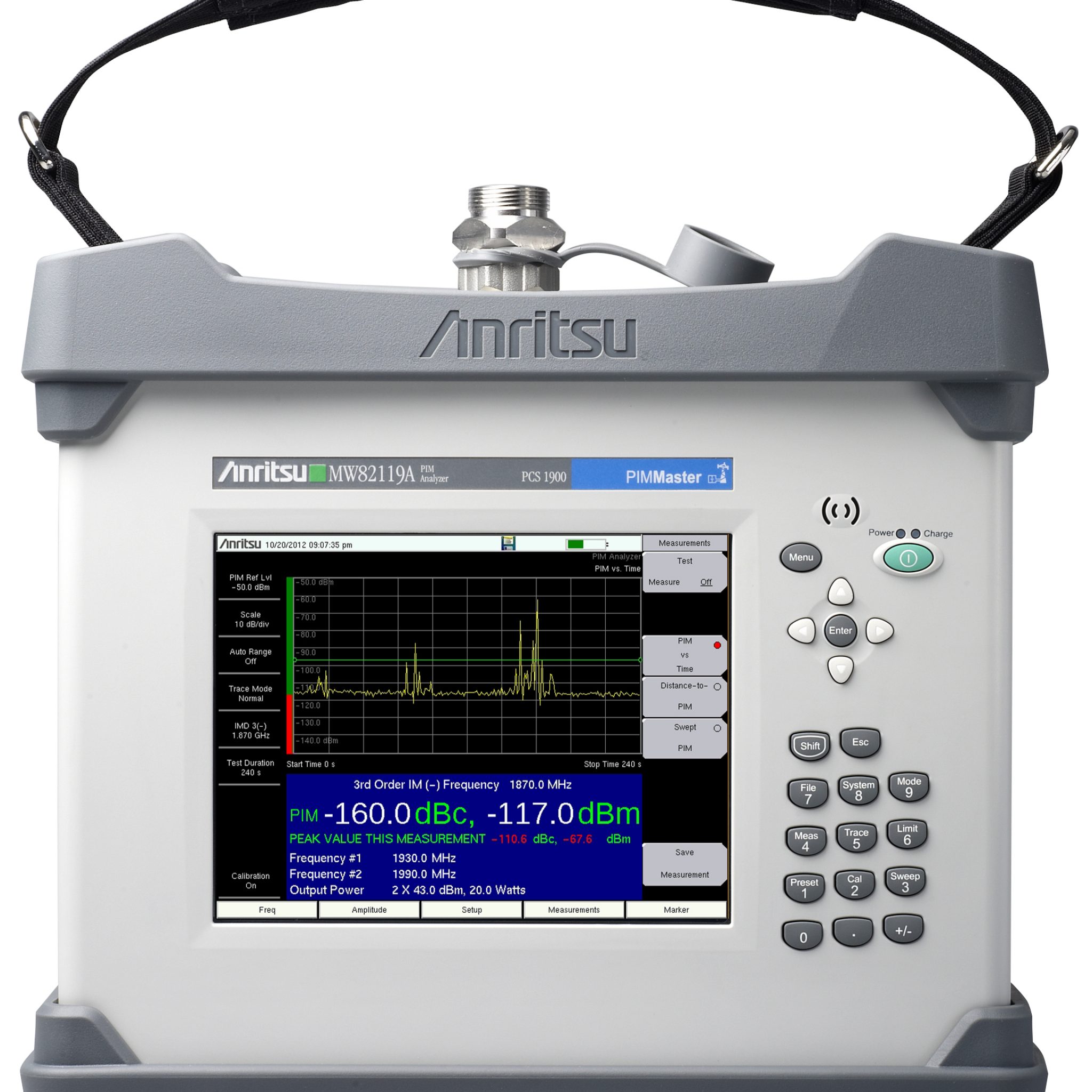
Anritsu's PIM Master is an example of equipment used to detect passive intermodulation
355

PIM, or passive intermodulation, is a type of interference that has become increasingly important to detect and mitigate because LTE networks are particularly sensitive to it.

PIM Explained: what is PIM?

PIM is a form of signal interference, and it can be caused either by metal components or by two or more carriers sharing the same downlink path in a wireless network, which is becoming more common as wireless networks become more complex with multiple technologies and technology generations at a single site. The signals combine to generate undesired interference, which impacts the LTE signal. Antennas, cables, and dirty or loose connectors can be sources of PIM, and so can damaged RF equipment or metal objects near or at a distance from the cell site.

PIM interference can have substantial impacts on the performance of LTE, which is why it is so important to wireless operators and their contractors to be able to test for, locate and mitigate PIM. PIM levels around -100 decible-milliwatts (dBm) or less are generally considered good, but the lower the better – test company Anritsu said that drive tests have found an 18% drop in download speeds when PIM levels were increased from -125 dBm to -105 dBm, even though the latter number can be considered an acceptable PIM level.

When is PIM tested for?

Individual components are often tested for PIM both in the design and production processes in order to ensure that they are not significant PIM sources once they are installed – however, installation is still a critical piece of PIM mitigation because proper connections are necessary. In the case of distributed antenna systems, in some instances the system is tested for PIM as well as individual components. PIM-certified equipment is becoming more common. Antennas, for example, may be PIM-certified to a level of -140 dBm and those requirements are increasingly strict.

PIM is also assessed during the siting process for cellular sites, ideally before the cell site and antennas are placed as well as during the installation process.

What equipment is used to test PIM in the field?

A number of test companies offer specialized equipment in order to detect, pinpoint and subsequently address PIM sources. Some equipment options include:

Anritsu’s PIM Master

AWT Global PIM testers

BoontonPIM testers

Communications components PIM testers

Kaelus’ portable PIM testers

Rosenberger PIM tester

One key feature of PIM testing in the field is that the testing must be done based on different frequency ranges. No single piece of PIM testing equipment can adequately assess PIM across a full range of frequencies, so PIM testing equipment is frequency-limited and comes in models that test specific frequencies.

Read more about PIM in this special report on LTE field testing from RCR Wireless News.


You Might Also Like
  • Massive MU-MIMO in FDD: ‘Simply outstanding’ in the uplink
  • High bandwidth, high fidelity: Vertex 6.0 delivers emulation for ISAC, 6G and more
  • Real-world network emulation is critical for 5G deployments (Reader Forum)
  • Complexity, convergence, AI and the demand for trust are reshaping telecom testing
  • Test And Measurement Market Pulse Report
  • Anterix: ‘Terrific’ results from NTN testing with Lynk Global

Table of Contents

  • PIM Explained: what is PIM?
  • When is PIM tested for?
  • What equipment is used to test PIM in the field?
Share 0 LinkedinEmail
Kelly Hill

Kelly Hill reports on network test and measurement, AI infrastructure and regulatory issues, including spectrum, for RCR Wireless News. She began covering the wireless industry in 2005, focusing on carriers and MVNOs, then took a few years’ hiatus and returned to RCR Wireless News to write about heterogeneous networks (remember those?) and network infrastructure. Kelly is an Ohio native with a masters degree in journalism from the University of California, Berkeley, where she focused on science writing and multimedia. She has written for the San Francisco Chronicle, The Oregonian and The Canton Repository. She lives in northern Virginia, not far from Data Center Alley.

previous post
SPONSORED: Juniper Networks: A three-layer approach for a transition to an open NFV environment
next post
GE Webinar: A Powerful Toolbox of DAS and Small Cell Power Solutions

White Papers

  • Norton eBook: The 2026 Telco Playbook

  • Enea White Paper: Why Intelligent AAA is the Swiss Army Knife of Telecom

  • CSG White Paper: Telco AI Enabler: Mediation’s Defining Role

  • Enea White Paper: Scalable Database Design for 5G and Beyond

  • Supermicro and NVIDIA Whitepaper: Powering sovereign AI at scale

Editorial Reports

  • Report: Building 6G — Aligning technology, policy and purpose

  • Report: Rethinking the RAN

  • Report: Building AI-Era Network Fabrics

Webinars

  • Appledore Webinar: Closing the Agent-Ready Data Gap for Autonomous Networks

  • Mimosa Webinar – Build the Right Network

  • Webinar: Building 6G — aligning technology, policy and purpose

  • SIMCom Webinar: Scaling your next deployment – from plastic to provisioning

  • Webinar: Rethinking the RAN as AI, cloud and openness converge

Since 1982, RCR Wireless News has been providing wireless and mobile industry news, insights, and analysis to mobile and wireless industry professionals, decision makers, policy makers, analysts and investors.

Facebook Twitter Youtube Linkedin Envelope Rss

Useful Links

  • Subscribe
  • About RCR Wireless News
  • Contact Us
  • Advertise
  • Editorial Calendar
  • Archive
  • RSS
  • Wireless News Archive
  • Subscribe
  • About RCR Wireless News
  • Contact Us
  • Advertise
  • Editorial Calendar
  • Archive
  • RSS
  • Wireless News Archive

Edtior's Picks

Nokia sees 2x spectral efficiency by 2028, but Orange is focused on what...
Starlink, and the battle for the edge of the network and heart of...
RCRTech Roundtables AI Infrastructure

Latest Articles

Nokia sees 2x spectral efficiency by 2028, but Orange is focused on what has to work first
Starlink, and the battle for the edge of the network and heart of the customer (Telco Diary)
RCRTech Roundtables AI Infrastructure
Network ownership, security, autonomy (Telco Diary)

© 2026 RCR Wireless News All Right Reserved. Developed by Eight Hats.

Cookie Policy | Privacy Policy

RCR Wireless
  • News
  • Channels
    • 5G
    • 6G
    • BSS OSS
    • Carriers
    • IoT
    • Network Infrastructure
    • Open RAN
    • Private 5G
    • Telco AI
    • Telco Cloud
    • Test & Measurement
  • Resources
    • Reports
    • Webinars
    • White papers
    • AI Fundamentals
    • Analyst Angle
    • Editorial Calendar
    • Fundamentals
      • 5G NR Release 17
      • AI
        • Telco AI in 2025
    • Podcasts
      • Let’s Get Digital with Carrie Charles
      • Wireless Connectivity to Enable Industry 4.0 for the Middleprise
      • Well Technically…
      • Will 5G Change the World
      • Accelerating Industry 4.0 Digitalization
  • AI Infrastructure
  • Programs
  • Events
  • RCRtv
  • Advertise
  • Subscribe
RCR Wireless
  • News
  • Channels
    • 5G
    • 6G
    • BSS OSS
    • Carriers
    • IoT
    • Network Infrastructure
    • Open RAN
    • Private 5G
    • Telco AI
    • Telco Cloud
    • Test & Measurement
  • Resources
    • Reports
    • Webinars
    • White papers
    • AI Fundamentals
    • Analyst Angle
    • Editorial Calendar
    • Fundamentals
      • 5G NR Release 17
      • AI
        • Telco AI in 2025
    • Podcasts
      • Let’s Get Digital with Carrie Charles
      • Wireless Connectivity to Enable Industry 4.0 for the Middleprise
      • Well Technically…
      • Will 5G Change the World
      • Accelerating Industry 4.0 Digitalization
  • AI Infrastructure
  • Programs
  • Events
  • RCRtv
  • Advertise
  • Subscribe
@2020 - All Right Reserved. Designed and Developed by PenciDesign
